

150
5 Arnol’d Diffusion
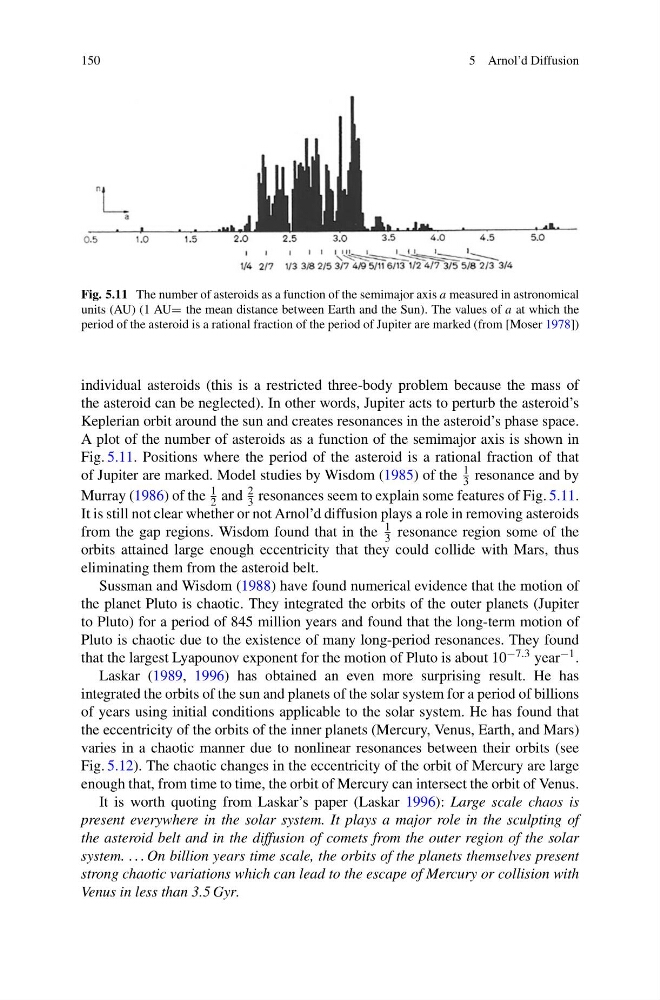
Fig. 5.11 The number of asteroids as a function of the semimajor axis a measured in astronomical
units (AU) (1 AU= the mean distance between Earth and the Sun). The values of a at which the
period of the asteroid is a rational fraction of the period of Jupiter are marked (from [Moser 1978])
individual asteroids (this is a restricted three-body problem because the mass of
the asteroid can be neglected). In other words, Jupiter acts to perturb the asteroid’s
Keplerian orbit around the sun and creates resonances in the asteroid’s phase space.
A plot of the number of asteroids as a function of the semimajor axis is shown in
Fig. 5.11. Positions where the period of the asteroid is a rational fraction of that
of Jupiter are marked. Model studies by Wisdom (1985) of the
1
3 resonance and by
Murray (1986) of the
1
2 and
2
3 resonances seem to explain some features of Fig. 5.11.
It is still not clear whether or not Arnol’d diffusion plays a role in removing asteroids
from the gap regions. Wisdom found that in the
1
3 resonance region some of the
orbits attained large enough eccentricity that they could collide with Mars, thus
eliminating them from the asteroid belt.
Sussman and Wisdom (1988) have found numerical evidence that the motion of
the planet Pluto is chaotic. They integrated the orbits of the outer planets (Jupiter
to Pluto) for a period of 845 million years and found that the long-term motion of
Pluto is chaotic due to the existence of many long-period resonances. They found
that the largest Lyapounov exponent for the motion of Pluto is about 10 −7.3 year −1 .
Laskar (1989, 1996) has obtained an even more surprising result. He has
integrated the orbits of the sun and planets of the solar system for a period of billions
of years using initial conditions applicable to the solar system. He has found that
the eccentricity of the orbits of the inner planets (Mercury, Venus, Earth, and Mars)
varies in a chaotic manner due to nonlinear resonances between their orbits (see
Fig. 5.12). The chaotic changes in the eccentricity of the orbit of Mercury are large
enough that, from time to time, the orbit of Mercury can intersect the orbit of Venus.
It is worth quoting from Laskar’s paper (Laskar 1996): Large scale chaos is
present everywhere in the solar system. It plays a major role in the sculpting of
the asteroid belt and in the diffusion of comets from the outer region of the solar
system. . . . On billion years time scale, the orbits of the planets themselves present
strong chaotic variations which can lead to the escape of Mercury or collision with
Venus in less than 3.5 Gyr.
5 Arnol’d Diffusion
Fig. 5.11 The number of asteroids as a function of the semimajor axis a measured in astronomical
units (AU) (1 AU= the mean distance between Earth and the Sun). The values of a at which the
period of the asteroid is a rational fraction of the period of Jupiter are marked (from [Moser 1978])
individual asteroids (this is a restricted three-body problem because the mass of
the asteroid can be neglected). In other words, Jupiter acts to perturb the asteroid’s
Keplerian orbit around the sun and creates resonances in the asteroid’s phase space.
A plot of the number of asteroids as a function of the semimajor axis is shown in
Fig. 5.11. Positions where the period of the asteroid is a rational fraction of that
of Jupiter are marked. Model studies by Wisdom (1985) of the
1
3 resonance and by
Murray (1986) of the
1
2 and
2
3 resonances seem to explain some features of Fig. 5.11.
It is still not clear whether or not Arnol’d diffusion plays a role in removing asteroids
from the gap regions. Wisdom found that in the
1
3 resonance region some of the
orbits attained large enough eccentricity that they could collide with Mars, thus
eliminating them from the asteroid belt.
Sussman and Wisdom (1988) have found numerical evidence that the motion of
the planet Pluto is chaotic. They integrated the orbits of the outer planets (Jupiter
to Pluto) for a period of 845 million years and found that the long-term motion of
Pluto is chaotic due to the existence of many long-period resonances. They found
that the largest Lyapounov exponent for the motion of Pluto is about 10 −7.3 year −1 .
Laskar (1989, 1996) has obtained an even more surprising result. He has
integrated the orbits of the sun and planets of the solar system for a period of billions
of years using initial conditions applicable to the solar system. He has found that
the eccentricity of the orbits of the inner planets (Mercury, Venus, Earth, and Mars)
varies in a chaotic manner due to nonlinear resonances between their orbits (see
Fig. 5.12). The chaotic changes in the eccentricity of the orbit of Mercury are large
enough that, from time to time, the orbit of Mercury can intersect the orbit of Venus.
It is worth quoting from Laskar’s paper (Laskar 1996): Large scale chaos is
present everywhere in the solar system. It plays a major role in the sculpting of
the asteroid belt and in the diffusion of comets from the outer region of the solar
system. . . . On billion years time scale, the orbits of the planets themselves present
strong chaotic variations which can lead to the escape of Mercury or collision with
Venus in less than 3.5 Gyr.