

5.6 Stability of the Solar System
149
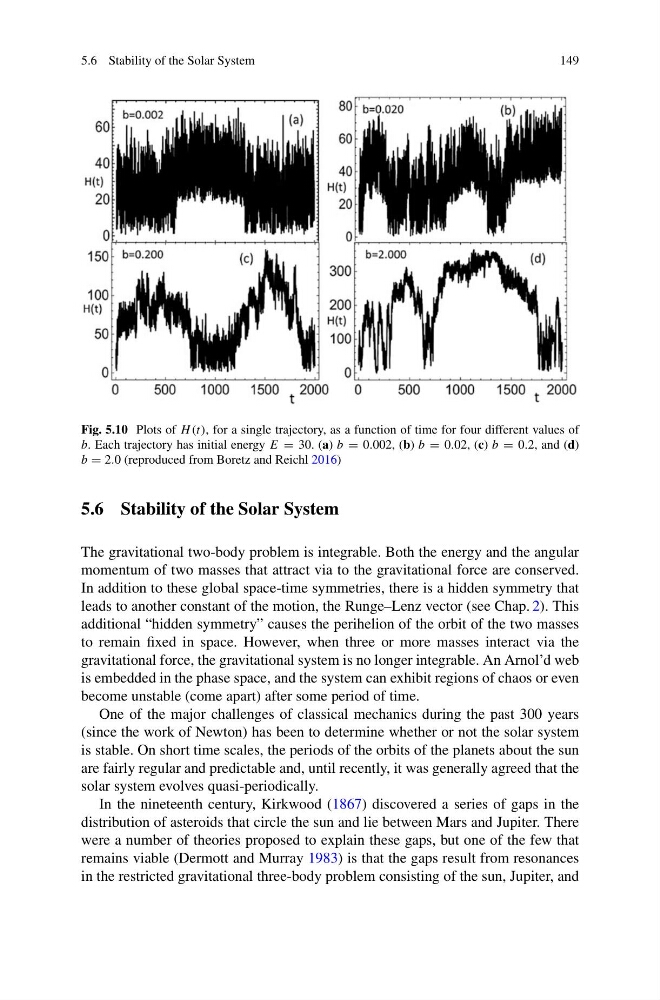
Fig. 5.10 Plots of H (t), for a single trajectory, as a function of time for four different values of
b. Each trajectory has initial energy E = 30. (a) b = 0.002, (b) b = 0.02, (c) b = 0.2, and (d)
b = 2.0 (reproduced from Boretz and Reichl 2016)
5.6 Stability of the Solar System
The gravitational two-body problem is integrable. Both the energy and the angular
momentum of two masses that attract via to the gravitational force are conserved.
In addition to these global space-time symmetries, there is a hidden symmetry that
leads to another constant of the motion, the Runge–Lenz vector (see Chap. 2). This
additional “hidden symmetry” causes the perihelion of the orbit of the two masses
to remain fixed in space. However, when three or more masses interact via the
gravitational force, the gravitational system is no longer integrable. An Arnol’d web
is embedded in the phase space, and the system can exhibit regions of chaos or even
become unstable (come apart) after some period of time.
One of the major challenges of classical mechanics during the past 300 years
(since the work of Newton) has been to determine whether or not the solar system
is stable. On short time scales, the periods of the orbits of the planets about the sun
are fairly regular and predictable and, until recently, it was generally agreed that the
solar system evolves quasi-periodically.
In the nineteenth century, Kirkwood (1867) discovered a series of gaps in the
distribution of asteroids that circle the sun and lie between Mars and Jupiter. There
were a number of theories proposed to explain these gaps, but one of the few that
remains viable (Dermott and Murray 1983) is that the gaps result from resonances
in the restricted gravitational three-body problem consisting of the sun, Jupiter, and
149
Fig. 5.10 Plots of H (t), for a single trajectory, as a function of time for four different values of
b. Each trajectory has initial energy E = 30. (a) b = 0.002, (b) b = 0.02, (c) b = 0.2, and (d)
b = 2.0 (reproduced from Boretz and Reichl 2016)
5.6 Stability of the Solar System
The gravitational two-body problem is integrable. Both the energy and the angular
momentum of two masses that attract via to the gravitational force are conserved.
In addition to these global space-time symmetries, there is a hidden symmetry that
leads to another constant of the motion, the Runge–Lenz vector (see Chap. 2). This
additional “hidden symmetry” causes the perihelion of the orbit of the two masses
to remain fixed in space. However, when three or more masses interact via the
gravitational force, the gravitational system is no longer integrable. An Arnol’d web
is embedded in the phase space, and the system can exhibit regions of chaos or even
become unstable (come apart) after some period of time.
One of the major challenges of classical mechanics during the past 300 years
(since the work of Newton) has been to determine whether or not the solar system
is stable. On short time scales, the periods of the orbits of the planets about the sun
are fairly regular and predictable and, until recently, it was generally agreed that the
solar system evolves quasi-periodically.
In the nineteenth century, Kirkwood (1867) discovered a series of gaps in the
distribution of asteroids that circle the sun and lie between Mars and Jupiter. There
were a number of theories proposed to explain these gaps, but one of the few that
remains viable (Dermott and Murray 1983) is that the gaps result from resonances
in the restricted gravitational three-body problem consisting of the sun, Jupiter, and