

152
5 Arnol’d Diffusion
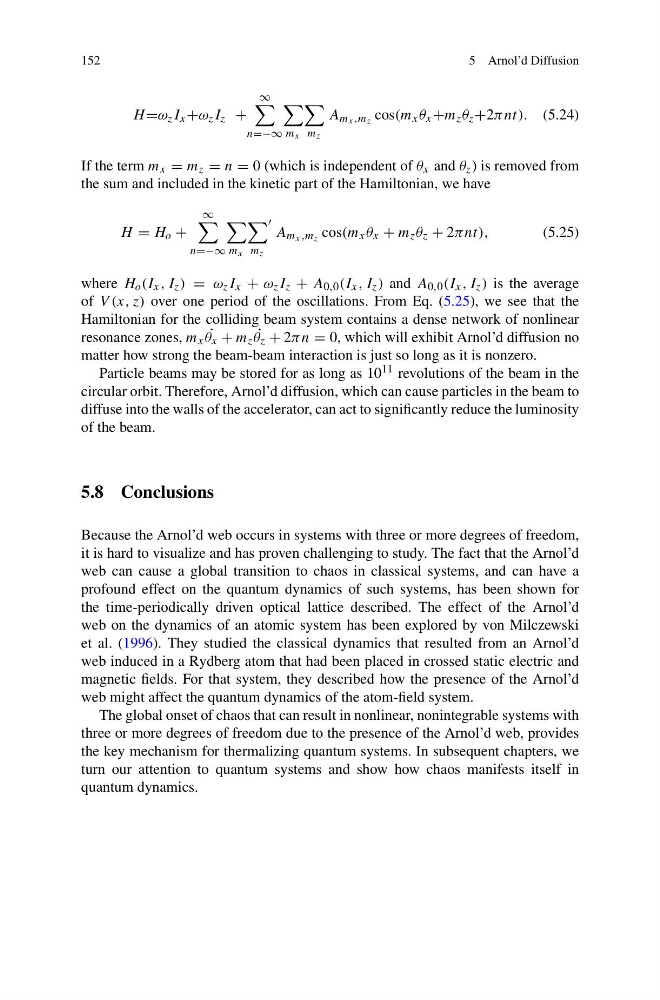
H =ω z I x +ω z I z +
∞
n=−∞
m x
m z
A m x ,m z cos(m x θ x +m z θ z +2πnt). (5.24)
If the term m x = m z = n = 0 (which is independent of θ x and θ z ) is removed from
the sum and included in the kinetic part of the Hamiltonian, we have
H = H o +
∞
n=−∞
m x
m z
A m x ,m z cos(m x θ x + m z θ z + 2πnt),
(5.25)
where H o (I x , I z ) = ω z I x + ω z I z + A 0,0 (I x , I z ) and A 0,0 (I x , I z ) is the average
of V (x, z) over one period of the oscillations. From Eq. (5.25), we see that the
Hamiltonian for the colliding beam system contains a dense network of nonlinear
resonance zones, m x ˙
θ x + m z ˙
θ z + 2πn = 0, which will exhibit Arnol’d diffusion no
matter how strong the beam-beam interaction is just so long as it is nonzero.
Particle beams may be stored for as long as 10 11 revolutions of the beam in the
circular orbit. Therefore, Arnol’d diffusion, which can cause particles in the beam to
diffuse into the walls of the accelerator, can act to significantly reduce the luminosity
of the beam.
5.8 Conclusions
Because the Arnol’d web occurs in systems with three or more degrees of freedom,
it is hard to visualize and has proven challenging to study. The fact that the Arnol’d
web can cause a global transition to chaos in classical systems, and can have a
profound effect on the quantum dynamics of such systems, has been shown for
the time-periodically driven optical lattice described. The effect of the Arnol’d
web on the dynamics of an atomic system has been explored by von Milczewski
et al. (1996). They studied the classical dynamics that resulted from an Arnol’d
web induced in a Rydberg atom that had been placed in crossed static electric and
magnetic fields. For that system, they described how the presence of the Arnol’d
web might affect the quantum dynamics of the atom-field system.
The global onset of chaos that can result in nonlinear, nonintegrable systems with
three or more degrees of freedom due to the presence of the Arnol’d web, provides
the key mechanism for thermalizing quantum systems. In subsequent chapters, we
turn our attention to quantum systems and show how chaos manifests itself in
quantum dynamics.
5 Arnol’d Diffusion
H =ω z I x +ω z I z +
∞
n=−∞
m x
m z
A m x ,m z cos(m x θ x +m z θ z +2πnt). (5.24)
If the term m x = m z = n = 0 (which is independent of θ x and θ z ) is removed from
the sum and included in the kinetic part of the Hamiltonian, we have
H = H o +
∞
n=−∞
m x
m z
A m x ,m z cos(m x θ x + m z θ z + 2πnt),
(5.25)
where H o (I x , I z ) = ω z I x + ω z I z + A 0,0 (I x , I z ) and A 0,0 (I x , I z ) is the average
of V (x, z) over one period of the oscillations. From Eq. (5.25), we see that the
Hamiltonian for the colliding beam system contains a dense network of nonlinear
resonance zones, m x ˙
θ x + m z ˙
θ z + 2πn = 0, which will exhibit Arnol’d diffusion no
matter how strong the beam-beam interaction is just so long as it is nonzero.
Particle beams may be stored for as long as 10 11 revolutions of the beam in the
circular orbit. Therefore, Arnol’d diffusion, which can cause particles in the beam to
diffuse into the walls of the accelerator, can act to significantly reduce the luminosity
of the beam.
5.8 Conclusions
Because the Arnol’d web occurs in systems with three or more degrees of freedom,
it is hard to visualize and has proven challenging to study. The fact that the Arnol’d
web can cause a global transition to chaos in classical systems, and can have a
profound effect on the quantum dynamics of such systems, has been shown for
the time-periodically driven optical lattice described. The effect of the Arnol’d
web on the dynamics of an atomic system has been explored by von Milczewski
et al. (1996). They studied the classical dynamics that resulted from an Arnol’d
web induced in a Rydberg atom that had been placed in crossed static electric and
magnetic fields. For that system, they described how the presence of the Arnol’d
web might affect the quantum dynamics of the atom-field system.
The global onset of chaos that can result in nonlinear, nonintegrable systems with
three or more degrees of freedom due to the presence of the Arnol’d web, provides
the key mechanism for thermalizing quantum systems. In subsequent chapters, we
turn our attention to quantum systems and show how chaos manifests itself in
quantum dynamics.