

5.5 Arnol’d Diffusion in an Optical Lattice
145
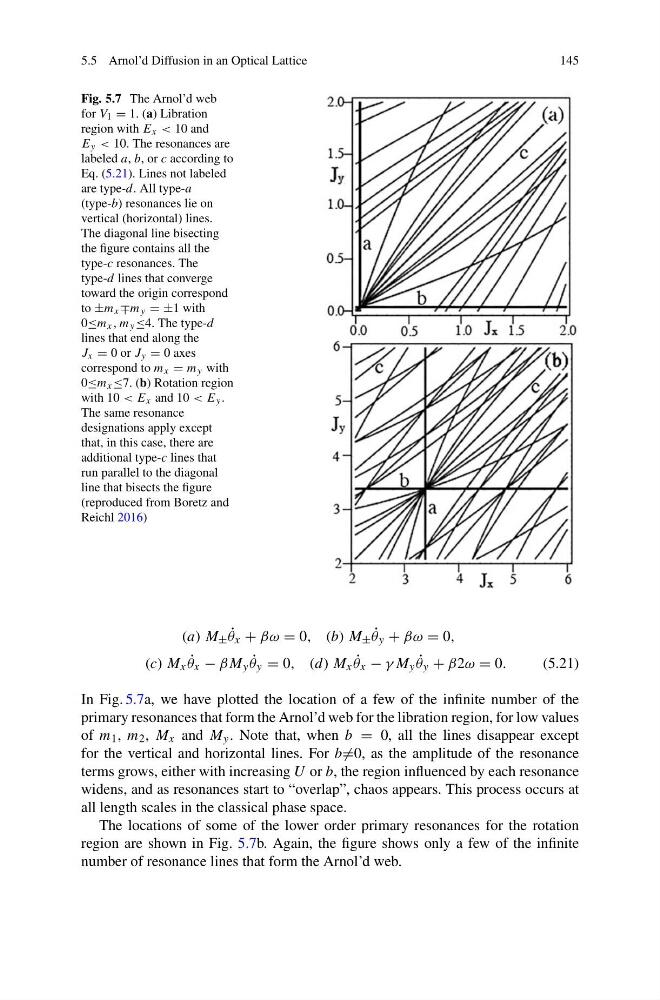
Fig. 5.7 The Arnol’d web
for V 1 = 1. (a) Libration
region with E x < 10 and
E y < 10. The resonances are
labeled a, b, or c according to
Eq. (5.21). Lines not labeled
are type-d. All type-a
(type-b) resonances lie on
vertical (horizontal) lines.
The diagonal line bisecting
the figure contains all the
type-c resonances. The
type-d lines that converge
toward the origin correspond
to ±m x ∓m y = ±1 with
0≤m x , m y ≤4. The type-d
lines that end along the
J x = 0 or J y = 0 axes
correspond to m x = m y with
0≤m x ≤7. (b) Rotation region
with 10 < E x and 10 < E y .
The same resonance
designations apply except
that, in this case, there are
additional type-c lines that
run parallel to the diagonal
line that bisects the figure
(reproduced from Boretz and
Reichl 2016)
(a) M ± ˙
θ x + βω = 0, (b) M ± ˙
θ y + βω = 0,
(c) M x ˙
θ x − βM y ˙
θ y = 0, (d) M x ˙
θ x − γ M y ˙
θ y + β2ω = 0.
(5.21)
In Fig. 5.7a, we have plotted the location of a few of the infinite number of the
primary resonances that form the Arnol’d web for the libration region, for low values
of m 1 , m 2 , M x and M y . Note that, when b = 0, all the lines disappear except
for the vertical and horizontal lines. For b =0, as the amplitude of the resonance
terms grows, either with increasing U or b, the region influenced by each resonance
widens, and as resonances start to “overlap”, chaos appears. This process occurs at
all length scales in the classical phase space.
The locations of some of the lower order primary resonances for the rotation
region are shown in Fig. 5.7b. Again, the figure shows only a few of the infinite
number of resonance lines that form the Arnol’d web.
145
Fig. 5.7 The Arnol’d web
for V 1 = 1. (a) Libration
region with E x < 10 and
E y < 10. The resonances are
labeled a, b, or c according to
Eq. (5.21). Lines not labeled
are type-d. All type-a
(type-b) resonances lie on
vertical (horizontal) lines.
The diagonal line bisecting
the figure contains all the
type-c resonances. The
type-d lines that converge
toward the origin correspond
to ±m x ∓m y = ±1 with
0≤m x , m y ≤4. The type-d
lines that end along the
J x = 0 or J y = 0 axes
correspond to m x = m y with
0≤m x ≤7. (b) Rotation region
with 10 < E x and 10 < E y .
The same resonance
designations apply except
that, in this case, there are
additional type-c lines that
run parallel to the diagonal
line that bisects the figure
(reproduced from Boretz and
Reichl 2016)
(a) M ± ˙
θ x + βω = 0, (b) M ± ˙
θ y + βω = 0,
(c) M x ˙
θ x − βM y ˙
θ y = 0, (d) M x ˙
θ x − γ M y ˙
θ y + β2ω = 0.
(5.21)
In Fig. 5.7a, we have plotted the location of a few of the infinite number of the
primary resonances that form the Arnol’d web for the libration region, for low values
of m 1 , m 2 , M x and M y . Note that, when b = 0, all the lines disappear except
for the vertical and horizontal lines. For b =0, as the amplitude of the resonance
terms grows, either with increasing U or b, the region influenced by each resonance
widens, and as resonances start to “overlap”, chaos appears. This process occurs at
all length scales in the classical phase space.
The locations of some of the lower order primary resonances for the rotation
region are shown in Fig. 5.7b. Again, the figure shows only a few of the infinite
number of resonance lines that form the Arnol’d web.