

144
5 Arnol’d Diffusion
Below we consider two cases, E x <
U
2 and E y <
U
2 , which we call libration, and
E x >
U
2 and E y >
U
2 , which we call rotation.
The libration region occurs at low energy where E j <
U
2 (j = x, y). Then in
Eq. (5.18), A x,y = κ x κ y , B x = κ 2
x , and B y = κ 2
y , κ 2
x =
2E x
U , κ 2
y =
2E y
U . The
rotation region occurs for higher energy where E j >
U
2 (j = x, y). Then in Eq.
(5.18), A x,y = 1, B x = 1, and B y = 1, κ 2
x =
U
2E x
, κ 2
y =
U
2E y
. In both cases,
f x =
2
π K(κ x )θ x , f y =
2
π K(κ y )θ y , and K(κ x ) is the complete elliptic integral of the
first kind.
The Jacobi sn function has a series expansion (Byrd and Friedman 1971).
sn[z, κ] =
∞
m=0
C m (κ) sin
(2m + 1)
πz
2K(κ)
(5.19)
where C m (κ) =
π
κK(κ) csch
(2m + 1)
π
2
K (κ)
K(κ)
. Some values of C m (κ) include
C 0 (0.999999) = 1.2530, C 0 (0.5) = 1.0176, C 0 (0.1) = 1.00063, C 1 (0.999999) =
0.3687, C 1 (0.5) = 0.0180, C 1 (0.1) = 0.0006, C 2 (0.999999) = 0.1546, C 2 (0.5) =
0.0003, C 2 (0.1) = 4×10 −7 . The values fall off rapidly with increasing m.
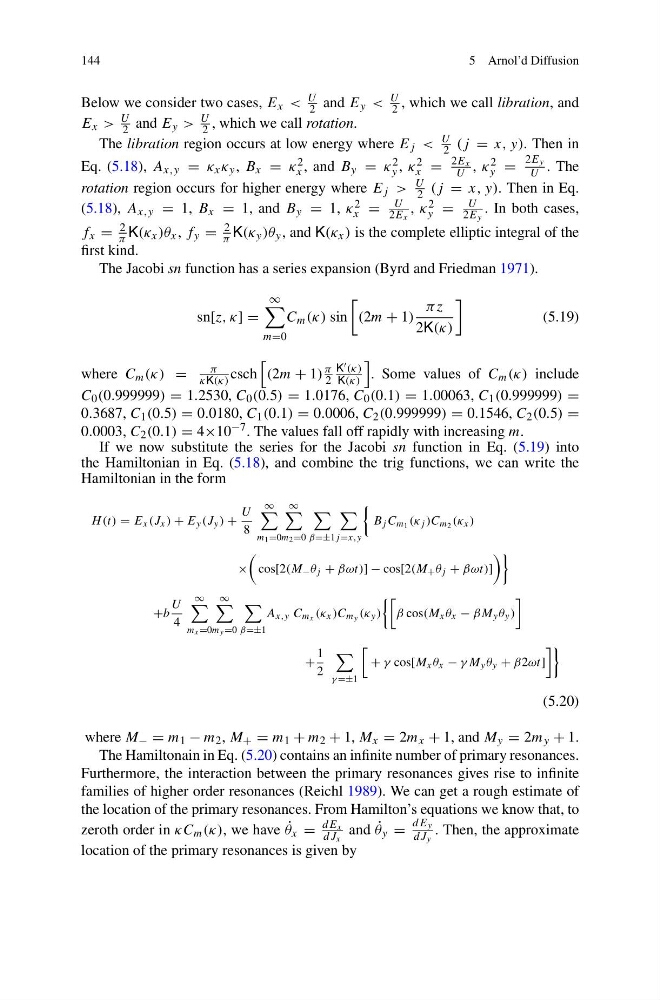
If we now substitute the series for the Jacobi sn function in Eq. (5.19) into
the Hamiltonian in Eq. (5.18), and combine the trig functions, we can write the
Hamiltonian in the form
H (t) = E x (J x ) + E y (J y ) +
U
8
∞
m 1 =0
∞
m 2 =0
β=±1
j =x,y
B j C m 1 (κ j )C m 2 (κ x )
×
cos[2(M − θ j + βωt)] − cos[2(M + θ j + βωt)]
+b
U
4
∞
mx =0
∞
my =0
β=±1
A x,y C mx (κ x )C my (κ y )
β cos(M x θ x − βM y θ y )
+
1
2
γ =±1
+ γ cos[M x θ x − γ M y θ y + β2ωt]
(5.20)
where M − = m 1 − m 2 , M + = m 1 + m 2 + 1, M x = 2m x + 1, and M y = 2m y + 1.
The Hamiltonain in Eq. (5.20) contains an infinite number of primary resonances.
Furthermore, the interaction between the primary resonances gives rise to infinite
families of higher order resonances (Reichl 1989). We can get a rough estimate of
the location of the primary resonances. From Hamilton’s equations we know that, to
zeroth order in κC m (κ), we have ˙
θ x =
dE x
dJ x
and ˙
θ y =
dE y
dJ y
. Then, the approximate
location of the primary resonances is given by
5 Arnol’d Diffusion
Below we consider two cases, E x <
U
2 and E y <
U
2 , which we call libration, and
E x >
U
2 and E y >
U
2 , which we call rotation.
The libration region occurs at low energy where E j <
U
2 (j = x, y). Then in
Eq. (5.18), A x,y = κ x κ y , B x = κ 2
x , and B y = κ 2
y , κ 2
x =
2E x
U , κ 2
y =
2E y
U . The
rotation region occurs for higher energy where E j >
U
2 (j = x, y). Then in Eq.
(5.18), A x,y = 1, B x = 1, and B y = 1, κ 2
x =
U
2E x
, κ 2
y =
U
2E y
. In both cases,
f x =
2
π K(κ x )θ x , f y =
2
π K(κ y )θ y , and K(κ x ) is the complete elliptic integral of the
first kind.
The Jacobi sn function has a series expansion (Byrd and Friedman 1971).
sn[z, κ] =
∞
m=0
C m (κ) sin
(2m + 1)
πz
2K(κ)
(5.19)
where C m (κ) =
π
κK(κ) csch
(2m + 1)
π
2
K (κ)
K(κ)
. Some values of C m (κ) include
C 0 (0.999999) = 1.2530, C 0 (0.5) = 1.0176, C 0 (0.1) = 1.00063, C 1 (0.999999) =
0.3687, C 1 (0.5) = 0.0180, C 1 (0.1) = 0.0006, C 2 (0.999999) = 0.1546, C 2 (0.5) =
0.0003, C 2 (0.1) = 4×10 −7 . The values fall off rapidly with increasing m.
If we now substitute the series for the Jacobi sn function in Eq. (5.19) into
the Hamiltonian in Eq. (5.18), and combine the trig functions, we can write the
Hamiltonian in the form
H (t) = E x (J x ) + E y (J y ) +
U
8
∞
m 1 =0
∞
m 2 =0
β=±1
j =x,y
B j C m 1 (κ j )C m 2 (κ x )
×
cos[2(M − θ j + βωt)] − cos[2(M + θ j + βωt)]
+b
U
4
∞
mx =0
∞
my =0
β=±1
A x,y C mx (κ x )C my (κ y )
β cos(M x θ x − βM y θ y )
+
1
2
γ =±1
+ γ cos[M x θ x − γ M y θ y + β2ωt]
(5.20)
where M − = m 1 − m 2 , M + = m 1 + m 2 + 1, M x = 2m x + 1, and M y = 2m y + 1.
The Hamiltonain in Eq. (5.20) contains an infinite number of primary resonances.
Furthermore, the interaction between the primary resonances gives rise to infinite
families of higher order resonances (Reichl 1989). We can get a rough estimate of
the location of the primary resonances. From Hamilton’s equations we know that, to
zeroth order in κC m (κ), we have ˙
θ x =
dE x
dJ x
and ˙
θ y =
dE y
dJ y
. Then, the approximate
location of the primary resonances is given by