

4.5 Chaos in the HOCl Molecular System
129
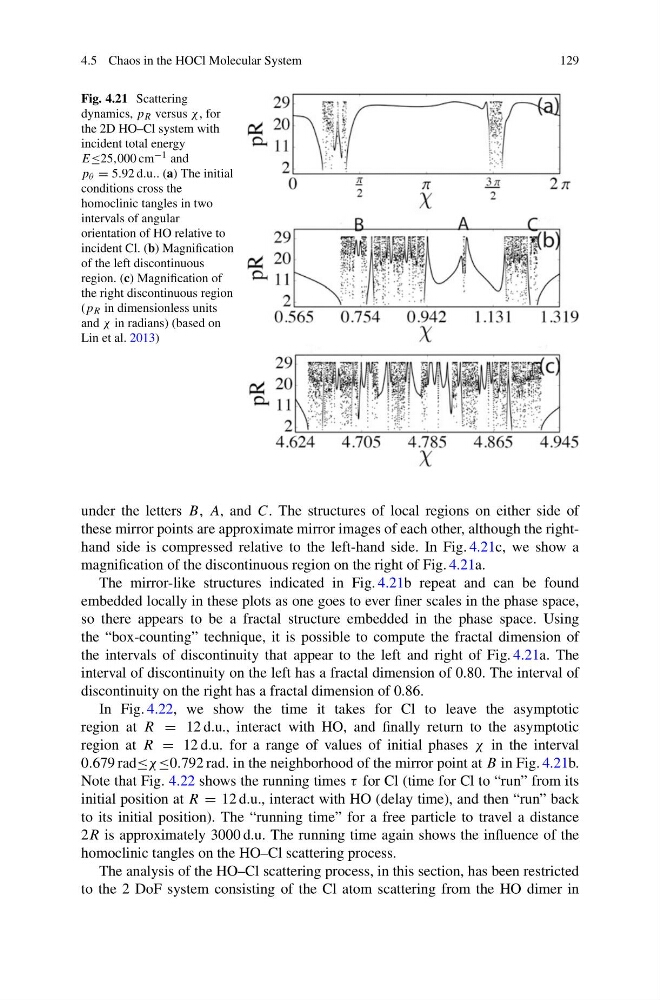
Fig. 4.21 Scattering
dynamics, p R versus χ, for
the 2D HO–Cl system with
incident total energy
E≤25,000 cm −1 and
p θ = 5.92 d.u.. (a) The initial
conditions cross the
homoclinic tangles in two
intervals of angular
orientation of HO relative to
incident Cl. (b) Magnification
of the left discontinuous
region. (c) Magnification of
the right discontinuous region
(p R in dimensionless units
and χ in radians) (based on
Lin et al. 2013)
under the letters B, A, and C. The structures of local regions on either side of
these mirror points are approximate mirror images of each other, although the righthand side is compressed relative to the left-hand side. In Fig. 4.21c, we show a
magnification of the discontinuous region on the right of Fig. 4.21a.
The mirror-like structures indicated in Fig. 4.21b repeat and can be found
embedded locally in these plots as one goes to ever finer scales in the phase space,
so there appears to be a fractal structure embedded in the phase space. Using
the “box-counting” technique, it is possible to compute the fractal dimension of
the intervals of discontinuity that appear to the left and right of Fig. 4.21a. The
interval of discontinuity on the left has a fractal dimension of 0.80. The interval of
discontinuity on the right has a fractal dimension of 0.86.
In Fig. 4.22, we show the time it takes for Cl to leave the asymptotic
region at R = 12 d.u., interact with HO, and finally return to the asymptotic
region at R = 12 d.u. for a range of values of initial phases χ in the interval
0.679 rad≤χ ≤0.792 rad. in the neighborhood of the mirror point at B in Fig. 4.21b.
Note that Fig. 4.22 shows the running times τ for Cl (time for Cl to “run” from its
initial position at R = 12 d.u., interact with HO (delay time), and then “run” back
to its initial position). The “running time” for a free particle to travel a distance
2R is approximately 3000 d.u. The running time again shows the influence of the
homoclinic tangles on the HO–Cl scattering process.
The analysis of the HO–Cl scattering process, in this section, has been restricted
to the 2 DoF system consisting of the Cl atom scattering from the HO dimer in
129
Fig. 4.21 Scattering
dynamics, p R versus χ, for
the 2D HO–Cl system with
incident total energy
E≤25,000 cm −1 and
p θ = 5.92 d.u.. (a) The initial
conditions cross the
homoclinic tangles in two
intervals of angular
orientation of HO relative to
incident Cl. (b) Magnification
of the left discontinuous
region. (c) Magnification of
the right discontinuous region
(p R in dimensionless units
and χ in radians) (based on
Lin et al. 2013)
under the letters B, A, and C. The structures of local regions on either side of
these mirror points are approximate mirror images of each other, although the righthand side is compressed relative to the left-hand side. In Fig. 4.21c, we show a
magnification of the discontinuous region on the right of Fig. 4.21a.
The mirror-like structures indicated in Fig. 4.21b repeat and can be found
embedded locally in these plots as one goes to ever finer scales in the phase space,
so there appears to be a fractal structure embedded in the phase space. Using
the “box-counting” technique, it is possible to compute the fractal dimension of
the intervals of discontinuity that appear to the left and right of Fig. 4.21a. The
interval of discontinuity on the left has a fractal dimension of 0.80. The interval of
discontinuity on the right has a fractal dimension of 0.86.
In Fig. 4.22, we show the time it takes for Cl to leave the asymptotic
region at R = 12 d.u., interact with HO, and finally return to the asymptotic
region at R = 12 d.u. for a range of values of initial phases χ in the interval
0.679 rad≤χ ≤0.792 rad. in the neighborhood of the mirror point at B in Fig. 4.21b.
Note that Fig. 4.22 shows the running times τ for Cl (time for Cl to “run” from its
initial position at R = 12 d.u., interact with HO (delay time), and then “run” back
to its initial position). The “running time” for a free particle to travel a distance
2R is approximately 3000 d.u. The running time again shows the influence of the
homoclinic tangles on the HO–Cl scattering process.
The analysis of the HO–Cl scattering process, in this section, has been restricted
to the 2 DoF system consisting of the Cl atom scattering from the HO dimer in