

130
4 Chaotic Scattering
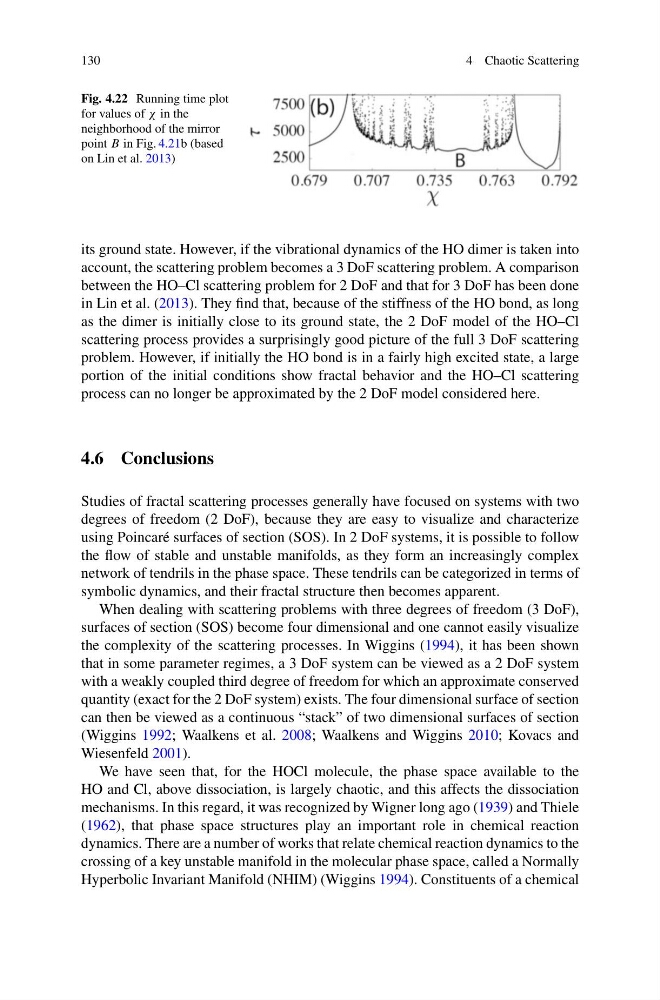
Fig. 4.22 Running time plot
for values of χ in the
neighborhood of the mirror
point B in Fig. 4.21b (based
on Lin et al. 2013)
its ground state. However, if the vibrational dynamics of the HO dimer is taken into
account, the scattering problem becomes a 3 DoF scattering problem. A comparison
between the HO–Cl scattering problem for 2 DoF and that for 3 DoF has been done
in Lin et al. (2013). They find that, because of the stiffness of the HO bond, as long
as the dimer is initially close to its ground state, the 2 DoF model of the HO–Cl
scattering process provides a surprisingly good picture of the full 3 DoF scattering
problem. However, if initially the HO bond is in a fairly high excited state, a large
portion of the initial conditions show fractal behavior and the HO–Cl scattering
process can no longer be approximated by the 2 DoF model considered here.
4.6 Conclusions
Studies of fractal scattering processes generally have focused on systems with two
degrees of freedom (2 DoF), because they are easy to visualize and characterize
using Poincaré surfaces of section (SOS). In 2 DoF systems, it is possible to follow
the flow of stable and unstable manifolds, as they form an increasingly complex
network of tendrils in the phase space. These tendrils can be categorized in terms of
symbolic dynamics, and their fractal structure then becomes apparent.
When dealing with scattering problems with three degrees of freedom (3 DoF),
surfaces of section (SOS) become four dimensional and one cannot easily visualize
the complexity of the scattering processes. In Wiggins (1994), it has been shown
that in some parameter regimes, a 3 DoF system can be viewed as a 2 DoF system
with a weakly coupled third degree of freedom for which an approximate conserved
quantity (exact for the 2 DoF system) exists. The four dimensional surface of section
can then be viewed as a continuous “stack” of two dimensional surfaces of section
(Wiggins 1992; Waalkens et al. 2008; Waalkens and Wiggins 2010; Kovacs and
Wiesenfeld 2001).
We have seen that, for the HOCl molecule, the phase space available to the
HO and Cl, above dissociation, is largely chaotic, and this affects the dissociation
mechanisms. In this regard, it was recognized by Wigner long ago (1939) and Thiele
(1962), that phase space structures play an important role in chemical reaction
dynamics. There are a number of works that relate chemical reaction dynamics to the
crossing of a key unstable manifold in the molecular phase space, called a Normally
Hyperbolic Invariant Manifold (NHIM) (Wiggins 1994). Constituents of a chemical
4 Chaotic Scattering
Fig. 4.22 Running time plot
for values of χ in the
neighborhood of the mirror
point B in Fig. 4.21b (based
on Lin et al. 2013)
its ground state. However, if the vibrational dynamics of the HO dimer is taken into
account, the scattering problem becomes a 3 DoF scattering problem. A comparison
between the HO–Cl scattering problem for 2 DoF and that for 3 DoF has been done
in Lin et al. (2013). They find that, because of the stiffness of the HO bond, as long
as the dimer is initially close to its ground state, the 2 DoF model of the HO–Cl
scattering process provides a surprisingly good picture of the full 3 DoF scattering
problem. However, if initially the HO bond is in a fairly high excited state, a large
portion of the initial conditions show fractal behavior and the HO–Cl scattering
process can no longer be approximated by the 2 DoF model considered here.
4.6 Conclusions
Studies of fractal scattering processes generally have focused on systems with two
degrees of freedom (2 DoF), because they are easy to visualize and characterize
using Poincaré surfaces of section (SOS). In 2 DoF systems, it is possible to follow
the flow of stable and unstable manifolds, as they form an increasingly complex
network of tendrils in the phase space. These tendrils can be categorized in terms of
symbolic dynamics, and their fractal structure then becomes apparent.
When dealing with scattering problems with three degrees of freedom (3 DoF),
surfaces of section (SOS) become four dimensional and one cannot easily visualize
the complexity of the scattering processes. In Wiggins (1994), it has been shown
that in some parameter regimes, a 3 DoF system can be viewed as a 2 DoF system
with a weakly coupled third degree of freedom for which an approximate conserved
quantity (exact for the 2 DoF system) exists. The four dimensional surface of section
can then be viewed as a continuous “stack” of two dimensional surfaces of section
(Wiggins 1992; Waalkens et al. 2008; Waalkens and Wiggins 2010; Kovacs and
Wiesenfeld 2001).
We have seen that, for the HOCl molecule, the phase space available to the
HO and Cl, above dissociation, is largely chaotic, and this affects the dissociation
mechanisms. In this regard, it was recognized by Wigner long ago (1939) and Thiele
(1962), that phase space structures play an important role in chemical reaction
dynamics. There are a number of works that relate chemical reaction dynamics to the
crossing of a key unstable manifold in the molecular phase space, called a Normally
Hyperbolic Invariant Manifold (NHIM) (Wiggins 1994). Constituents of a chemical