

128
4 Chaotic Scattering
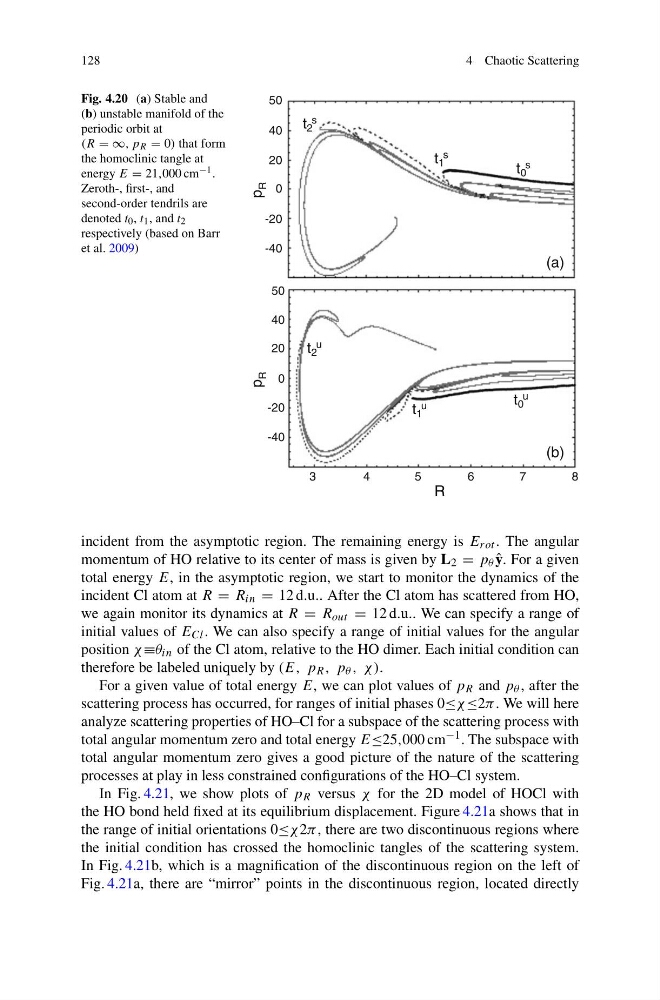
Fig. 4.20 (a) Stable and
(b) unstable manifold of the
periodic orbit at
(R = ∞, p R = 0) that form
the homoclinic tangle at
energy E = 21,000 cm −1 .
Zeroth-, first-, and
second-order tendrils are
denoted t 0 , t 1 , and t 2
respectively (based on Barr
et al. 2009)
50
40
20
0
p
R
p
R
-20
-40
50
40
20
0
-20
-40
3
4
5
6
7
8
R
(a)
(b)
t 2
u
t 1
u
t 0
u
t 2
s
t 1
s
t 0
s
incident from the asymptotic region. The remaining energy is E rot . The angular
momentum of HO relative to its center of mass is given by L 2 = p θ ˆ
y. For a given
total energy E, in the asymptotic region, we start to monitor the dynamics of the
incident Cl atom at R = R in = 12 d.u.. After the Cl atom has scattered from HO,
we again monitor its dynamics at R = R out = 12 d.u.. We can specify a range of
initial values of E Cl . We can also specify a range of initial values for the angular
position χ ≡θ in of the Cl atom, relative to the HO dimer. Each initial condition can
therefore be labeled uniquely by (E, p R , p θ , χ).
For a given value of total energy E, we can plot values of p R and p θ , after the
scattering process has occurred, for ranges of initial phases 0≤χ ≤2π . We will here
analyze scattering properties of HO–Cl for a subspace of the scattering process with
total angular momentum zero and total energy E≤25,000 cm −1 . The subspace with
total angular momentum zero gives a good picture of the nature of the scattering
processes at play in less constrained configurations of the HO–Cl system.
In Fig. 4.21, we show plots of p R versus χ for the 2D model of HOCl with
the HO bond held fixed at its equilibrium displacement. Figure 4.21a shows that in
the range of initial orientations 0≤χ 2π , there are two discontinuous regions where
the initial condition has crossed the homoclinic tangles of the scattering system.
In Fig. 4.21b, which is a magnification of the discontinuous region on the left of
Fig. 4.21a, there are “mirror” points in the discontinuous region, located directly
4 Chaotic Scattering
Fig. 4.20 (a) Stable and
(b) unstable manifold of the
periodic orbit at
(R = ∞, p R = 0) that form
the homoclinic tangle at
energy E = 21,000 cm −1 .
Zeroth-, first-, and
second-order tendrils are
denoted t 0 , t 1 , and t 2
respectively (based on Barr
et al. 2009)
50
40
20
0
p
R
p
R
-20
-40
50
40
20
0
-20
-40
3
4
5
6
7
8
R
(a)
(b)
t 2
u
t 1
u
t 0
u
t 2
s
t 1
s
t 0
s
incident from the asymptotic region. The remaining energy is E rot . The angular
momentum of HO relative to its center of mass is given by L 2 = p θ ˆ
y. For a given
total energy E, in the asymptotic region, we start to monitor the dynamics of the
incident Cl atom at R = R in = 12 d.u.. After the Cl atom has scattered from HO,
we again monitor its dynamics at R = R out = 12 d.u.. We can specify a range of
initial values of E Cl . We can also specify a range of initial values for the angular
position χ ≡θ in of the Cl atom, relative to the HO dimer. Each initial condition can
therefore be labeled uniquely by (E, p R , p θ , χ).
For a given value of total energy E, we can plot values of p R and p θ , after the
scattering process has occurred, for ranges of initial phases 0≤χ ≤2π . We will here
analyze scattering properties of HO–Cl for a subspace of the scattering process with
total angular momentum zero and total energy E≤25,000 cm −1 . The subspace with
total angular momentum zero gives a good picture of the nature of the scattering
processes at play in less constrained configurations of the HO–Cl system.
In Fig. 4.21, we show plots of p R versus χ for the 2D model of HOCl with
the HO bond held fixed at its equilibrium displacement. Figure 4.21a shows that in
the range of initial orientations 0≤χ 2π , there are two discontinuous regions where
the initial condition has crossed the homoclinic tangles of the scattering system.
In Fig. 4.21b, which is a magnification of the discontinuous region on the left of
Fig. 4.21a, there are “mirror” points in the discontinuous region, located directly