

4.5 Chaos in the HOCl Molecular System
127
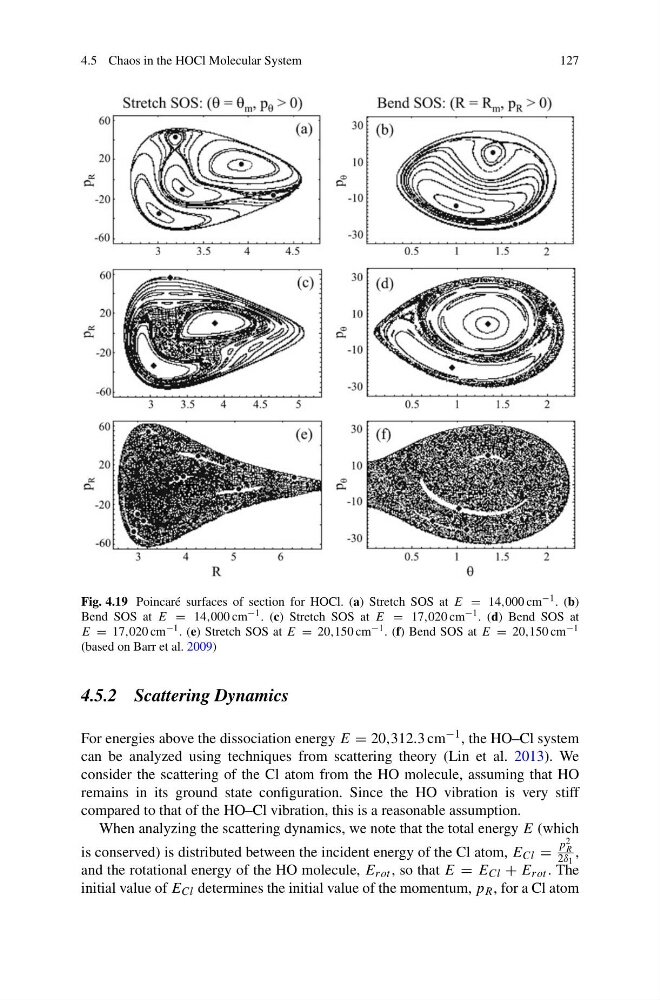
Fig. 4.19 Poincaré surfaces of section for HOCl. (a) Stretch SOS at E = 14,000 cm −1 . (b)
Bend SOS at E = 14,000 cm −1 . (c) Stretch SOS at E = 17,020 cm −1 . (d) Bend SOS at
E = 17,020 cm −1 . (e) Stretch SOS at E = 20,150 cm −1 . (f) Bend SOS at E = 20,150 cm −1
(based on Barr et al. 2009)
4.5.2 Scattering Dynamics
For energies above the dissociation energy E = 20,312.3 cm −1 , the HO–Cl system
can be analyzed using techniques from scattering theory (Lin et al. 2013). We
consider the scattering of the Cl atom from the HO molecule, assuming that HO
remains in its ground state configuration. Since the HO vibration is very stiff
compared to that of the HO–Cl vibration, this is a reasonable assumption.
When analyzing the scattering dynamics, we note that the total energy E (which
is conserved) is distributed between the incident energy of the Cl atom, E Cl =
p 2
R
2δ 1
,
and the rotational energy of the HO molecule, E rot , so that E = E Cl + E rot . The
initial value of E Cl determines the initial value of the momentum, p R , for a Cl atom
127
Fig. 4.19 Poincaré surfaces of section for HOCl. (a) Stretch SOS at E = 14,000 cm −1 . (b)
Bend SOS at E = 14,000 cm −1 . (c) Stretch SOS at E = 17,020 cm −1 . (d) Bend SOS at
E = 17,020 cm −1 . (e) Stretch SOS at E = 20,150 cm −1 . (f) Bend SOS at E = 20,150 cm −1
(based on Barr et al. 2009)
4.5.2 Scattering Dynamics
For energies above the dissociation energy E = 20,312.3 cm −1 , the HO–Cl system
can be analyzed using techniques from scattering theory (Lin et al. 2013). We
consider the scattering of the Cl atom from the HO molecule, assuming that HO
remains in its ground state configuration. Since the HO vibration is very stiff
compared to that of the HO–Cl vibration, this is a reasonable assumption.
When analyzing the scattering dynamics, we note that the total energy E (which
is conserved) is distributed between the incident energy of the Cl atom, E Cl =
p 2
R
2δ 1
,
and the rotational energy of the HO molecule, E rot , so that E = E Cl + E rot . The
initial value of E Cl determines the initial value of the momentum, p R , for a Cl atom