

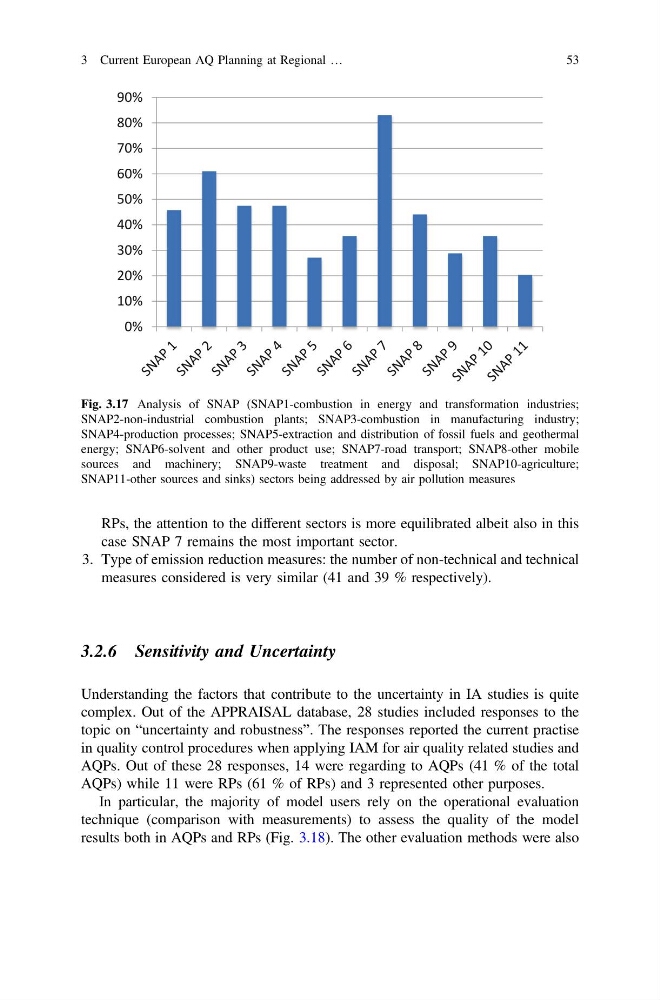
RPs, the attention to the different sectors is more equilibrated albeit also in this
case SNAP 7 remains the most important sector.
3. Type of emission reduction measures: the number of non-technical and technical
measures considered is very similar (41 and 39 % respectively).
3.2.6 Sensitivity and Uncertainty
Understanding the factors that contribute to the uncertainty in IA studies is quite
complex. Out of the APPRAISAL database, 28 studies included responses to the
topic on “uncertainty and robustness”. The responses reported the current practise
in quality control procedures when applying IAM for air quality related studies and
AQPs. Out of these 28 responses, 14 were regarding to AQPs (41 % of the total
AQPs) while 11 were RPs (61 % of RPs) and 3 represented other purposes.
In particular, the majority of model users rely on the operational evaluation
technique (comparison with measurements) to assess the quality of the model
results both in AQPs and RPs (Fig. 3.18). The other evaluation methods were also
0%
10%
20%
30%
40%
50%
60%
70%
80%
90%
Fig. 3.17 Analysis of SNAP (SNAP1-combustion in energy and transformation industries;
SNAP2-non-industrial combustion plants; SNAP3-combustion in manufacturing industry;
SNAP4-production processes; SNAP5-extraction and distribution of fossil fuels and geothermal
energy; SNAP6-solvent and other product use; SNAP7-road transport; SNAP8-other mobile
sources and machinery; SNAP9-waste treatment and disposal; SNAP10-agriculture;
SNAP11-other sources and sinks) sectors being addressed by air pollution measures
3 Current European AQ Planning at Regional …
53
case SNAP 7 remains the most important sector.
3. Type of emission reduction measures: the number of non-technical and technical
measures considered is very similar (41 and 39 % respectively).
3.2.6 Sensitivity and Uncertainty
Understanding the factors that contribute to the uncertainty in IA studies is quite
complex. Out of the APPRAISAL database, 28 studies included responses to the
topic on “uncertainty and robustness”. The responses reported the current practise
in quality control procedures when applying IAM for air quality related studies and
AQPs. Out of these 28 responses, 14 were regarding to AQPs (41 % of the total
AQPs) while 11 were RPs (61 % of RPs) and 3 represented other purposes.
In particular, the majority of model users rely on the operational evaluation
technique (comparison with measurements) to assess the quality of the model
results both in AQPs and RPs (Fig. 3.18). The other evaluation methods were also
0%
10%
20%
30%
40%
50%
60%
70%
80%
90%
Fig. 3.17 Analysis of SNAP (SNAP1-combustion in energy and transformation industries;
SNAP2-non-industrial combustion plants; SNAP3-combustion in manufacturing industry;
SNAP4-production processes; SNAP5-extraction and distribution of fossil fuels and geothermal
energy; SNAP6-solvent and other product use; SNAP7-road transport; SNAP8-other mobile
sources and machinery; SNAP9-waste treatment and disposal; SNAP10-agriculture;
SNAP11-other sources and sinks) sectors being addressed by air pollution measures
3 Current European AQ Planning at Regional …
53