

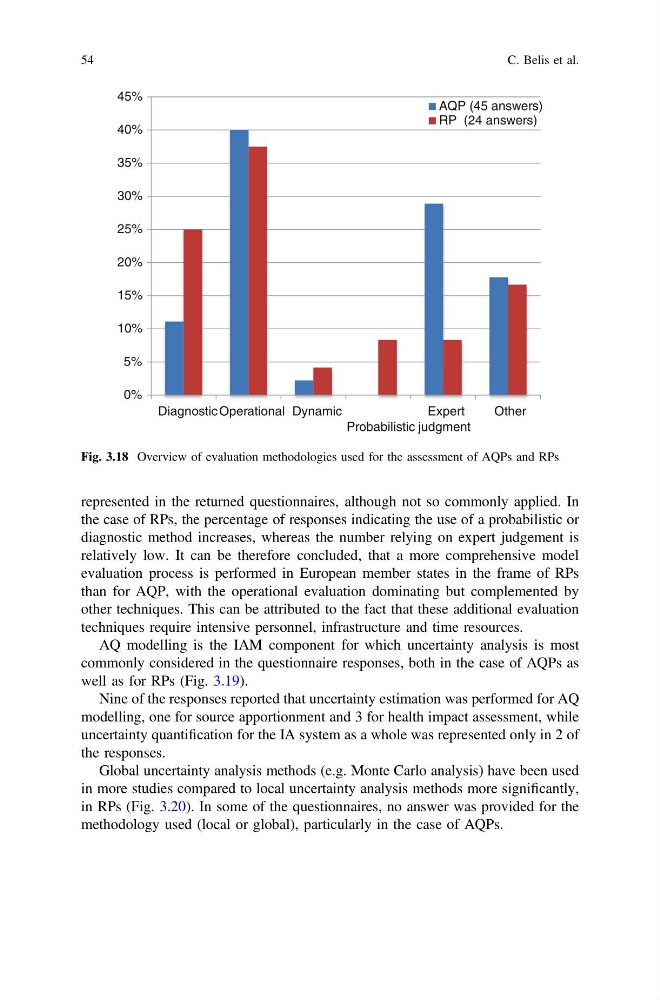
represented in the returned questionnaires, although not so commonly applied. In
the case of RPs, the percentage of responses indicating the use of a probabilistic or
diagnostic method increases, whereas the number relying on expert judgement is
relatively low. It can be therefore concluded, that a more comprehensive model
evaluation process is performed in European member states in the frame of RPs
than for AQP, with the operational evaluation dominating but complemented by
other techniques. This can be attributed to the fact that these additional evaluation
techniques require intensive personnel, infrastructure and time resources.
AQ modelling is the IAM component for which uncertainty analysis is most
commonly considered in the questionnaire responses, both in the case of AQPs as
well as for RPs (Fig. 3.19).
Nine of the responses reported that uncertainty estimation was performed for AQ
modelling, one for source apportionment and 3 for health impact assessment, while
uncertainty quantification for the IA system as a whole was represented only in 2 of
the responses.
Global uncertainty analysis methods (e.g. Monte Carlo analysis) have been used
in more studies compared to local uncertainty analysis methods more significantly,
in RPs (Fig. 3.20). In some of the questionnaires, no answer was provided for the
methodology used (local or global), particularly in the case of AQPs.
0%
5%
10%
15%
20%
25%
30%
35%
40%
45%
Diagnostic Operational Dynamic
Probabilistic
Expert
judgment
Other
AQP (45 answers)
RP (24 answers)
Fig. 3.18 Overview of evaluation methodologies used for the assessment of AQPs and RPs
54
C. Belis et al.
the case of RPs, the percentage of responses indicating the use of a probabilistic or
diagnostic method increases, whereas the number relying on expert judgement is
relatively low. It can be therefore concluded, that a more comprehensive model
evaluation process is performed in European member states in the frame of RPs
than for AQP, with the operational evaluation dominating but complemented by
other techniques. This can be attributed to the fact that these additional evaluation
techniques require intensive personnel, infrastructure and time resources.
AQ modelling is the IAM component for which uncertainty analysis is most
commonly considered in the questionnaire responses, both in the case of AQPs as
well as for RPs (Fig. 3.19).
Nine of the responses reported that uncertainty estimation was performed for AQ
modelling, one for source apportionment and 3 for health impact assessment, while
uncertainty quantification for the IA system as a whole was represented only in 2 of
the responses.
Global uncertainty analysis methods (e.g. Monte Carlo analysis) have been used
in more studies compared to local uncertainty analysis methods more significantly,
in RPs (Fig. 3.20). In some of the questionnaires, no answer was provided for the
methodology used (local or global), particularly in the case of AQPs.
0%
5%
10%
15%
20%
25%
30%
35%
40%
45%
Diagnostic Operational Dynamic
Probabilistic
Expert
judgment
Other
AQP (45 answers)
RP (24 answers)
Fig. 3.18 Overview of evaluation methodologies used for the assessment of AQPs and RPs
54
C. Belis et al.