

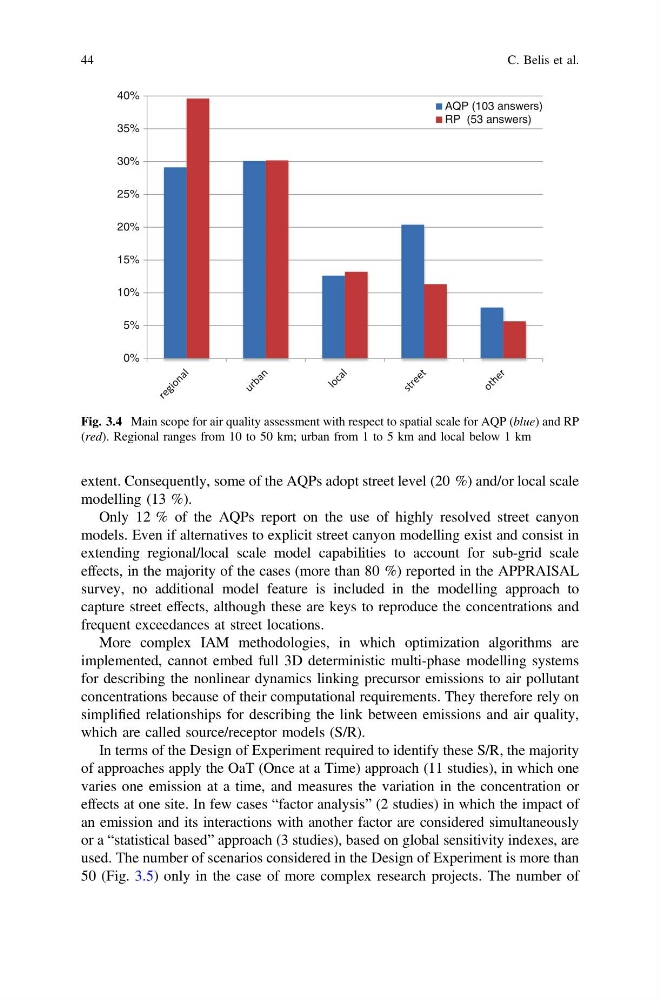
extent. Consequently, some of the AQPs adopt street level (20 %) and/or local scale
modelling (13 %).
Only 12 % of the AQPs report on the use of highly resolved street canyon
models. Even if alternatives to explicit street canyon modelling exist and consist in
extending regional/local scale model capabilities to account for sub-grid scale
effects, in the majority of the cases (more than 80 %) reported in the APPRAISAL
survey, no additional model feature is included in the modelling approach to
capture street effects, although these are keys to reproduce the concentrations and
frequent exceedances at street locations.
More complex IAM methodologies, in which optimization algorithms are
implemented, cannot embed full 3D deterministic multi-phase modelling systems
for describing the nonlinear dynamics linking precursor emissions to air pollutant
concentrations because of their computational requirements. They therefore rely on
simplified relationships for describing the link between emissions and air quality,
which are called source/receptor models (S/R).
In terms of the Design of Experiment required to identify these S/R, the majority
of approaches apply the OaT (Once at a Time) approach (11 studies), in which one
varies one emission at a time, and measures the variation in the concentration or
effects at one site. In few cases “factor analysis” (2 studies) in which the impact of
an emission and its interactions with another factor are considered simultaneously
or a “statistical based” approach (3 studies), based on global sensitivity indexes, are
used. The number of scenarios considered in the Design of Experiment is more than
50 (Fig. 3.5) only in the case of more complex research projects. The number of
0%
5%
10%
15%
20%
25%
30%
35%
40%
AQP (103 answers)
RP (53 answers)
Fig. 3.4 Main scope for air quality assessment with respect to spatial scale for AQP (blue) and RP
(red). Regional ranges from 10 to 50 km; urban from 1 to 5 km and local below 1 km
44
C. Belis et al.
modelling (13 %).
Only 12 % of the AQPs report on the use of highly resolved street canyon
models. Even if alternatives to explicit street canyon modelling exist and consist in
extending regional/local scale model capabilities to account for sub-grid scale
effects, in the majority of the cases (more than 80 %) reported in the APPRAISAL
survey, no additional model feature is included in the modelling approach to
capture street effects, although these are keys to reproduce the concentrations and
frequent exceedances at street locations.
More complex IAM methodologies, in which optimization algorithms are
implemented, cannot embed full 3D deterministic multi-phase modelling systems
for describing the nonlinear dynamics linking precursor emissions to air pollutant
concentrations because of their computational requirements. They therefore rely on
simplified relationships for describing the link between emissions and air quality,
which are called source/receptor models (S/R).
In terms of the Design of Experiment required to identify these S/R, the majority
of approaches apply the OaT (Once at a Time) approach (11 studies), in which one
varies one emission at a time, and measures the variation in the concentration or
effects at one site. In few cases “factor analysis” (2 studies) in which the impact of
an emission and its interactions with another factor are considered simultaneously
or a “statistical based” approach (3 studies), based on global sensitivity indexes, are
used. The number of scenarios considered in the Design of Experiment is more than
50 (Fig. 3.5) only in the case of more complex research projects. The number of
0%
5%
10%
15%
20%
25%
30%
35%
40%
AQP (103 answers)
RP (53 answers)
Fig. 3.4 Main scope for air quality assessment with respect to spatial scale for AQP (blue) and RP
(red). Regional ranges from 10 to 50 km; urban from 1 to 5 km and local below 1 km
44
C. Belis et al.