

60
N. Crampé and A. M. Grundland
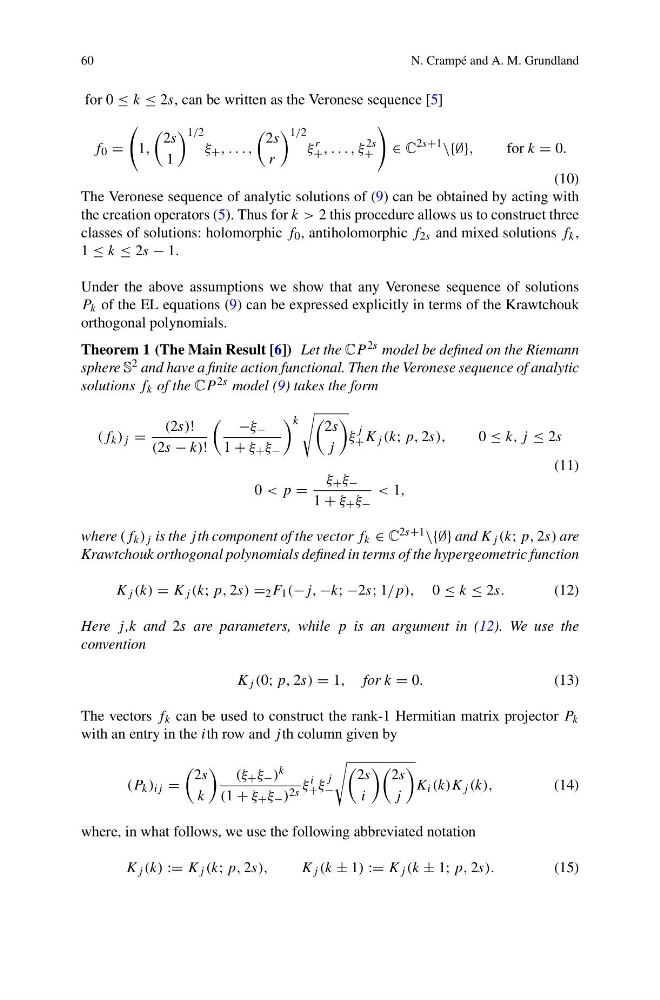
for 0 ≤ k ≤ 2s, can be written as the Veronese sequence [5]
f 0 =
1,
2s
1
1/2
ξ + , . . . ,
2s
r
1/2
ξ
r
+ , . . . , ξ
2s
+
∈ C
2s+1
\{∅},
for k = 0.
(10)
The Veronese sequence of analytic solutions of (9) can be obtained by acting with
the creation operators (5). Thus for k > 2 this procedure allows us to construct three
classes of solutions: holomorphic f 0 , antiholomorphic f 2s and mixed solutions f k ,
1 ≤ k ≤ 2s − 1.
Under the above assumptions we show that any Veronese sequence of solutions
P k of the EL equations (9) can be expressed explicitly in terms of the Krawtchouk
orthogonal polynomials.
Theorem 1 (The Main Result [6]) Let the CP 2s model be defined on the Riemann
sphere S 2 and have a finite action functional. Then the Veronese sequence of analytic
solutions f k of the CP 2s model (9) takes the form
(f k ) j =
(2s)!
(2s − k)!
−ξ −
1 + ξ + ξ −
k
2s
j
ξ
j
+ K j (k; p, 2s),
0 ≤ k, j ≤ 2s
(11)
0 < p =
ξ + ξ −
1 + ξ + ξ −
< 1,
where (f k ) j is the j th component of the vector f k ∈ C 2s+1 \{∅} and K j (k; p, 2s) are
Krawtchouk orthogonal polynomials defined in terms of the hypergeometric function
K j (k) = K j (k; p, 2s) = 2 F 1 (−j, −k; −2s; 1/p), 0 ≤ k ≤ 2s.
(12)
Here j ,k and 2s are parameters, while p is an argument in (12). We use the
convention
K j (0; p, 2s) = 1, for k = 0.
(13)
The vectors f k can be used to construct the rank-1 Hermitian matrix projector P k
with an entry in the ith row and j th column given by
(P k ) ij =
2s
k
(ξ + ξ − ) k
(1 + ξ + ξ − ) 2s ξ
i
+ ξ
j
−
2s
i
2s
j
K i (k)K j (k),
(14)
where, in what follows, we use the following abbreviated notation
K j (k) := K j (k; p, 2s),
K j (k ± 1) := K j (k ± 1; p, 2s).
(15)
N. Crampé and A. M. Grundland
for 0 ≤ k ≤ 2s, can be written as the Veronese sequence [5]
f 0 =
1,
2s
1
1/2
ξ + , . . . ,
2s
r
1/2
ξ
r
+ , . . . , ξ
2s
+
∈ C
2s+1
\{∅},
for k = 0.
(10)
The Veronese sequence of analytic solutions of (9) can be obtained by acting with
the creation operators (5). Thus for k > 2 this procedure allows us to construct three
classes of solutions: holomorphic f 0 , antiholomorphic f 2s and mixed solutions f k ,
1 ≤ k ≤ 2s − 1.
Under the above assumptions we show that any Veronese sequence of solutions
P k of the EL equations (9) can be expressed explicitly in terms of the Krawtchouk
orthogonal polynomials.
Theorem 1 (The Main Result [6]) Let the CP 2s model be defined on the Riemann
sphere S 2 and have a finite action functional. Then the Veronese sequence of analytic
solutions f k of the CP 2s model (9) takes the form
(f k ) j =
(2s)!
(2s − k)!
−ξ −
1 + ξ + ξ −
k
2s
j
ξ
j
+ K j (k; p, 2s),
0 ≤ k, j ≤ 2s
(11)
0 < p =
ξ + ξ −
1 + ξ + ξ −
< 1,
where (f k ) j is the j th component of the vector f k ∈ C 2s+1 \{∅} and K j (k; p, 2s) are
Krawtchouk orthogonal polynomials defined in terms of the hypergeometric function
K j (k) = K j (k; p, 2s) = 2 F 1 (−j, −k; −2s; 1/p), 0 ≤ k ≤ 2s.
(12)
Here j ,k and 2s are parameters, while p is an argument in (12). We use the
convention
K j (0; p, 2s) = 1, for k = 0.
(13)
The vectors f k can be used to construct the rank-1 Hermitian matrix projector P k
with an entry in the ith row and j th column given by
(P k ) ij =
2s
k
(ξ + ξ − ) k
(1 + ξ + ξ − ) 2s ξ
i
+ ξ
j
−
2s
i
2s
j
K i (k)K j (k),
(14)
where, in what follows, we use the following abbreviated notation
K j (k) := K j (k; p, 2s),
K j (k ± 1) := K j (k ± 1; p, 2s).
(15)