

The Veronese Sequence of Analytic Solutions of the CP 2s Sigma Model. . .
59
where the symbols ∂ and ¯
∂ stand for the complex derivatives with respect to ξ + and
ξ − given by
∂ =
1
2
∂
∂ξ 1 − i
∂
∂ξ 2
,
¯
∂ =
1
2
∂
∂ξ 1 + i
∂
∂ξ 2
.
Under the above assumptions every solution can be obtained from a holomorphic
(respectively, antiholomorphic) solution f : S 2 → C 2s+1 \ {∅}, ¯
∂f = 0, by
successive applications of the raising or lowering operator [1],
f k+1 = P + (f k ) := (I 2s+1 − P k )∂f k ,
f k−1 = P − (f k ) := (I 2s+1 − P k ) ¯
∂f k ,
(5)
P
0
± = I 2s+1 ,
P
2s+1
±
f k = 0,
k = 0, 1, . . . , 2s,
where P + (f k ) is a creation operator and P − (f k ) is an annihilation operator. Thus
the sequence of solutions in the CP 2s model consists of 2s + 1 vectors f k or 2s + 1
rank-1 Hermitian projectors P k . The action integral (1) in terms of the projectors P k
has a more compact form
A(P k ) =
S 2
tr
∂P k · ¯
∂P k
dξ + dξ − .
(6)
In terms of the nonconstant projectors P k , the recurrence relations (5) become [2–4]
P k±1 = Π ± (P k ) :=
(∂ ± P k )P k (∂ ∓ P k )
tr[(∂ ± P k )P k (∂ ∓ P k )]
,
(7)
for tr[(∂ ± P k )P k (∂ ∓ P k )] = 0 and are equal to zero when tr[(∂ ± P k )P k (∂ ∓ P k )] =
0, where ∂ + and ∂ − stand for ∂ and ¯
∂, respectively. Here P k stands for one of the
projectors {P 0 , P 1 , . . . , P 2s }. This set satisfies the orthogonality and completeness
relations
P j P k = δ jk P j , 0 ≤ k, j ≤ 2s,
2s
j =0
P j = I 2s+1 .
(8)
3 Solutions of the CP 2s Sigma Model
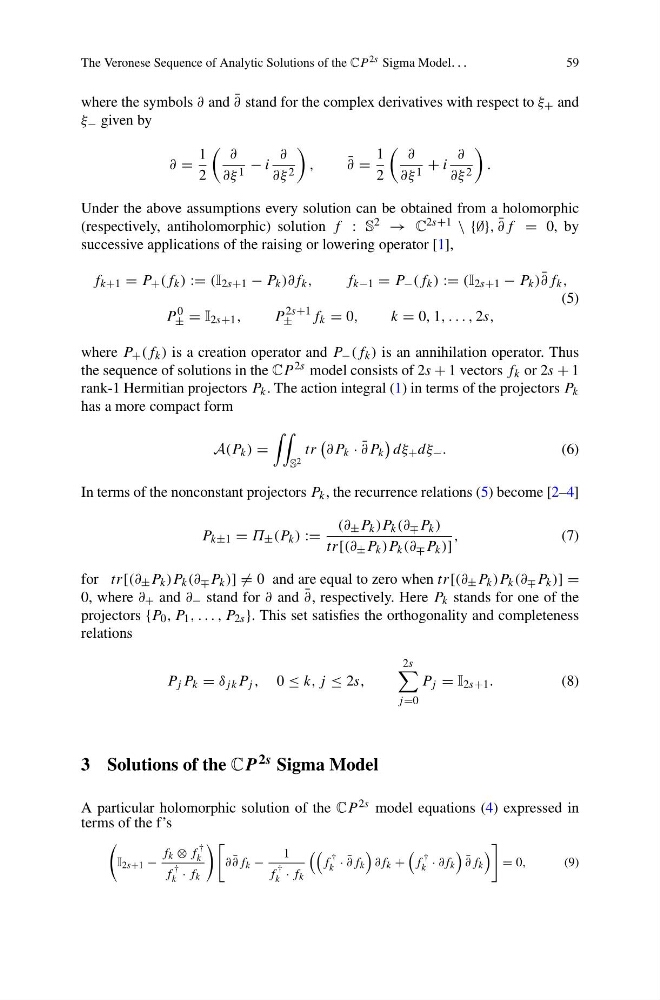
A particular holomorphic solution of the CP 2s model equations (4) expressed in
terms of the f’s
I 2s+1 −
f k ⊗ f
†
k
f
†
k · f k
∂ ¯
∂f k −
1
f
†
k · f k
f
†
k · ¯
∂f k
∂f k +
f
†
k · ∂f k
¯
∂f k
= 0,
(9)
59
where the symbols ∂ and ¯
∂ stand for the complex derivatives with respect to ξ + and
ξ − given by
∂ =
1
2
∂
∂ξ 1 − i
∂
∂ξ 2
,
¯
∂ =
1
2
∂
∂ξ 1 + i
∂
∂ξ 2
.
Under the above assumptions every solution can be obtained from a holomorphic
(respectively, antiholomorphic) solution f : S 2 → C 2s+1 \ {∅}, ¯
∂f = 0, by
successive applications of the raising or lowering operator [1],
f k+1 = P + (f k ) := (I 2s+1 − P k )∂f k ,
f k−1 = P − (f k ) := (I 2s+1 − P k ) ¯
∂f k ,
(5)
P
0
± = I 2s+1 ,
P
2s+1
±
f k = 0,
k = 0, 1, . . . , 2s,
where P + (f k ) is a creation operator and P − (f k ) is an annihilation operator. Thus
the sequence of solutions in the CP 2s model consists of 2s + 1 vectors f k or 2s + 1
rank-1 Hermitian projectors P k . The action integral (1) in terms of the projectors P k
has a more compact form
A(P k ) =
S 2
tr
∂P k · ¯
∂P k
dξ + dξ − .
(6)
In terms of the nonconstant projectors P k , the recurrence relations (5) become [2–4]
P k±1 = Π ± (P k ) :=
(∂ ± P k )P k (∂ ∓ P k )
tr[(∂ ± P k )P k (∂ ∓ P k )]
,
(7)
for tr[(∂ ± P k )P k (∂ ∓ P k )] = 0 and are equal to zero when tr[(∂ ± P k )P k (∂ ∓ P k )] =
0, where ∂ + and ∂ − stand for ∂ and ¯
∂, respectively. Here P k stands for one of the
projectors {P 0 , P 1 , . . . , P 2s }. This set satisfies the orthogonality and completeness
relations
P j P k = δ jk P j , 0 ≤ k, j ≤ 2s,
2s
j =0
P j = I 2s+1 .
(8)
3 Solutions of the CP 2s Sigma Model
A particular holomorphic solution of the CP 2s model equations (4) expressed in
terms of the f’s
I 2s+1 −
f k ⊗ f
†
k
f
†
k · f k
∂ ¯
∂f k −
1
f
†
k · f k
f
†
k · ¯
∂f k
∂f k +
f
†
k · ∂f k
¯
∂f k
= 0,
(9)