

The Veronese Sequence of Analytic Solutions of the CP 2s Sigma Model. . .
61
The EL equations (9) with the idempotency condition P 2
k = P k admit a larger class
of solutions [4] than the rank-1 Hermitian projector P k .
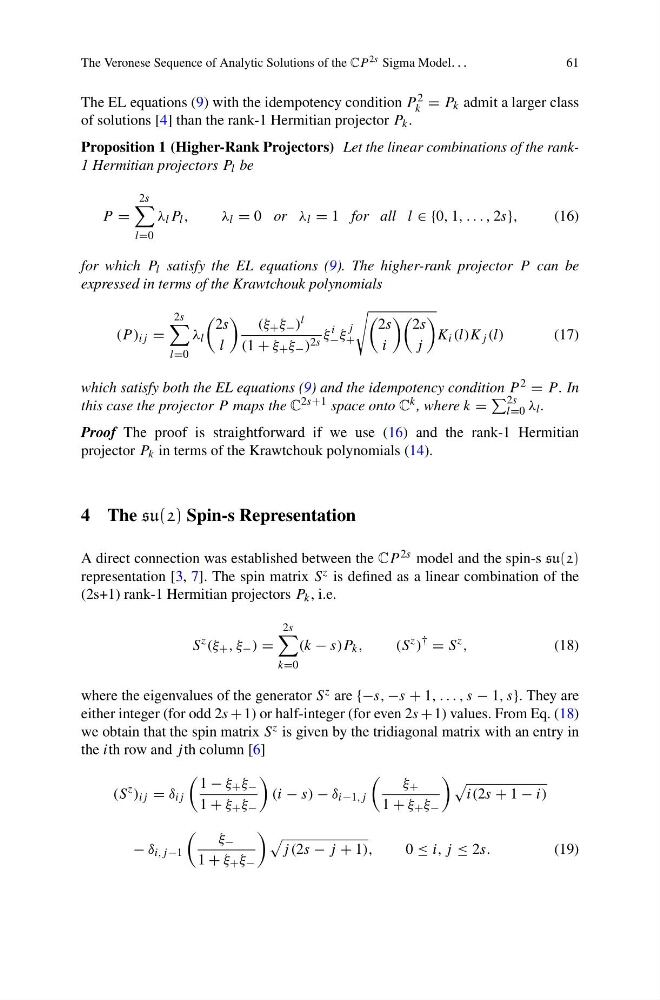
Proposition 1 (Higher-Rank Projectors) Let the linear combinations of the rank1 Hermitian projectors P l be
P =
2s
l=0
λ l P l ,
λ l = 0 or λ l = 1 for all l ∈ {0, 1, . . . , 2s},
(16)
for which P l satisfy the EL equations (9). The higher-rank projector P can be
expressed in terms of the Krawtchouk polynomials
(P ) ij =
2s
l=0
λ l
2s
l
(ξ + ξ − ) l
(1 + ξ + ξ − ) 2s ξ
i
− ξ
j
+
2s
i
2s
j
K i (l)K j (l)
(17)
which satisfy both the EL equations (9) and the idempotency condition P 2 = P . In
this case the projector P maps the C 2s+1 space onto C k , where k =
2s
l=0 λ l .
Proof The proof is straightforward if we use (16) and the rank-1 Hermitian
projector P k in terms of the Krawtchouk polynomials (14).
4 The su(2) Spin-s Representation
A direct connection was established between the CP 2s model and the spin-s su(2)
representation [3, 7]. The spin matrix S z is defined as a linear combination of the
(2s+1) rank-1 Hermitian projectors P k , i.e.
S
z (ξ + , ξ − ) =
2s
k=0
(k − s)P k ,
(S
z )
†
= S
z ,
(18)
where the eigenvalues of the generator S z are {−s, −s + 1, . . . , s − 1, s}. They are
either integer (for odd 2s + 1) or half-integer (for even 2s + 1) values. From Eq. (18)
we obtain that the spin matrix S z is given by the tridiagonal matrix with an entry in
the ith row and j th column [6]
(S
z ) ij = δ ij
1 − ξ + ξ −
1 + ξ + ξ −
(i − s) − δ i−1,j
ξ +
1 + ξ + ξ −
i(2s + 1 − i)
− δ i,j −1
ξ −
1 + ξ + ξ −
j (2s − j + 1),
0 ≤ i, j ≤ 2s.
(19)
61
The EL equations (9) with the idempotency condition P 2
k = P k admit a larger class
of solutions [4] than the rank-1 Hermitian projector P k .
Proposition 1 (Higher-Rank Projectors) Let the linear combinations of the rank1 Hermitian projectors P l be
P =
2s
l=0
λ l P l ,
λ l = 0 or λ l = 1 for all l ∈ {0, 1, . . . , 2s},
(16)
for which P l satisfy the EL equations (9). The higher-rank projector P can be
expressed in terms of the Krawtchouk polynomials
(P ) ij =
2s
l=0
λ l
2s
l
(ξ + ξ − ) l
(1 + ξ + ξ − ) 2s ξ
i
− ξ
j
+
2s
i
2s
j
K i (l)K j (l)
(17)
which satisfy both the EL equations (9) and the idempotency condition P 2 = P . In
this case the projector P maps the C 2s+1 space onto C k , where k =
2s
l=0 λ l .
Proof The proof is straightforward if we use (16) and the rank-1 Hermitian
projector P k in terms of the Krawtchouk polynomials (14).
4 The su(2) Spin-s Representation
A direct connection was established between the CP 2s model and the spin-s su(2)
representation [3, 7]. The spin matrix S z is defined as a linear combination of the
(2s+1) rank-1 Hermitian projectors P k , i.e.
S
z (ξ + , ξ − ) =
2s
k=0
(k − s)P k ,
(S
z )
†
= S
z ,
(18)
where the eigenvalues of the generator S z are {−s, −s + 1, . . . , s − 1, s}. They are
either integer (for odd 2s + 1) or half-integer (for even 2s + 1) values. From Eq. (18)
we obtain that the spin matrix S z is given by the tridiagonal matrix with an entry in
the ith row and j th column [6]
(S
z ) ij = δ ij
1 − ξ + ξ −
1 + ξ + ξ −
(i − s) − δ i−1,j
ξ +
1 + ξ + ξ −
i(2s + 1 − i)
− δ i,j −1
ξ −
1 + ξ + ξ −
j (2s − j + 1),
0 ≤ i, j ≤ 2s.
(19)