

Fast Tests for Probing the Causal Structure of Quantum Processes
627
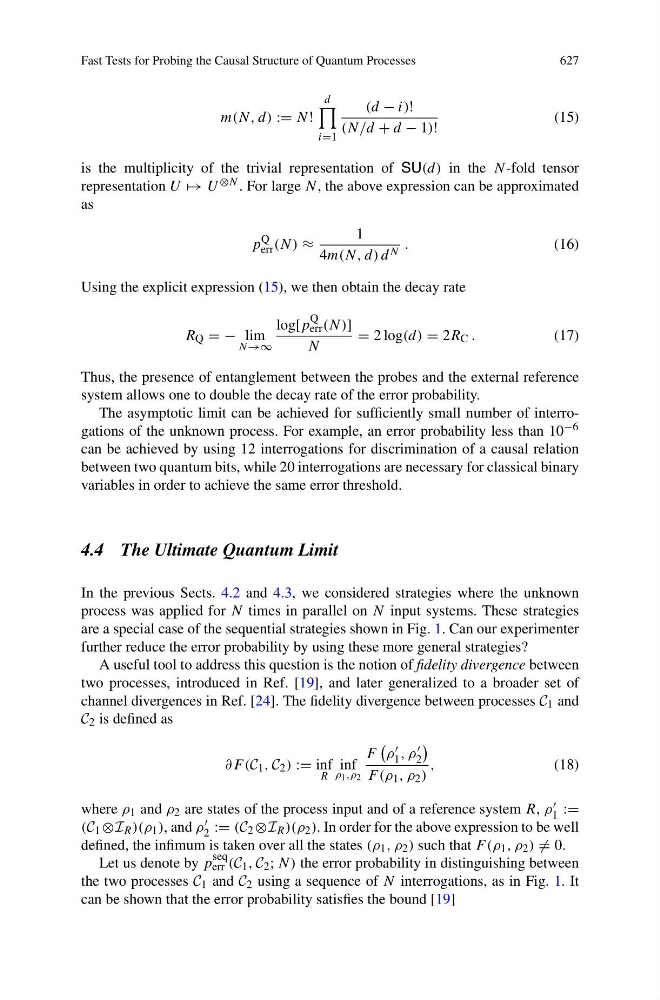
m(N, d) := N !
d
i=1
(d − i)!
(N/d + d − 1)!
(15)
is the multiplicity of the trivial representation of SU(d) in the N -fold tensor
representation U → U ⊗N . For large N , the above expression can be approximated
as
p
Q
err (N) ≈
1
4m(N, d) d N .
(16)
Using the explicit expression (15), we then obtain the decay rate
R Q = − lim
N →∞
log[p
Q
err (N)]
N
= 2 log(d) = 2R C .
(17)
Thus, the presence of entanglement between the probes and the external reference
system allows one to double the decay rate of the error probability.
The asymptotic limit can be achieved for sufficiently small number of interrogations of the unknown process. For example, an error probability less than 10 −6
can be achieved by using 12 interrogations for discrimination of a causal relation
between two quantum bits, while 20 interrogations are necessary for classical binary
variables in order to achieve the same error threshold.
4.4 The Ultimate Quantum Limit
In the previous Sects. 4.2 and 4.3, we considered strategies where the unknown
process was applied for N times in parallel on N input systems. These strategies
are a special case of the sequential strategies shown in Fig. 1. Can our experimenter
further reduce the error probability by using these more general strategies?
A useful tool to address this question is the notion of fidelity divergence between
two processes, introduced in Ref. [19], and later generalized to a broader set of
channel divergences in Ref. [24]. The fidelity divergence between processes C 1 and
C 2 is defined as
∂F (C 1 , C 2 ) := inf
R
inf
ρ 1 ,ρ 2
F
ρ
1 , ρ
2
F (ρ 1 , ρ 2 )
,
(18)
where ρ 1 and ρ 2 are states of the process input and of a reference system R, ρ
1 :=
(C 1 ⊗I R )(ρ 1 ), and ρ
2 := (C 2 ⊗I R )(ρ 2 ). In order for the above expression to be well
defined, the infimum is taken over all the states (ρ 1 , ρ 2 ) such that F (ρ 1 , ρ 2 ) = 0.
Let us denote by p
seq
err (C 1 , C 2 ; N) the error probability in distinguishing between
the two processes C 1 and C 2 using a sequence of N interrogations, as in Fig. 1. It
can be shown that the error probability satisfies the bound [19]
627
m(N, d) := N !
d
i=1
(d − i)!
(N/d + d − 1)!
(15)
is the multiplicity of the trivial representation of SU(d) in the N -fold tensor
representation U → U ⊗N . For large N , the above expression can be approximated
as
p
Q
err (N) ≈
1
4m(N, d) d N .
(16)
Using the explicit expression (15), we then obtain the decay rate
R Q = − lim
N →∞
log[p
Q
err (N)]
N
= 2 log(d) = 2R C .
(17)
Thus, the presence of entanglement between the probes and the external reference
system allows one to double the decay rate of the error probability.
The asymptotic limit can be achieved for sufficiently small number of interrogations of the unknown process. For example, an error probability less than 10 −6
can be achieved by using 12 interrogations for discrimination of a causal relation
between two quantum bits, while 20 interrogations are necessary for classical binary
variables in order to achieve the same error threshold.
4.4 The Ultimate Quantum Limit
In the previous Sects. 4.2 and 4.3, we considered strategies where the unknown
process was applied for N times in parallel on N input systems. These strategies
are a special case of the sequential strategies shown in Fig. 1. Can our experimenter
further reduce the error probability by using these more general strategies?
A useful tool to address this question is the notion of fidelity divergence between
two processes, introduced in Ref. [19], and later generalized to a broader set of
channel divergences in Ref. [24]. The fidelity divergence between processes C 1 and
C 2 is defined as
∂F (C 1 , C 2 ) := inf
R
inf
ρ 1 ,ρ 2
F
ρ
1 , ρ
2
F (ρ 1 , ρ 2 )
,
(18)
where ρ 1 and ρ 2 are states of the process input and of a reference system R, ρ
1 :=
(C 1 ⊗I R )(ρ 1 ), and ρ
2 := (C 2 ⊗I R )(ρ 2 ). In order for the above expression to be well
defined, the infimum is taken over all the states (ρ 1 , ρ 2 ) such that F (ρ 1 , ρ 2 ) = 0.
Let us denote by p
seq
err (C 1 , C 2 ; N) the error probability in distinguishing between
the two processes C 1 and C 2 using a sequence of N interrogations, as in Fig. 1. It
can be shown that the error probability satisfies the bound [19]