

628
G. Chiribella and Swati
p
seq
err (C 1 , C 2 ; N)
∂F (C 1 , C 2 ) N
4
.
(19)
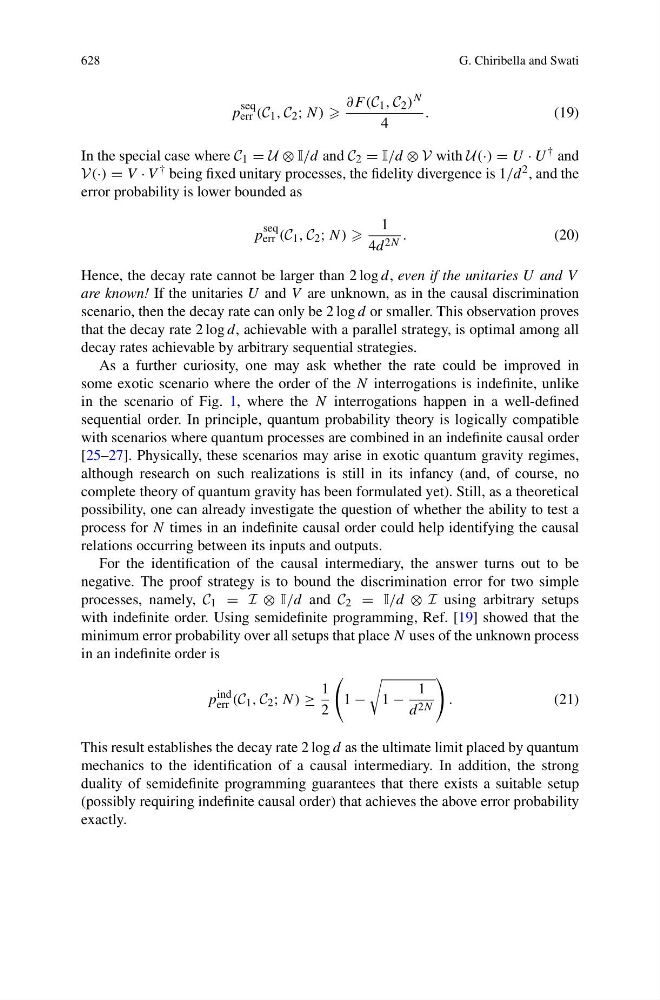
In the special case where C 1 = U ⊗ I/d and C 2 = I/d ⊗ V with U (·) = U · U † and
V(·) = V · V † being fixed unitary processes, the fidelity divergence is 1/d 2 , and the
error probability is lower bounded as
p
seq
err (C 1 , C 2 ; N)
1
4d 2N .
(20)
Hence, the decay rate cannot be larger than 2 log d, even if the unitaries U and V
are known! If the unitaries U and V are unknown, as in the causal discrimination
scenario, then the decay rate can only be 2 log d or smaller. This observation proves
that the decay rate 2 log d, achievable with a parallel strategy, is optimal among all
decay rates achievable by arbitrary sequential strategies.
As a further curiosity, one may ask whether the rate could be improved in
some exotic scenario where the order of the N interrogations is indefinite, unlike
in the scenario of Fig. 1, where the N interrogations happen in a well-defined
sequential order. In principle, quantum probability theory is logically compatible
with scenarios where quantum processes are combined in an indefinite causal order
[25–27]. Physically, these scenarios may arise in exotic quantum gravity regimes,
although research on such realizations is still in its infancy (and, of course, no
complete theory of quantum gravity has been formulated yet). Still, as a theoretical
possibility, one can already investigate the question of whether the ability to test a
process for N times in an indefinite causal order could help identifying the causal
relations occurring between its inputs and outputs.
For the identification of the causal intermediary, the answer turns out to be
negative. The proof strategy is to bound the discrimination error for two simple
processes, namely, C 1 = I ⊗ I/d and C 2 = I/d ⊗ I using arbitrary setups
with indefinite order. Using semidefinite programming, Ref. [19] showed that the
minimum error probability over all setups that place N uses of the unknown process
in an indefinite order is
p
ind
err (C 1 , C 2 ; N) ≥
1
2
1 −
1 −
1
d 2N
.
(21)
This result establishes the decay rate 2 log d as the ultimate limit placed by quantum
mechanics to the identification of a causal intermediary. In addition, the strong
duality of semidefinite programming guarantees that there exists a suitable setup
(possibly requiring indefinite causal order) that achieves the above error probability
exactly.
G. Chiribella and Swati
p
seq
err (C 1 , C 2 ; N)
∂F (C 1 , C 2 ) N
4
.
(19)
In the special case where C 1 = U ⊗ I/d and C 2 = I/d ⊗ V with U (·) = U · U † and
V(·) = V · V † being fixed unitary processes, the fidelity divergence is 1/d 2 , and the
error probability is lower bounded as
p
seq
err (C 1 , C 2 ; N)
1
4d 2N .
(20)
Hence, the decay rate cannot be larger than 2 log d, even if the unitaries U and V
are known! If the unitaries U and V are unknown, as in the causal discrimination
scenario, then the decay rate can only be 2 log d or smaller. This observation proves
that the decay rate 2 log d, achievable with a parallel strategy, is optimal among all
decay rates achievable by arbitrary sequential strategies.
As a further curiosity, one may ask whether the rate could be improved in
some exotic scenario where the order of the N interrogations is indefinite, unlike
in the scenario of Fig. 1, where the N interrogations happen in a well-defined
sequential order. In principle, quantum probability theory is logically compatible
with scenarios where quantum processes are combined in an indefinite causal order
[25–27]. Physically, these scenarios may arise in exotic quantum gravity regimes,
although research on such realizations is still in its infancy (and, of course, no
complete theory of quantum gravity has been formulated yet). Still, as a theoretical
possibility, one can already investigate the question of whether the ability to test a
process for N times in an indefinite causal order could help identifying the causal
relations occurring between its inputs and outputs.
For the identification of the causal intermediary, the answer turns out to be
negative. The proof strategy is to bound the discrimination error for two simple
processes, namely, C 1 = I ⊗ I/d and C 2 = I/d ⊗ I using arbitrary setups
with indefinite order. Using semidefinite programming, Ref. [19] showed that the
minimum error probability over all setups that place N uses of the unknown process
in an indefinite order is
p
ind
err (C 1 , C 2 ; N) ≥
1
2
1 −
1 −
1
d 2N
.
(21)
This result establishes the decay rate 2 log d as the ultimate limit placed by quantum
mechanics to the identification of a causal intermediary. In addition, the strong
duality of semidefinite programming guarantees that there exists a suitable setup
(possibly requiring indefinite causal order) that achieves the above error probability
exactly.