

604
M. Toharia
where Δ gg = 2.13v
Re
δy b
m b
+ 1.13v
2
Re
δy b
m b
2
+ 2.51v
2
I m
δy b
m b
2
. This
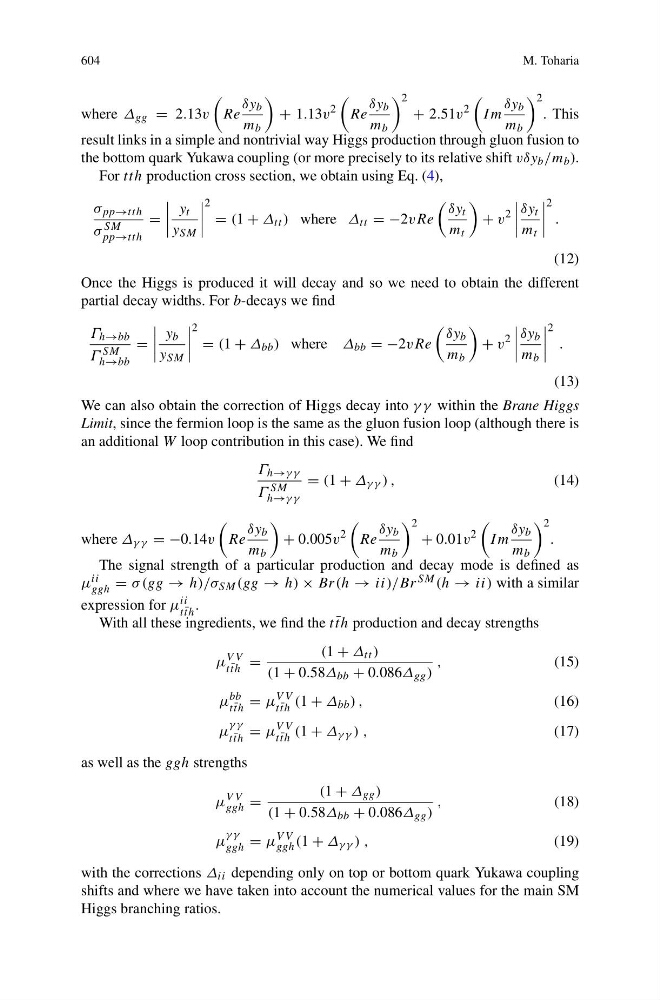
result links in a simple and nontrivial way Higgs production through gluon fusion to
the bottom quark Yukawa coupling (or more precisely to its relative shift vδy b /m b ).
For tth production cross section, we obtain using Eq. (4),
σ pp→tth
σ SM
pp→tth
=
y t
y SM
2
= (1 + Δ tt ) where Δ tt = −2vRe
δy t
m t
+ v
2
δy t
m t
2
.
(12)
Once the Higgs is produced it will decay and so we need to obtain the different
partial decay widths. For b-decays we find
Γ h→bb
Γ SM
h→bb
=
y b
y SM
2
= (1 + Δ bb ) where Δ bb = −2vRe
δy b
m b
+ v
2
δy b
m b
2
.
(13)
We can also obtain the correction of Higgs decay into γ γ within the Brane Higgs
Limit, since the fermion loop is the same as the gluon fusion loop (although there is
an additional W loop contribution in this case). We find
Γ h→γ γ
Γ SM
h→γ γ
= (1 + Δ γ γ ) ,
(14)
where Δ γ γ = −0.14v
Re
δy b
m b
+ 0.005v
2
Re
δy b
m b
2
+ 0.01v
2
I m
δy b
m b
2
.
The signal strength of a particular production and decay mode is defined as
μ ii
ggh = σ (gg → h)/σ SM (gg → h) × Br(h → ii)/Br SM (h → ii) with a similar
expression for μ ii
t ¯
th
.
With all these ingredients, we find the t ¯
th production and decay strengths
μ
V V
t ¯
th =
(1 + Δ tt )
(1 + 0.58Δ bb + 0.086Δ gg )
,
(15)
μ
bb
t ¯
th = μ
V V
t ¯
th (1 + Δ bb ) ,
(16)
μ
γ γ
t ¯
th
= μ
V V
t ¯
th (1 + Δ γ γ ) ,
(17)
as well as the ggh strengths
μ
V V
ggh =
(1 + Δ gg )
(1 + 0.58Δ bb + 0.086Δ gg )
,
(18)
μ
γ γ
ggh = μ
V V
ggh (1 + Δ γ γ ) ,
(19)
with the corrections Δ ii depending only on top or bottom quark Yukawa coupling
shifts and where we have taken into account the numerical values for the main SM
Higgs branching ratios.
M. Toharia
where Δ gg = 2.13v
Re
δy b
m b
+ 1.13v
2
Re
δy b
m b
2
+ 2.51v
2
I m
δy b
m b
2
. This
result links in a simple and nontrivial way Higgs production through gluon fusion to
the bottom quark Yukawa coupling (or more precisely to its relative shift vδy b /m b ).
For tth production cross section, we obtain using Eq. (4),
σ pp→tth
σ SM
pp→tth
=
y t
y SM
2
= (1 + Δ tt ) where Δ tt = −2vRe
δy t
m t
+ v
2
δy t
m t
2
.
(12)
Once the Higgs is produced it will decay and so we need to obtain the different
partial decay widths. For b-decays we find
Γ h→bb
Γ SM
h→bb
=
y b
y SM
2
= (1 + Δ bb ) where Δ bb = −2vRe
δy b
m b
+ v
2
δy b
m b
2
.
(13)
We can also obtain the correction of Higgs decay into γ γ within the Brane Higgs
Limit, since the fermion loop is the same as the gluon fusion loop (although there is
an additional W loop contribution in this case). We find
Γ h→γ γ
Γ SM
h→γ γ
= (1 + Δ γ γ ) ,
(14)
where Δ γ γ = −0.14v
Re
δy b
m b
+ 0.005v
2
Re
δy b
m b
2
+ 0.01v
2
I m
δy b
m b
2
.
The signal strength of a particular production and decay mode is defined as
μ ii
ggh = σ (gg → h)/σ SM (gg → h) × Br(h → ii)/Br SM (h → ii) with a similar
expression for μ ii
t ¯
th
.
With all these ingredients, we find the t ¯
th production and decay strengths
μ
V V
t ¯
th =
(1 + Δ tt )
(1 + 0.58Δ bb + 0.086Δ gg )
,
(15)
μ
bb
t ¯
th = μ
V V
t ¯
th (1 + Δ bb ) ,
(16)
μ
γ γ
t ¯
th
= μ
V V
t ¯
th (1 + Δ γ γ ) ,
(17)
as well as the ggh strengths
μ
V V
ggh =
(1 + Δ gg )
(1 + 0.58Δ bb + 0.086Δ gg )
,
(18)
μ
γ γ
ggh = μ
V V
ggh (1 + Δ γ γ ) ,
(19)
with the corrections Δ ii depending only on top or bottom quark Yukawa coupling
shifts and where we have taken into account the numerical values for the main SM
Higgs branching ratios.