

t-t-h, Top & Bottom Partners, and the Brane Higgs Limit
605
2.3 Higgs Phenomenology
Within the Brane Higgs Limit region of parameter space, all signal strengths
associated with the Higgs will deviate from the SM values only due to shifts in
the top and bottom quark Yukawa couplings. This means that ratios of Higgs signal
strengths involving electroweak production processes, and decays through the same
channels “ii”, should be equal to one, i.e. μ ii
V BF /μ ii
W h = μ ii
V BF /μ ii
Zh = 1. Also
signal strengths involving decays into W W should be equal to signals with decays
into ZZ, i.e. μ W W
ggh /μ ZZ
ggh = μ W W
tth /μ ZZ
tth = μ W W
V h /μ ZZ
V h = μ W W
V BF /μ ZZ
V BF = 1.
The corrections to the rest of Higgs signal strengths depend only on two complex
parameters, i.e. the relative top and bottom Yukawa coupling deviations δy t and
δy b . We start exploring the dominant Higgs production mechanism, the gluon fusion
process, paying particular attention to the signal strengths μ
γ γ
ggh and μ
W W,ZZ
ggh
. These
depend only on the deviation of the bottom quark coupling (magnitude and phase).
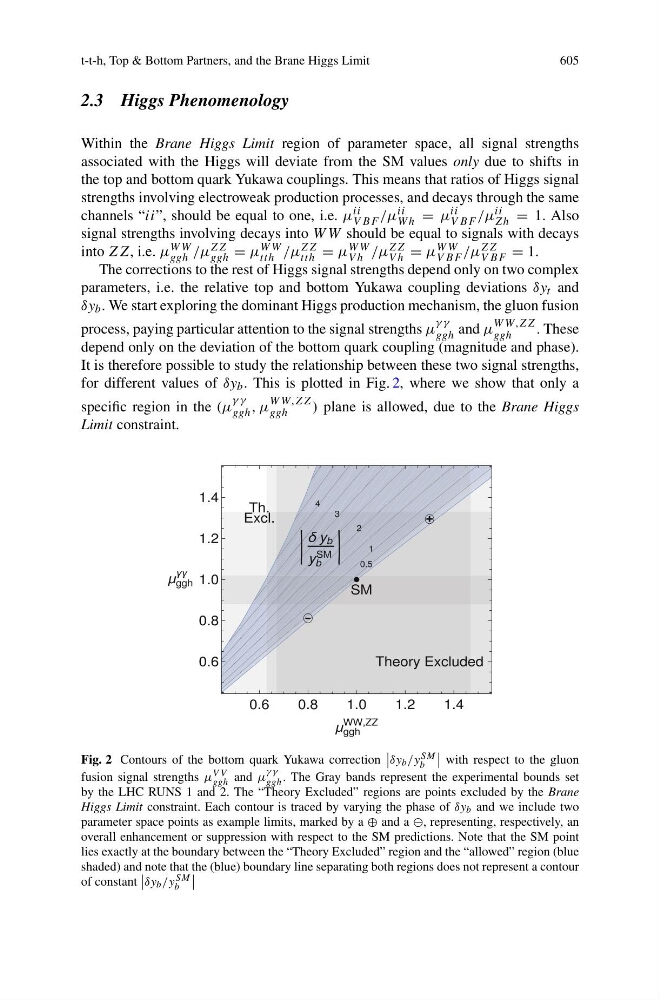
It is therefore possible to study the relationship between these two signal strengths,
for different values of δy b . This is plotted in Fig. 2, where we show that only a
specific region in the (μ
γ γ
ggh , μ
W W,ZZ
ggh
) plane is allowed, due to the Brane Higgs
Limit constraint.
Fig. 2 Contours of the bottom quark Yukawa correction
δy b /y SM
b
with respect to the gluon
fusion signal strengths μ V V
ggh and μ
γ γ
ggh . The Gray bands represent the experimental bounds set
by the LHC RUNS 1 and 2. The “Theory Excluded” regions are points excluded by the Brane
Higgs Limit constraint. Each contour is traced by varying the phase of δy b and we include two
parameter space points as example limits, marked by a ⊕ and a representing, respectively, an
overall enhancement or suppression with respect to the SM predictions. Note that the SM point
lies exactly at the boundary between the “Theory Excluded” region and the “allowed” region (blue
shaded) and note that the (blue) boundary line separating both regions does not represent a contour
of constant
δy b /y SM
b
605
2.3 Higgs Phenomenology
Within the Brane Higgs Limit region of parameter space, all signal strengths
associated with the Higgs will deviate from the SM values only due to shifts in
the top and bottom quark Yukawa couplings. This means that ratios of Higgs signal
strengths involving electroweak production processes, and decays through the same
channels “ii”, should be equal to one, i.e. μ ii
V BF /μ ii
W h = μ ii
V BF /μ ii
Zh = 1. Also
signal strengths involving decays into W W should be equal to signals with decays
into ZZ, i.e. μ W W
ggh /μ ZZ
ggh = μ W W
tth /μ ZZ
tth = μ W W
V h /μ ZZ
V h = μ W W
V BF /μ ZZ
V BF = 1.
The corrections to the rest of Higgs signal strengths depend only on two complex
parameters, i.e. the relative top and bottom Yukawa coupling deviations δy t and
δy b . We start exploring the dominant Higgs production mechanism, the gluon fusion
process, paying particular attention to the signal strengths μ
γ γ
ggh and μ
W W,ZZ
ggh
. These
depend only on the deviation of the bottom quark coupling (magnitude and phase).
It is therefore possible to study the relationship between these two signal strengths,
for different values of δy b . This is plotted in Fig. 2, where we show that only a
specific region in the (μ
γ γ
ggh , μ
W W,ZZ
ggh
) plane is allowed, due to the Brane Higgs
Limit constraint.
Fig. 2 Contours of the bottom quark Yukawa correction
δy b /y SM
b
with respect to the gluon
fusion signal strengths μ V V
ggh and μ
γ γ
ggh . The Gray bands represent the experimental bounds set
by the LHC RUNS 1 and 2. The “Theory Excluded” regions are points excluded by the Brane
Higgs Limit constraint. Each contour is traced by varying the phase of δy b and we include two
parameter space points as example limits, marked by a ⊕ and a representing, respectively, an
overall enhancement or suppression with respect to the SM predictions. Note that the SM point
lies exactly at the boundary between the “Theory Excluded” region and the “allowed” region (blue
shaded) and note that the (blue) boundary line separating both regions does not represent a contour
of constant
δy b /y SM
b