

t-t-h, Top & Bottom Partners, and the Brane Higgs Limit
603
In the SM limit, the expression in Eq. (7) must tend to ∼
1
v
(1 + A
S
1/2 (τ b )), and
we would like to find a way to ensure that the overall contribution from the top
partners to Higgs production (in gluon fusion) is kept under control. We will require
that the Yukawa coupling matrices involving the new vector-like quarks are such
that det ˜
Y t = det ˜
Y b = 0 with the matrices ˜
Y t and ˜
Y b defined in Eq. (3). This
constraint implies that Y t
2
1 − e iθ 1 |Y t
1 ||Y 0
t |
|Y Qt ||Y qT |
= 0 and thus ensures that the top
sector contribution to Higgs production, given in Eq. (8), gives the same result as
the SM top quark contribution to the same process.
The above condition of vanishing determinant could simply come from a specific
flavor structure in the Yukawa matrix but it turns out that the flavor structure required
can also be obtained naturally in models of warped extra-dimensions. In particular
we think of the usual Randall–Sundrum warped extra-dimensional scenario [10]
with matter fields in bulk. It is necessary, that the Higgs be sufficiently localized
towards the brane and that the KK modes of the top quark (and bottom quark) be
much lighter than the KK partners of the rest of quarks. Because of this connection
to extra-dimensions, we call this parameter space region of our simple model with
vector-like fermions the Brane Higgs Limit [6].
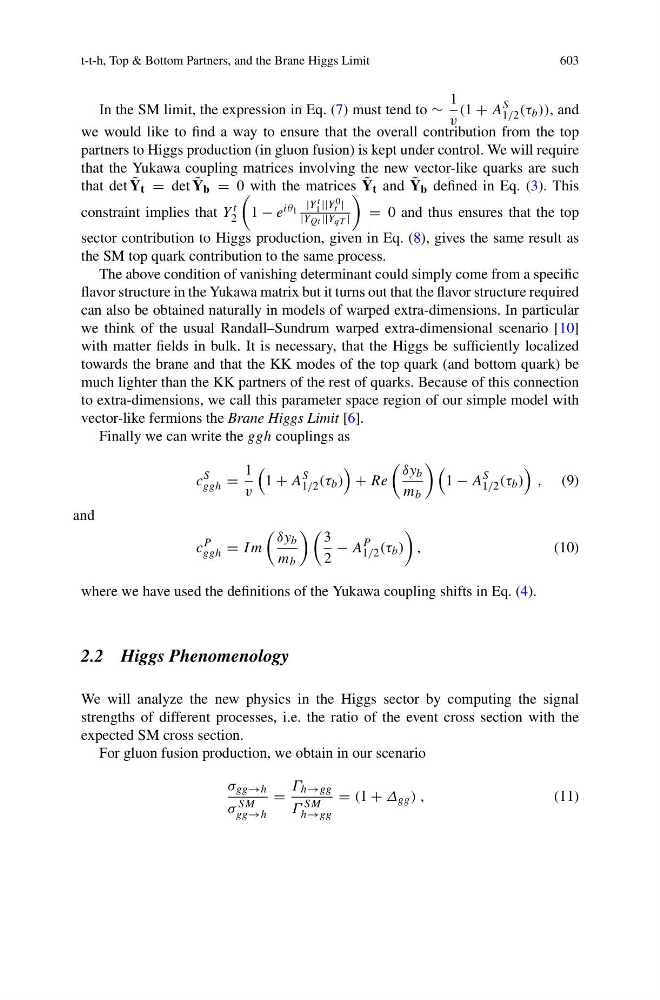
Finally we can write the ggh couplings as
c
S
ggh =
1
v
1 + A
S
1/2 (τ b )
+ Re
δy b
m b
1 − A
S
1/2 (τ b )
, (9)
and
c
P
ggh = I m
δy b
m b
3
2
− A
P
1/2 (τ b )
,
(10)
where we have used the definitions of the Yukawa coupling shifts in Eq. (4).
2.2 Higgs Phenomenology
We will analyze the new physics in the Higgs sector by computing the signal
strengths of different processes, i.e. the ratio of the event cross section with the
expected SM cross section.
For gluon fusion production, we obtain in our scenario
σ gg→h
σ SM
gg→h
=
Γ h→gg
Γ SM
h→gg
= (1 + Δ gg ) ,
(11)
603
In the SM limit, the expression in Eq. (7) must tend to ∼
1
v
(1 + A
S
1/2 (τ b )), and
we would like to find a way to ensure that the overall contribution from the top
partners to Higgs production (in gluon fusion) is kept under control. We will require
that the Yukawa coupling matrices involving the new vector-like quarks are such
that det ˜
Y t = det ˜
Y b = 0 with the matrices ˜
Y t and ˜
Y b defined in Eq. (3). This
constraint implies that Y t
2
1 − e iθ 1 |Y t
1 ||Y 0
t |
|Y Qt ||Y qT |
= 0 and thus ensures that the top
sector contribution to Higgs production, given in Eq. (8), gives the same result as
the SM top quark contribution to the same process.
The above condition of vanishing determinant could simply come from a specific
flavor structure in the Yukawa matrix but it turns out that the flavor structure required
can also be obtained naturally in models of warped extra-dimensions. In particular
we think of the usual Randall–Sundrum warped extra-dimensional scenario [10]
with matter fields in bulk. It is necessary, that the Higgs be sufficiently localized
towards the brane and that the KK modes of the top quark (and bottom quark) be
much lighter than the KK partners of the rest of quarks. Because of this connection
to extra-dimensions, we call this parameter space region of our simple model with
vector-like fermions the Brane Higgs Limit [6].
Finally we can write the ggh couplings as
c
S
ggh =
1
v
1 + A
S
1/2 (τ b )
+ Re
δy b
m b
1 − A
S
1/2 (τ b )
, (9)
and
c
P
ggh = I m
δy b
m b
3
2
− A
P
1/2 (τ b )
,
(10)
where we have used the definitions of the Yukawa coupling shifts in Eq. (4).
2.2 Higgs Phenomenology
We will analyze the new physics in the Higgs sector by computing the signal
strengths of different processes, i.e. the ratio of the event cross section with the
expected SM cross section.
For gluon fusion production, we obtain in our scenario
σ gg→h
σ SM
gg→h
=
Γ h→gg
Γ SM
h→gg
= (1 + Δ gg ) ,
(11)