

Anomalies in B Decays: A Sign of New Physics?
581
Their measurements exhibited discrepancies with the predictions of the SM.
Combining R D and R D ∗ , the deviation was ∼ 3.8σ [28]. At Moriond, 2019, Belle
announced new results [29]:
R
τ//
D ∗ /(R
τ//
D ∗ ) SM = 1.10 ± 0.09 ,
R
τ//
D /(R
τ//
D ) SM = 1.03 ± 0.13 .
(11)
These results are in better agreement with the SM, so that the deviation from the
SM in R D and R D ∗ (combined) has been reduced from ∼ 3.8σ to 3.1σ [28].
LHCb has also measured
R J/ψ ≡
B(B +
c → J /ψτ + ν τ )
B(B
+
c → J /ψμ + ν μ )
,
(12)
finding [30]
R J/ψ
(R J/ψ ) SM
= 2.51 ± 0.97 .
(13)
Here the discrepancy with the SM is 1.7σ [31].
The discrepancies in R D , R D ∗ , and R J/ψ are hints of τ -μ and τ -e universality
violation in b → cc − ¯
ν, and suggest the presence of NP in b → cτ − ¯
ν decays.
3 Models of New Physics
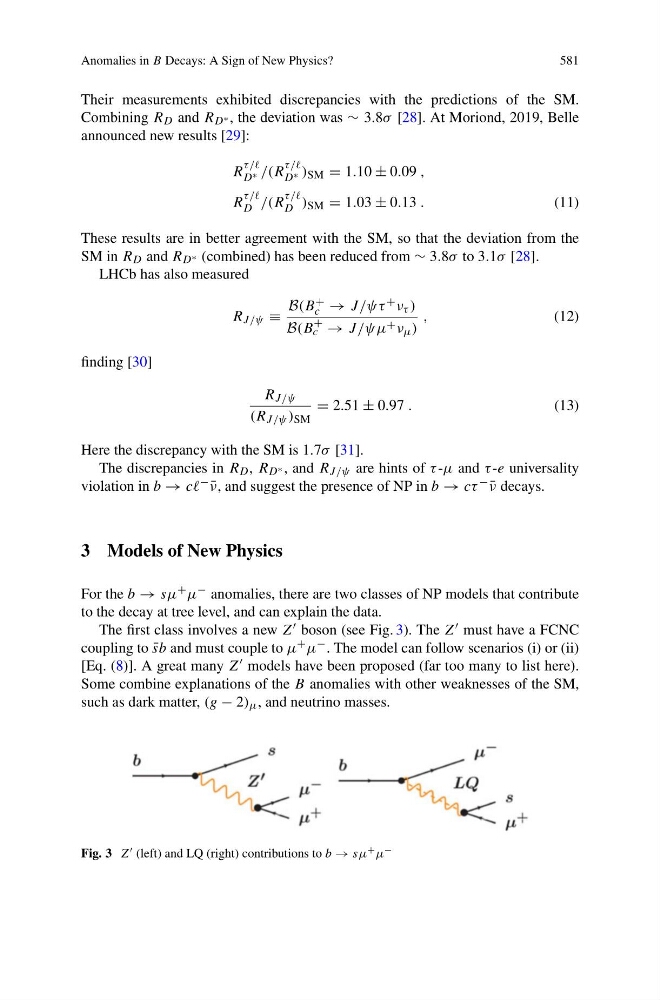
For the b → sμ + μ − anomalies, there are two classes of NP models that contribute
to the decay at tree level, and can explain the data.
The first class involves a new Z boson (see Fig. 3). The Z must have a FCNC
coupling to ¯
sb and must couple to μ + μ − . The model can follow scenarios (i) or (ii)
[Eq. (8)]. A great many Z models have been proposed (far too many to list here).
Some combine explanations of the B anomalies with other weaknesses of the SM,
such as dark matter, (g − 2) μ , and neutrino masses.
Fig. 3 Z (left) and LQ (right) contributions to b → sμ + μ −
581
Their measurements exhibited discrepancies with the predictions of the SM.
Combining R D and R D ∗ , the deviation was ∼ 3.8σ [28]. At Moriond, 2019, Belle
announced new results [29]:
R
τ//
D ∗ /(R
τ//
D ∗ ) SM = 1.10 ± 0.09 ,
R
τ//
D /(R
τ//
D ) SM = 1.03 ± 0.13 .
(11)
These results are in better agreement with the SM, so that the deviation from the
SM in R D and R D ∗ (combined) has been reduced from ∼ 3.8σ to 3.1σ [28].
LHCb has also measured
R J/ψ ≡
B(B +
c → J /ψτ + ν τ )
B(B
+
c → J /ψμ + ν μ )
,
(12)
finding [30]
R J/ψ
(R J/ψ ) SM
= 2.51 ± 0.97 .
(13)
Here the discrepancy with the SM is 1.7σ [31].
The discrepancies in R D , R D ∗ , and R J/ψ are hints of τ -μ and τ -e universality
violation in b → cc − ¯
ν, and suggest the presence of NP in b → cτ − ¯
ν decays.
3 Models of New Physics
For the b → sμ + μ − anomalies, there are two classes of NP models that contribute
to the decay at tree level, and can explain the data.
The first class involves a new Z boson (see Fig. 3). The Z must have a FCNC
coupling to ¯
sb and must couple to μ + μ − . The model can follow scenarios (i) or (ii)
[Eq. (8)]. A great many Z models have been proposed (far too many to list here).
Some combine explanations of the B anomalies with other weaknesses of the SM,
such as dark matter, (g − 2) μ , and neutrino masses.
Fig. 3 Z (left) and LQ (right) contributions to b → sμ + μ −