

582
D. London
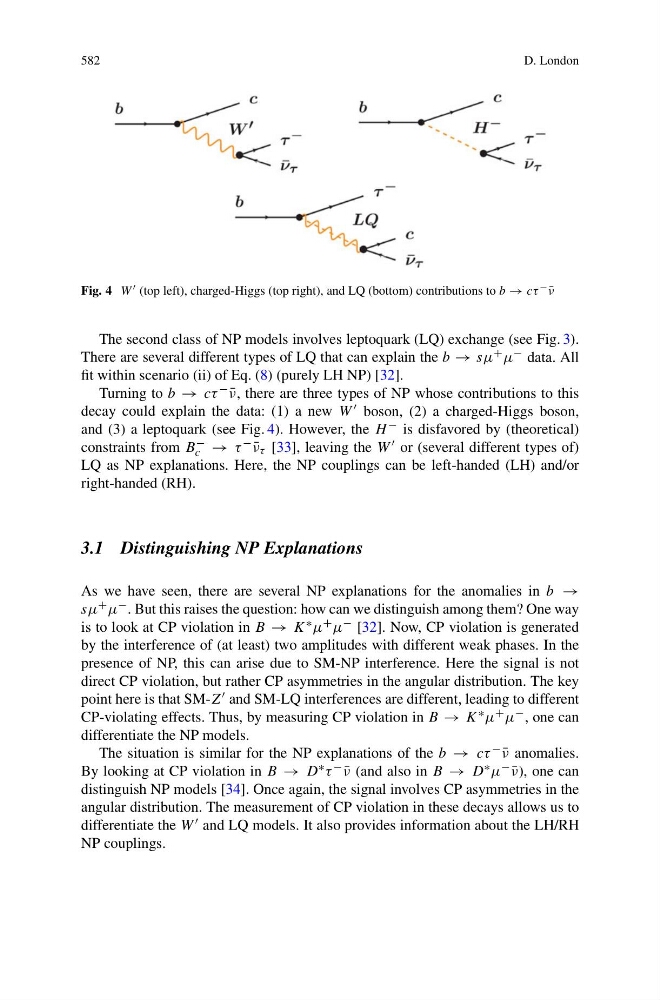
Fig. 4 W (top left), charged-Higgs (top right), and LQ (bottom) contributions to b → cτ − ¯
ν
The second class of NP models involves leptoquark (LQ) exchange (see Fig. 3).
There are several different types of LQ that can explain the b → sμ + μ − data. All
fit within scenario (ii) of Eq. (8) (purely LH NP) [32].
Turning to b → cτ − ¯
ν, there are three types of NP whose contributions to this
decay could explain the data: (1) a new W boson, (2) a charged-Higgs boson,
and (3) a leptoquark (see Fig. 4). However, the H − is disfavored by (theoretical)
constraints from B −
c → τ − ¯
ν τ [33], leaving the W or (several different types of)
LQ as NP explanations. Here, the NP couplings can be left-handed (LH) and/or
right-handed (RH).
3.1 Distinguishing NP Explanations
As we have seen, there are several NP explanations for the anomalies in b →
sμ + μ − . But this raises the question: how can we distinguish among them? One way
is to look at CP violation in B → K ∗ μ + μ − [32]. Now, CP violation is generated
by the interference of (at least) two amplitudes with different weak phases. In the
presence of NP, this can arise due to SM-NP interference. Here the signal is not
direct CP violation, but rather CP asymmetries in the angular distribution. The key
point here is that SM-Z and SM-LQ interferences are different, leading to different
CP-violating effects. Thus, by measuring CP violation in B → K ∗ μ + μ − , one can
differentiate the NP models.
The situation is similar for the NP explanations of the b → cτ − ¯
ν anomalies.
By looking at CP violation in B → D ∗ τ − ¯
ν (and also in B → D ∗ μ − ¯
ν), one can
distinguish NP models [34]. Once again, the signal involves CP asymmetries in the
angular distribution. The measurement of CP violation in these decays allows us to
differentiate the W and LQ models. It also provides information about the LH/RH
NP couplings.
D. London
Fig. 4 W (top left), charged-Higgs (top right), and LQ (bottom) contributions to b → cτ − ¯
ν
The second class of NP models involves leptoquark (LQ) exchange (see Fig. 3).
There are several different types of LQ that can explain the b → sμ + μ − data. All
fit within scenario (ii) of Eq. (8) (purely LH NP) [32].
Turning to b → cτ − ¯
ν, there are three types of NP whose contributions to this
decay could explain the data: (1) a new W boson, (2) a charged-Higgs boson,
and (3) a leptoquark (see Fig. 4). However, the H − is disfavored by (theoretical)
constraints from B −
c → τ − ¯
ν τ [33], leaving the W or (several different types of)
LQ as NP explanations. Here, the NP couplings can be left-handed (LH) and/or
right-handed (RH).
3.1 Distinguishing NP Explanations
As we have seen, there are several NP explanations for the anomalies in b →
sμ + μ − . But this raises the question: how can we distinguish among them? One way
is to look at CP violation in B → K ∗ μ + μ − [32]. Now, CP violation is generated
by the interference of (at least) two amplitudes with different weak phases. In the
presence of NP, this can arise due to SM-NP interference. Here the signal is not
direct CP violation, but rather CP asymmetries in the angular distribution. The key
point here is that SM-Z and SM-LQ interferences are different, leading to different
CP-violating effects. Thus, by measuring CP violation in B → K ∗ μ + μ − , one can
differentiate the NP models.
The situation is similar for the NP explanations of the b → cτ − ¯
ν anomalies.
By looking at CP violation in B → D ∗ τ − ¯
ν (and also in B → D ∗ μ − ¯
ν), one can
distinguish NP models [34]. Once again, the signal involves CP asymmetries in the
angular distribution. The measurement of CP violation in these decays allows us to
differentiate the W and LQ models. It also provides information about the LH/RH
NP couplings.