

552
M. B. Wise
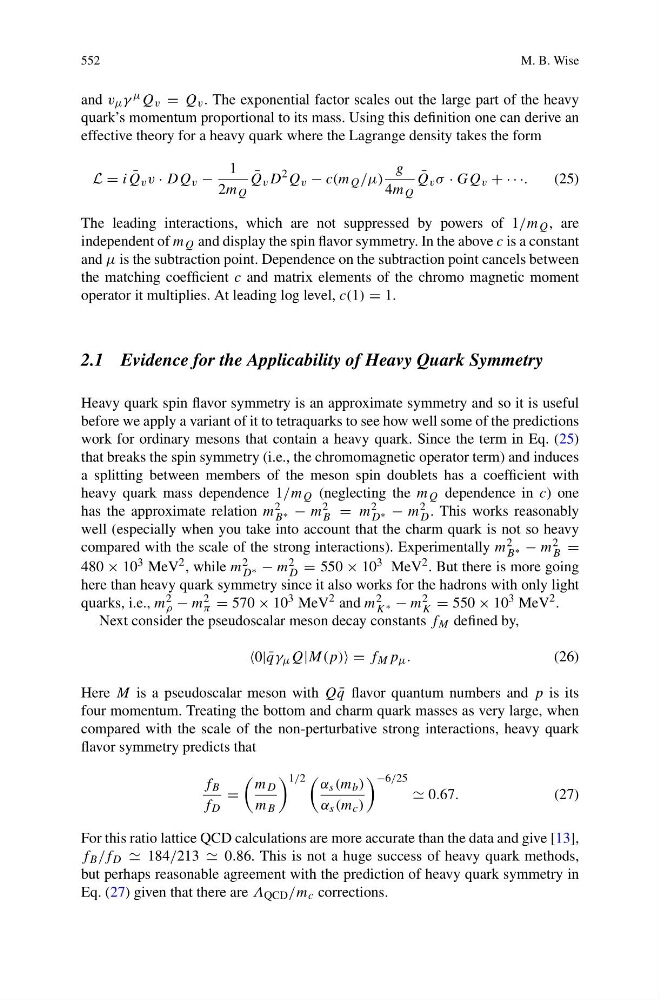
and v μ γ μ Q v = Q v . The exponential factor scales out the large part of the heavy
quark’s momentum proportional to its mass. Using this definition one can derive an
effective theory for a heavy quark where the Lagrange density takes the form
L = i ¯
Q v v · DQ v −
1
2m Q
¯
Q v D
2 Q v − c(m Q /μ)
g
4m Q
¯
Q v σ · GQ v + · · ·.
(25)
The leading interactions, which are not suppressed by powers of 1/m Q , are
independent of m Q and display the spin flavor symmetry. In the above c is a constant
and μ is the subtraction point. Dependence on the subtraction point cancels between
the matching coefficient c and matrix elements of the chromo magnetic moment
operator it multiplies. At leading log level, c(1) = 1.
2.1 Evidence for the Applicability of Heavy Quark Symmetry
Heavy quark spin flavor symmetry is an approximate symmetry and so it is useful
before we apply a variant of it to tetraquarks to see how well some of the predictions
work for ordinary mesons that contain a heavy quark. Since the term in Eq. (25)
that breaks the spin symmetry (i.e., the chromomagnetic operator term) and induces
a splitting between members of the meson spin doublets has a coefficient with
heavy quark mass dependence 1/m Q (neglecting the m Q dependence in c) one
has the approximate relation m 2
B ∗ − m 2
B = m 2
D ∗ − m 2
D . This works reasonably
well (especially when you take into account that the charm quark is not so heavy
compared with the scale of the strong interactions). Experimentally m 2
B ∗ − m 2
B =
480 × 10 3 MeV
2 , while m 2
D ∗ − m 2
D = 550 × 10 3 MeV
2 . But there is more going
here than heavy quark symmetry since it also works for the hadrons with only light
quarks, i.e., m 2
ρ − m 2
π = 570 × 10 3 MeV
2 and m 2
K ∗ − m 2
K = 550 × 10 3 MeV
2 .
Next consider the pseudoscalar meson decay constants f M defined by,
¯
qγ μ Q|M(p) = f M p μ .
(26)
Here M is a pseudoscalar meson with Q ¯
q flavor quantum numbers and p is its
four momentum. Treating the bottom and charm quark masses as very large, when
compared with the scale of the non-perturbative strong interactions, heavy quark
flavor symmetry predicts that
f B
f D
=
m D
m B
1/2
α s (m b )
α s (m c )
−6/25
0.67.
(27)
For this ratio lattice QCD calculations are more accurate than the data and give [13],
f B /f D 184/213 0.86. This is not a huge success of heavy quark methods,
but perhaps reasonable agreement with the prediction of heavy quark symmetry in
Eq. (27) given that there are Λ QCD /m c corrections.
M. B. Wise
and v μ γ μ Q v = Q v . The exponential factor scales out the large part of the heavy
quark’s momentum proportional to its mass. Using this definition one can derive an
effective theory for a heavy quark where the Lagrange density takes the form
L = i ¯
Q v v · DQ v −
1
2m Q
¯
Q v D
2 Q v − c(m Q /μ)
g
4m Q
¯
Q v σ · GQ v + · · ·.
(25)
The leading interactions, which are not suppressed by powers of 1/m Q , are
independent of m Q and display the spin flavor symmetry. In the above c is a constant
and μ is the subtraction point. Dependence on the subtraction point cancels between
the matching coefficient c and matrix elements of the chromo magnetic moment
operator it multiplies. At leading log level, c(1) = 1.
2.1 Evidence for the Applicability of Heavy Quark Symmetry
Heavy quark spin flavor symmetry is an approximate symmetry and so it is useful
before we apply a variant of it to tetraquarks to see how well some of the predictions
work for ordinary mesons that contain a heavy quark. Since the term in Eq. (25)
that breaks the spin symmetry (i.e., the chromomagnetic operator term) and induces
a splitting between members of the meson spin doublets has a coefficient with
heavy quark mass dependence 1/m Q (neglecting the m Q dependence in c) one
has the approximate relation m 2
B ∗ − m 2
B = m 2
D ∗ − m 2
D . This works reasonably
well (especially when you take into account that the charm quark is not so heavy
compared with the scale of the strong interactions). Experimentally m 2
B ∗ − m 2
B =
480 × 10 3 MeV
2 , while m 2
D ∗ − m 2
D = 550 × 10 3 MeV
2 . But there is more going
here than heavy quark symmetry since it also works for the hadrons with only light
quarks, i.e., m 2
ρ − m 2
π = 570 × 10 3 MeV
2 and m 2
K ∗ − m 2
K = 550 × 10 3 MeV
2 .
Next consider the pseudoscalar meson decay constants f M defined by,
¯
qγ μ Q|M(p) = f M p μ .
(26)
Here M is a pseudoscalar meson with Q ¯
q flavor quantum numbers and p is its
four momentum. Treating the bottom and charm quark masses as very large, when
compared with the scale of the non-perturbative strong interactions, heavy quark
flavor symmetry predicts that
f B
f D
=
m D
m B
1/2
α s (m b )
α s (m c )
−6/25
0.67.
(27)
For this ratio lattice QCD calculations are more accurate than the data and give [13],
f B /f D 184/213 0.86. This is not a huge success of heavy quark methods,
but perhaps reasonable agreement with the prediction of heavy quark symmetry in
Eq. (27) given that there are Λ QCD /m c corrections.