

Applications of Symmetry to the Large Scale Structure of the Universe. . .
551
in [8] and [9]. Similar enhancements occur in the primordial bispectrum for galaxies
in QSFI [10].
The enhancements in Eqs. (22) and (23) occur in other inflationary models. In
QSFI they arise from tree Feynman diagrams in de Sitter space. There are simple
models where it is one loop diagrams [11] that give rise to these effects.
The SPHEREx all sky survey should be able to observe primordial nonGaussianity if f NL is greater than unity (http://spherex.caltech.edu). It may also
see these enhancements in the galaxy power spectrum at low q.
2 Heavy Diquark and Quark Spin Flavor Symmetry
In this section I will mostly give references for more recent work. See [12] for
references to the earlier work on the applications of heavy quark symmetry and the
development of the 1/m Q expansion.
Heavy quarks Q have m Q Λ QCD . In a meson or baryon that contains
a single heavy quark and other light degrees of freedom (i.e., light quarks and
gluons) the interactions of the light degrees of freedom with the heavy quark
and between themselves involve momentum transfers of order the non-perturbative
scale associated with the strong interactions, Λ QCD . Changes in the heavy quark
velocity caused by these interactions Δv ∼ Λ QCD /m Q → 0 as m Q → ∞. In
this limit the strong interactions of light degrees of freedom with the heavy quark
are independent of the heavy quark’s mass and spin. Hence for charm and bottom
quarks with the same four velocity, in the limit m c,b → ∞, there is an SU (4) spin
flavor symmetry. 3 This symmetry has physical implications that are important for
understanding the properties of hadrons containing a single heavy quark and for
extracting the elements of the CKM matrix V cb and V ub from experimental data.
Note that the heavy quark flavor symmetry arises not because the charm and bottom
quarks have almost equal mass (m c /m b ∼ 1/3) but rather because both their masses
are large when compared with Λ QCD .
In the limit m Q → ∞, for a given spin of the light degrees of freedom s l = 0,
hadrons with a single heavy quark come in degenerate multiplets with total spin
s = s l − 1/2 and s = s l + 1/2. For s l = 1/2 and Q = b an example is the ¯
B (s = 0)
and ¯
B ∗ (s = 1) mesons. Hadrons with s l = 0 (e.g., for Q = c the Λ c ) have total
spin 1/2 and are not members of a doublet with different total spins.
The effective theory for a heavy quark Q moving with four velocity v replaces
the full QCD heavy quark field Q with Q v where
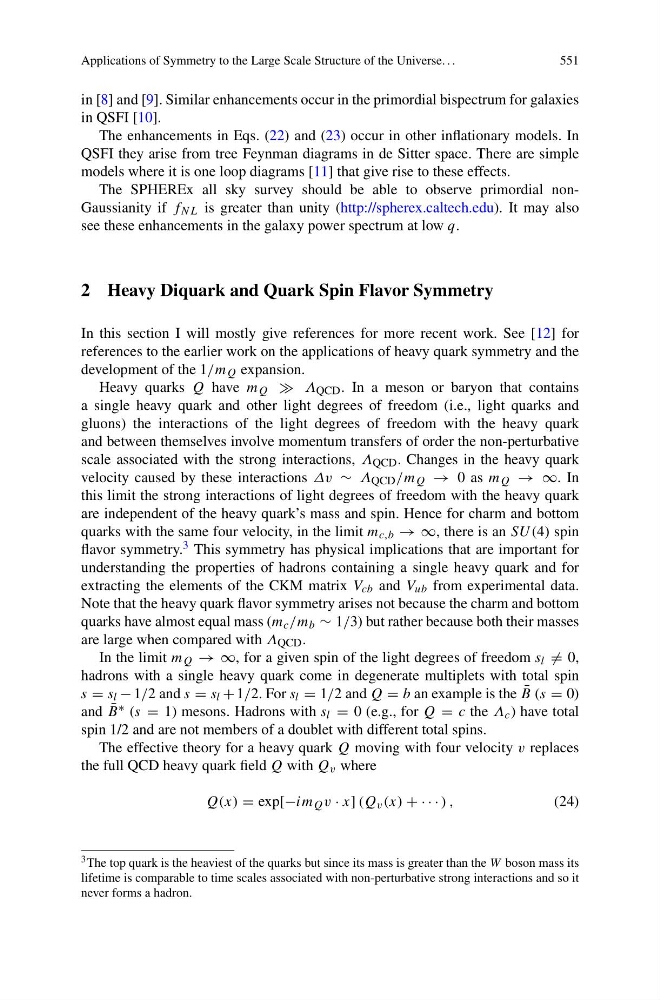
Q(x) = exp[−im Q v · x] (Q v (x) + · · · ) ,
(24)
3 The top quark is the heaviest of the quarks but since its mass is greater than the W boson mass its
lifetime is comparable to time scales associated with non-perturbative strong interactions and so it
never forms a hadron.
551
in [8] and [9]. Similar enhancements occur in the primordial bispectrum for galaxies
in QSFI [10].
The enhancements in Eqs. (22) and (23) occur in other inflationary models. In
QSFI they arise from tree Feynman diagrams in de Sitter space. There are simple
models where it is one loop diagrams [11] that give rise to these effects.
The SPHEREx all sky survey should be able to observe primordial nonGaussianity if f NL is greater than unity (http://spherex.caltech.edu). It may also
see these enhancements in the galaxy power spectrum at low q.
2 Heavy Diquark and Quark Spin Flavor Symmetry
In this section I will mostly give references for more recent work. See [12] for
references to the earlier work on the applications of heavy quark symmetry and the
development of the 1/m Q expansion.
Heavy quarks Q have m Q Λ QCD . In a meson or baryon that contains
a single heavy quark and other light degrees of freedom (i.e., light quarks and
gluons) the interactions of the light degrees of freedom with the heavy quark
and between themselves involve momentum transfers of order the non-perturbative
scale associated with the strong interactions, Λ QCD . Changes in the heavy quark
velocity caused by these interactions Δv ∼ Λ QCD /m Q → 0 as m Q → ∞. In
this limit the strong interactions of light degrees of freedom with the heavy quark
are independent of the heavy quark’s mass and spin. Hence for charm and bottom
quarks with the same four velocity, in the limit m c,b → ∞, there is an SU (4) spin
flavor symmetry. 3 This symmetry has physical implications that are important for
understanding the properties of hadrons containing a single heavy quark and for
extracting the elements of the CKM matrix V cb and V ub from experimental data.
Note that the heavy quark flavor symmetry arises not because the charm and bottom
quarks have almost equal mass (m c /m b ∼ 1/3) but rather because both their masses
are large when compared with Λ QCD .
In the limit m Q → ∞, for a given spin of the light degrees of freedom s l = 0,
hadrons with a single heavy quark come in degenerate multiplets with total spin
s = s l − 1/2 and s = s l + 1/2. For s l = 1/2 and Q = b an example is the ¯
B (s = 0)
and ¯
B ∗ (s = 1) mesons. Hadrons with s l = 0 (e.g., for Q = c the Λ c ) have total
spin 1/2 and are not members of a doublet with different total spins.
The effective theory for a heavy quark Q moving with four velocity v replaces
the full QCD heavy quark field Q with Q v where
Q(x) = exp[−im Q v · x] (Q v (x) + · · · ) ,
(24)
3 The top quark is the heaviest of the quarks but since its mass is greater than the W boson mass its
lifetime is comparable to time scales associated with non-perturbative strong interactions and so it
never forms a hadron.