

550
M. B. Wise
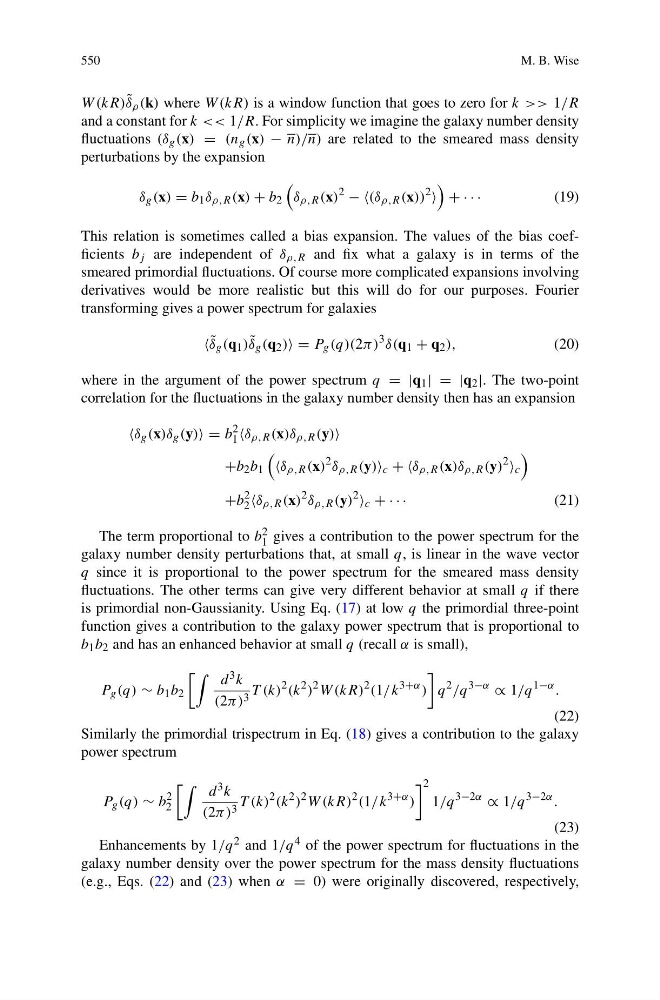
W (kR) ˜
δ ρ (k) where W (kR) is a window function that goes to zero for k >> 1/R
and a constant for k << 1/R. For simplicity we imagine the galaxy number density
fluctuations (δ g (x) = (n g (x) − n)/n) are related to the smeared mass density
perturbations by the expansion
δ g (x) = b 1 δ ρ,R (x) + b 2
δ ρ,R (x)
2
− −(δ ρ,R (x))
2
+ · · ·
(19)
This relation is sometimes called a bias expansion. The values of the bias coefficients b j are independent of δ ρ,R and fix what a galaxy is in terms of the
smeared primordial fluctuations. Of course more complicated expansions involving
derivatives would be more realistic but this will do for our purposes. Fourier
transforming gives a power spectrum for galaxies
˜
δ g (q 1 ) ˜
δ g (q 2 ) = P g (q)(2π)
3 δ(q 1 + q 2 ),
(20)
where in the argument of the power spectrum q = |q 1 | = |q 2 |. The two-point
correlation for the fluctuations in the galaxy number density then has an expansion
g (x)δ g (y) = b
2
1 ρ,R (x)δ ρ,R (y)
+b 2 b 1
ρ,R (x)
2 δ ρ,R (y) c + +δ ρ,R (x)δ ρ,R (y)
2
c
+b
2
2 ρ,R (x)
2 δ ρ,R (y)
2
c + · · ·
(21)
The term proportional to b 2
1 gives a contribution to the power spectrum for the
galaxy number density perturbations that, at small q, is linear in the wave vector
q since it is proportional to the power spectrum for the smeared mass density
fluctuations. The other terms can give very different behavior at small q if there
is primordial non-Gaussianity. Using Eq. (17) at low q the primordial three-point
function gives a contribution to the galaxy power spectrum that is proportional to
b 1 b 2 and has an enhanced behavior at small q (recall α is small),
P g (q) ∼ b 1 b 2
d 3 k
(2π) 3 T (k)
2 (k
2 )
2 W (kR)
2 (1/k
3+α )
q
2 /q
3−α
∝ 1/q
1−α .
(22)
Similarly the primordial trispectrum in Eq. (18) gives a contribution to the galaxy
power spectrum
P g (q) ∼ b
2
2
d 3 k
(2π) 3 T (k)
2 (k
2 )
2 W (kR)
2 (1/k
3+α )
2
1/q
3−2α
∝ 1/q
3−2α .
(23)
Enhancements by 1/q 2 and 1/q 4 of the power spectrum for fluctuations in the
galaxy number density over the power spectrum for the mass density fluctuations
(e.g., Eqs. (22) and (23) when α = 0) were originally discovered, respectively,
M. B. Wise
W (kR) ˜
δ ρ (k) where W (kR) is a window function that goes to zero for k >> 1/R
and a constant for k << 1/R. For simplicity we imagine the galaxy number density
fluctuations (δ g (x) = (n g (x) − n)/n) are related to the smeared mass density
perturbations by the expansion
δ g (x) = b 1 δ ρ,R (x) + b 2
δ ρ,R (x)
2
− −(δ ρ,R (x))
2
+ · · ·
(19)
This relation is sometimes called a bias expansion. The values of the bias coefficients b j are independent of δ ρ,R and fix what a galaxy is in terms of the
smeared primordial fluctuations. Of course more complicated expansions involving
derivatives would be more realistic but this will do for our purposes. Fourier
transforming gives a power spectrum for galaxies
˜
δ g (q 1 ) ˜
δ g (q 2 ) = P g (q)(2π)
3 δ(q 1 + q 2 ),
(20)
where in the argument of the power spectrum q = |q 1 | = |q 2 |. The two-point
correlation for the fluctuations in the galaxy number density then has an expansion
g (x)δ g (y) = b
2
1 ρ,R (x)δ ρ,R (y)
+b 2 b 1
ρ,R (x)
2 δ ρ,R (y) c + +δ ρ,R (x)δ ρ,R (y)
2
c
+b
2
2 ρ,R (x)
2 δ ρ,R (y)
2
c + · · ·
(21)
The term proportional to b 2
1 gives a contribution to the power spectrum for the
galaxy number density perturbations that, at small q, is linear in the wave vector
q since it is proportional to the power spectrum for the smeared mass density
fluctuations. The other terms can give very different behavior at small q if there
is primordial non-Gaussianity. Using Eq. (17) at low q the primordial three-point
function gives a contribution to the galaxy power spectrum that is proportional to
b 1 b 2 and has an enhanced behavior at small q (recall α is small),
P g (q) ∼ b 1 b 2
d 3 k
(2π) 3 T (k)
2 (k
2 )
2 W (kR)
2 (1/k
3+α )
q
2 /q
3−α
∝ 1/q
1−α .
(22)
Similarly the primordial trispectrum in Eq. (18) gives a contribution to the galaxy
power spectrum
P g (q) ∼ b
2
2
d 3 k
(2π) 3 T (k)
2 (k
2 )
2 W (kR)
2 (1/k
3+α )
2
1/q
3−2α
∝ 1/q
3−2α .
(23)
Enhancements by 1/q 2 and 1/q 4 of the power spectrum for fluctuations in the
galaxy number density over the power spectrum for the mass density fluctuations
(e.g., Eqs. (22) and (23) when α = 0) were originally discovered, respectively,