

Applications of Symmetry to the Large Scale Structure of the Universe. . .
549
would expect that f NL ∼ 10 5 . But the constraint from the CMB is (for local nonGaussianity) roughly f NL < 10. Clearly this is a very strong constraint and the fact
that single field inflation is consistent with this is a success of that model. Similar
remarks hold for τ NL .
Even though in standard single field inflation the perturbations in the curvature
and hence the mass density are almost Gaussian [5], more complicated models with
additional fields that are not much heavier than the Hubble constant during inflation
and couple to the inflation can give rise to non-Gaussianities that are consistent with
CMB limits and may be measured in the future by galaxy surveys.
The simplest model of this type is called quasi single field inflation (QSFI) [6]
and it has one additional scalar field. If the mass of the additional scalar m is small
compared with the Hubble constant during inflation, then the bispectrum in the socalled squeezed limit (i.e., q = |k 1 | = |k 2 + k 3 | | |k 2,3 |) can have dramatic
physical consequences that we discuss later. In the squeezed limit k 2 −k 3 (in
configuration space it corresponds to the points x 2 and x 3 close together and well
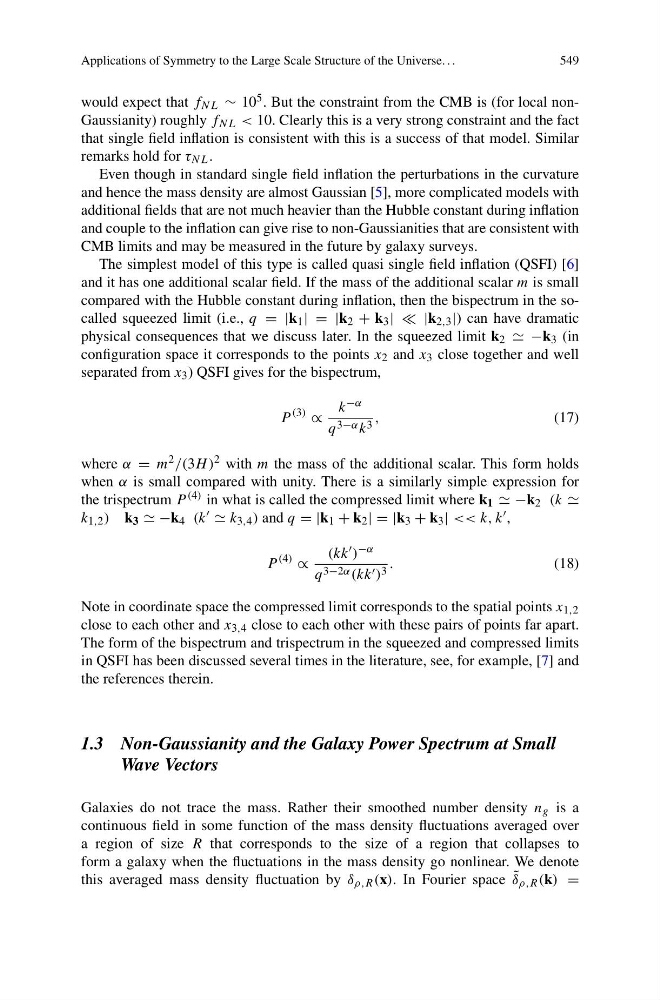
separated from x 3 ) QSFI gives for the bispectrum,
P
(3)
∝
k −α
q 3−α k 3 ,
(17)
where α = m 2 /(3H ) 2 with m the mass of the additional scalar. This form holds
when α is small compared with unity. There is a similarly simple expression for
the trispectrum P (4) in what is called the compressed limit where k 1 −k 2 (k
k 1,2 ) k 3 −k 4 (k k 3,4 ) and q = |k 1 + k 2 | = |k 3 + k 3 | << k, k ,
P
(4)
∝
(kk ) −α
q 3−2α (kk ) 3 .
(18)
Note in coordinate space the compressed limit corresponds to the spatial points x 1,2
close to each other and x 3,4 close to each other with these pairs of points far apart.
The form of the bispectrum and trispectrum in the squeezed and compressed limits
in QSFI has been discussed several times in the literature, see, for example, [7] and
the references therein.
1.3 Non-Gaussianity and the Galaxy Power Spectrum at Small
Wave Vectors
Galaxies do not trace the mass. Rather their smoothed number density n g is a
continuous field in some function of the mass density fluctuations averaged over
a region of size R that corresponds to the size of a region that collapses to
form a galaxy when the fluctuations in the mass density go nonlinear. We denote
this averaged mass density fluctuation by δ ρ,R (x). In Fourier space ˜
δ ρ,R (k) =
549
would expect that f NL ∼ 10 5 . But the constraint from the CMB is (for local nonGaussianity) roughly f NL < 10. Clearly this is a very strong constraint and the fact
that single field inflation is consistent with this is a success of that model. Similar
remarks hold for τ NL .
Even though in standard single field inflation the perturbations in the curvature
and hence the mass density are almost Gaussian [5], more complicated models with
additional fields that are not much heavier than the Hubble constant during inflation
and couple to the inflation can give rise to non-Gaussianities that are consistent with
CMB limits and may be measured in the future by galaxy surveys.
The simplest model of this type is called quasi single field inflation (QSFI) [6]
and it has one additional scalar field. If the mass of the additional scalar m is small
compared with the Hubble constant during inflation, then the bispectrum in the socalled squeezed limit (i.e., q = |k 1 | = |k 2 + k 3 | | |k 2,3 |) can have dramatic
physical consequences that we discuss later. In the squeezed limit k 2 −k 3 (in
configuration space it corresponds to the points x 2 and x 3 close together and well
separated from x 3 ) QSFI gives for the bispectrum,
P
(3)
∝
k −α
q 3−α k 3 ,
(17)
where α = m 2 /(3H ) 2 with m the mass of the additional scalar. This form holds
when α is small compared with unity. There is a similarly simple expression for
the trispectrum P (4) in what is called the compressed limit where k 1 −k 2 (k
k 1,2 ) k 3 −k 4 (k k 3,4 ) and q = |k 1 + k 2 | = |k 3 + k 3 | << k, k ,
P
(4)
∝
(kk ) −α
q 3−2α (kk ) 3 .
(18)
Note in coordinate space the compressed limit corresponds to the spatial points x 1,2
close to each other and x 3,4 close to each other with these pairs of points far apart.
The form of the bispectrum and trispectrum in the squeezed and compressed limits
in QSFI has been discussed several times in the literature, see, for example, [7] and
the references therein.
1.3 Non-Gaussianity and the Galaxy Power Spectrum at Small
Wave Vectors
Galaxies do not trace the mass. Rather their smoothed number density n g is a
continuous field in some function of the mass density fluctuations averaged over
a region of size R that corresponds to the size of a region that collapses to
form a galaxy when the fluctuations in the mass density go nonlinear. We denote
this averaged mass density fluctuation by δ ρ,R (x). In Fourier space ˜
δ ρ,R (k) =