

548
M. B. Wise
In the inflationary cosmology scale invariance is not exact. It is broken by a small
amount because the inflaton potential is not exactly flat and the Hubble constant
decreases somewhat as the inflaton evolves along its potential. The measured tilt
(n s − 1) is consistent with what inflationary models give. Moving away from very
small k the density perturbations take the form
˜
δ ρ (k; t 0 ) = ˜
δ ζ (k)k
2 T (k),
(12)
where the transfer function T (k) goes to a constant as k → 0 but cuts off the growth
at large k.
Non-Gaussianities in the curvature probability distribution imply the existence of
higher point connect correlations of the curvature scalar. For the n-point correlation
ζ(∞, k 1 ), . . . , ˜
ζ (∞, k n ) c = P
(n)
ζ (k 1 , . . . , k n )(2π)
3 δ(k 1 + · · · + k n ).
(13)
The higher point spectra 2 are also constrained by the symmetries of de Sitter space.
The P (n) ’s are rotationally invariant functions of the wave vectors so they must
depend only on the magnitudes and dot products of the wave vectors. Furthermore
scale invariance implies that
P
(n)
ζ (λk 1 , . . . , λk n ) = λ
3−3n P
(n)
ζ (k 1 , . . . , k n ),
(14)
where the +3 in the power of λ arises because of the Dirac delta function on the
sum of the wave vectors.
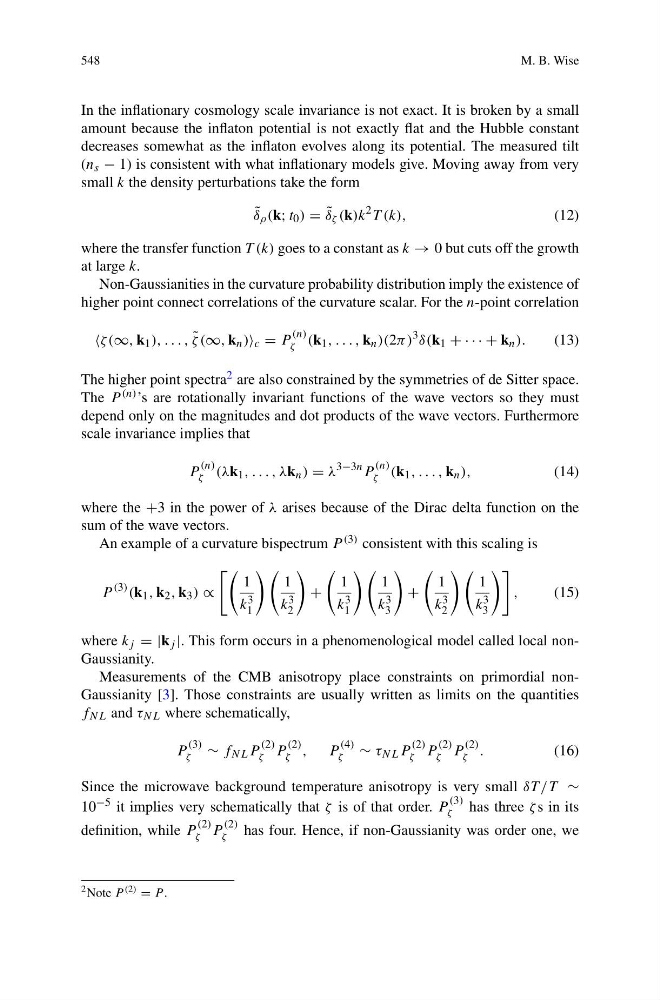
An example of a curvature bispectrum P (3) consistent with this scaling is
P
(3) (k 1 , k 2 , k 3 ) ∝
1
k 3
1
1
k 3
2
+
1
k 3
1
1
k 3
3
+
1
k 3
2
1
k 3
3
,
(15)
where k j = |k j |. This form occurs in a phenomenological model called local nonGaussianity.
Measurements of the CMB anisotropy place constraints on primordial nonGaussianity [3]. Those constraints are usually written as limits on the quantities
f NL and τ NL where schematically,
P
(3)
ζ ∼ f NL P
(2)
ζ P
(2)
ζ , P
(4)
ζ ∼ τ NL P
(2)
ζ P
(2)
ζ P
(2)
ζ .
(16)
Since the microwave background temperature anisotropy is very small δT /T ∼
10 −5 it implies very schematically that ζ is of that order. P
(3)
ζ
has three ζ s in its
definition, while P
(2)
ζ P
(2)
ζ
has four. Hence, if non-Gaussianity was order one, we
2 Note P (2) = P .
M. B. Wise
In the inflationary cosmology scale invariance is not exact. It is broken by a small
amount because the inflaton potential is not exactly flat and the Hubble constant
decreases somewhat as the inflaton evolves along its potential. The measured tilt
(n s − 1) is consistent with what inflationary models give. Moving away from very
small k the density perturbations take the form
˜
δ ρ (k; t 0 ) = ˜
δ ζ (k)k
2 T (k),
(12)
where the transfer function T (k) goes to a constant as k → 0 but cuts off the growth
at large k.
Non-Gaussianities in the curvature probability distribution imply the existence of
higher point connect correlations of the curvature scalar. For the n-point correlation
ζ(∞, k 1 ), . . . , ˜
ζ (∞, k n ) c = P
(n)
ζ (k 1 , . . . , k n )(2π)
3 δ(k 1 + · · · + k n ).
(13)
The higher point spectra 2 are also constrained by the symmetries of de Sitter space.
The P (n) ’s are rotationally invariant functions of the wave vectors so they must
depend only on the magnitudes and dot products of the wave vectors. Furthermore
scale invariance implies that
P
(n)
ζ (λk 1 , . . . , λk n ) = λ
3−3n P
(n)
ζ (k 1 , . . . , k n ),
(14)
where the +3 in the power of λ arises because of the Dirac delta function on the
sum of the wave vectors.
An example of a curvature bispectrum P (3) consistent with this scaling is
P
(3) (k 1 , k 2 , k 3 ) ∝
1
k 3
1
1
k 3
2
+
1
k 3
1
1
k 3
3
+
1
k 3
2
1
k 3
3
,
(15)
where k j = |k j |. This form occurs in a phenomenological model called local nonGaussianity.
Measurements of the CMB anisotropy place constraints on primordial nonGaussianity [3]. Those constraints are usually written as limits on the quantities
f NL and τ NL where schematically,
P
(3)
ζ ∼ f NL P
(2)
ζ P
(2)
ζ , P
(4)
ζ ∼ τ NL P
(2)
ζ P
(2)
ζ P
(2)
ζ .
(16)
Since the microwave background temperature anisotropy is very small δT /T ∼
10 −5 it implies very schematically that ζ is of that order. P
(3)
ζ
has three ζ s in its
definition, while P
(2)
ζ P
(2)
ζ
has four. Hence, if non-Gaussianity was order one, we
2 Note P (2) = P .