

Applications of Symmetry to the Large Scale Structure of the Universe. . .
547
is an invariance. At infinite time this just becomes scale invariance. Now let the
scalar field φ(t, x) be propagating in a de Sitter background space time. Fourier
transforming with respect to the comoving coordinate x,
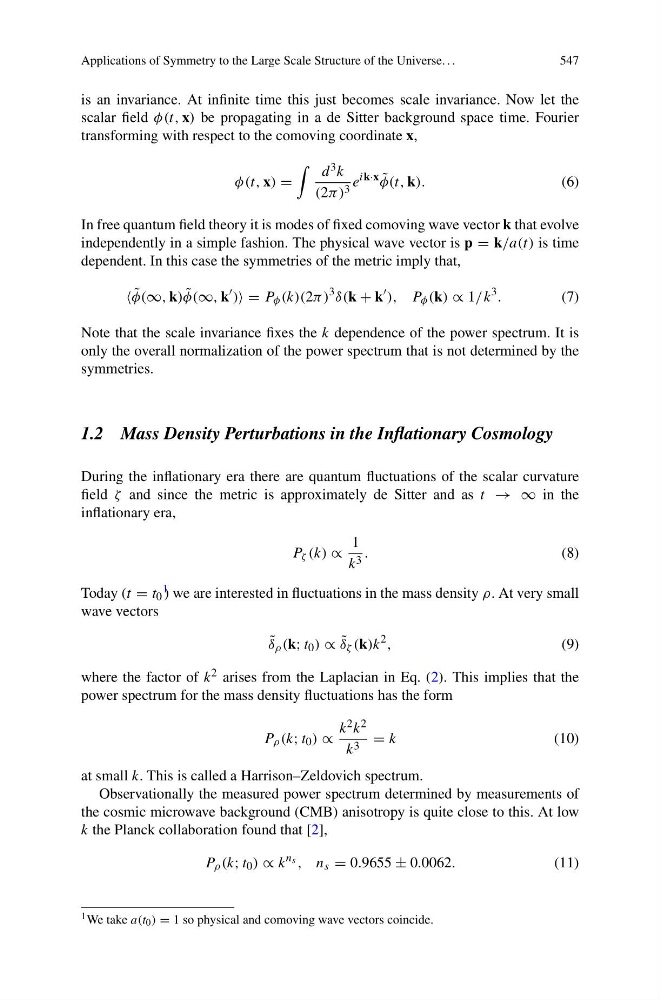
φ(t, x) =
d 3 k
(2π) 3 e
ik·x ˜
φ(t, k).
(6)
In free quantum field theory it is modes of fixed comoving wave vector k that evolve
independently in a simple fashion. The physical wave vector is p = k/a(t) is time
dependent. In this case the symmetries of the metric imply that,
˜
φ(∞, k) ˜
φ(∞, k
) = P φ (k)(2π)
3 δ(k + k
), P φ (k) ∝ 1/k
3 .
(7)
Note that the scale invariance fixes the k dependence of the power spectrum. It is
only the overall normalization of the power spectrum that is not determined by the
symmetries.
1.2 Mass Density Perturbations in the Inflationary Cosmology
During the inflationary era there are quantum fluctuations of the scalar curvature
field ζ and since the metric is approximately de Sitter and as t → ∞ in the
inflationary era,
P ζ (k) ∝
1
k 3 .
(8)
Today (t = t 0
1 ) we are interested in fluctuations in the mass density ρ. At very small
wave vectors
˜
δ ρ (k; t 0 ) ∝ ˜
δ ζ (k)k
2 ,
(9)
where the factor of k 2 arises from the Laplacian in Eq. (2). This implies that the
power spectrum for the mass density fluctuations has the form
P ρ (k; t 0 ) ∝
k 2 k 2
k 3 = k
(10)
at small k. This is called a Harrison–Zeldovich spectrum.
Observationally the measured power spectrum determined by measurements of
the cosmic microwave background (CMB) anisotropy is quite close to this. At low
k the Planck collaboration found that [2],
P ρ (k; t 0 ) ∝ k
n s , n s = 0.9655 ± 0.0062.
(11)
1 We take a(t 0 ) = 1 so physical and comoving wave vectors coincide.
547
is an invariance. At infinite time this just becomes scale invariance. Now let the
scalar field φ(t, x) be propagating in a de Sitter background space time. Fourier
transforming with respect to the comoving coordinate x,
φ(t, x) =
d 3 k
(2π) 3 e
ik·x ˜
φ(t, k).
(6)
In free quantum field theory it is modes of fixed comoving wave vector k that evolve
independently in a simple fashion. The physical wave vector is p = k/a(t) is time
dependent. In this case the symmetries of the metric imply that,
˜
φ(∞, k) ˜
φ(∞, k
) = P φ (k)(2π)
3 δ(k + k
), P φ (k) ∝ 1/k
3 .
(7)
Note that the scale invariance fixes the k dependence of the power spectrum. It is
only the overall normalization of the power spectrum that is not determined by the
symmetries.
1.2 Mass Density Perturbations in the Inflationary Cosmology
During the inflationary era there are quantum fluctuations of the scalar curvature
field ζ and since the metric is approximately de Sitter and as t → ∞ in the
inflationary era,
P ζ (k) ∝
1
k 3 .
(8)
Today (t = t 0
1 ) we are interested in fluctuations in the mass density ρ. At very small
wave vectors
˜
δ ρ (k; t 0 ) ∝ ˜
δ ζ (k)k
2 ,
(9)
where the factor of k 2 arises from the Laplacian in Eq. (2). This implies that the
power spectrum for the mass density fluctuations has the form
P ρ (k; t 0 ) ∝
k 2 k 2
k 3 = k
(10)
at small k. This is called a Harrison–Zeldovich spectrum.
Observationally the measured power spectrum determined by measurements of
the cosmic microwave background (CMB) anisotropy is quite close to this. At low
k the Planck collaboration found that [2],
P ρ (k; t 0 ) ∝ k
n s , n s = 0.9655 ± 0.0062.
(11)
1 We take a(t 0 ) = 1 so physical and comoving wave vectors coincide.