

Applications of Symmetry to the Large Scale Structure of the Universe. . .
553
The next topic we discuss is the semileptonic form factors for ¯
B → DDν and
¯
B → D ∗ decay. The D and D ∗ mesons are members of the charm quark ground
state heavy meson doublet with s l = 1/2. The Lorentz invariant form factors that
determine the invariant matrix elements for these decays (and hence the differential
decay distributions) are defined by,
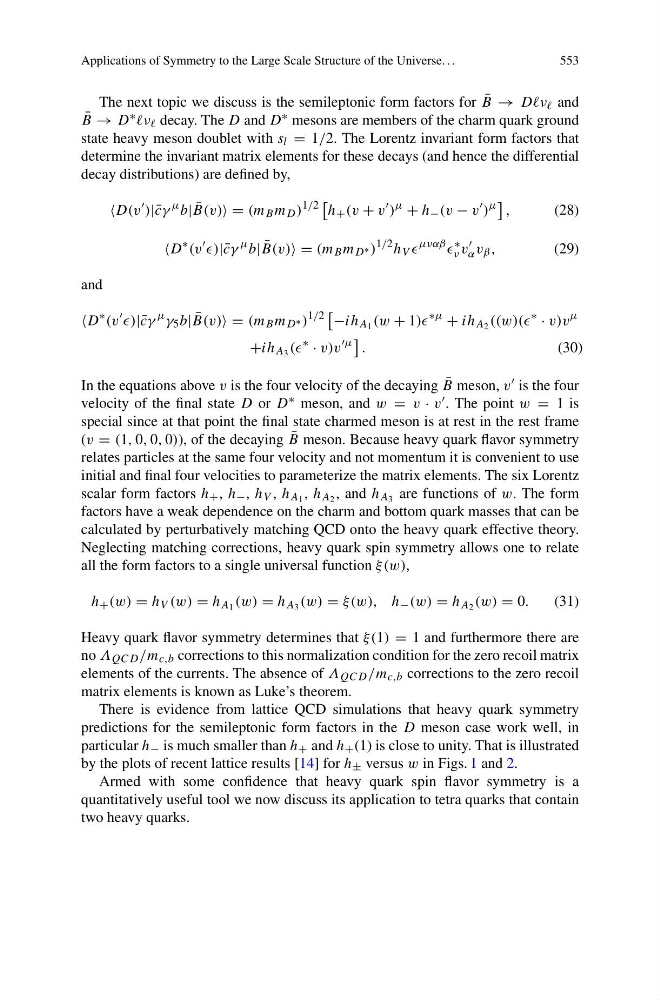
D(v
)| ¯
cγ
μ b| ¯
B(v) = (m B m D )
1/2
h + (v + v
)
μ
+ h − (v − v
)
μ
,
(28)
∗ (v
)| ¯
cγ
μ b| ¯
B(v) = (m B m D ∗ )
1/2 h V
μναβ
∗
ν v
α v β ,
(29)
and
∗ (v
)| ¯
cγ
μ γ 5 b| ¯
B(v) = (m B m D ∗ )
1/2
−ih A 1 (w + 1))
∗μ
+ ih A 2 ((w)((
∗
· v)v
μ
+ih A 3 ((
∗
· v)v
.
(30)
In the equations above v is the four velocity of the decaying ¯
B meson, v is the four
velocity of the final state D or D ∗ meson, and w = v · v . The point w = 1 is
special since at that point the final state charmed meson is at rest in the rest frame
(v = (1, 0, 0, 0)), of the decaying ¯
B meson. Because heavy quark flavor symmetry
relates particles at the same four velocity and not momentum it is convenient to use
initial and final four velocities to parameterize the matrix elements. The six Lorentz
scalar form factors h + , h − , h V , h A 1 , h A 2 , and h A 3 are functions of w. The form
factors have a weak dependence on the charm and bottom quark masses that can be
calculated by perturbatively matching QCD onto the heavy quark effective theory.
Neglecting matching corrections, heavy quark spin symmetry allows one to relate
all the form factors to a single universal function ξ(w),
h + (w) = h V (w) = h A 1 (w) = h A 3 (w) = ξ(w), h − (w) = h A 2 (w) = 0.
(31)
Heavy quark flavor symmetry determines that ξ(1) = 1 and furthermore there are
no Λ QCD /m c,b corrections to this normalization condition for the zero recoil matrix
elements of the currents. The absence of Λ QCD /m c,b corrections to the zero recoil
matrix elements is known as Luke’s theorem.
There is evidence from lattice QCD simulations that heavy quark symmetry
predictions for the semileptonic form factors in the D meson case work well, in
particular h − is much smaller than h + and h + (1) is close to unity. That is illustrated
by the plots of recent lattice results [14] for h ± versus w in Figs. 1 and 2.
Armed with some confidence that heavy quark spin flavor symmetry is a
quantitatively useful tool we now discuss its application to tetra quarks that contain
two heavy quarks.
553
The next topic we discuss is the semileptonic form factors for ¯
B → DDν and
¯
B → D ∗ decay. The D and D ∗ mesons are members of the charm quark ground
state heavy meson doublet with s l = 1/2. The Lorentz invariant form factors that
determine the invariant matrix elements for these decays (and hence the differential
decay distributions) are defined by,
D(v
)| ¯
cγ
μ b| ¯
B(v) = (m B m D )
1/2
h + (v + v
)
μ
+ h − (v − v
)
μ
,
(28)
∗ (v
)| ¯
cγ
μ b| ¯
B(v) = (m B m D ∗ )
1/2 h V
μναβ
∗
ν v
α v β ,
(29)
and
∗ (v
)| ¯
cγ
μ γ 5 b| ¯
B(v) = (m B m D ∗ )
1/2
−ih A 1 (w + 1))
∗μ
+ ih A 2 ((w)((
∗
· v)v
μ
+ih A 3 ((
∗
· v)v
.
(30)
In the equations above v is the four velocity of the decaying ¯
B meson, v is the four
velocity of the final state D or D ∗ meson, and w = v · v . The point w = 1 is
special since at that point the final state charmed meson is at rest in the rest frame
(v = (1, 0, 0, 0)), of the decaying ¯
B meson. Because heavy quark flavor symmetry
relates particles at the same four velocity and not momentum it is convenient to use
initial and final four velocities to parameterize the matrix elements. The six Lorentz
scalar form factors h + , h − , h V , h A 1 , h A 2 , and h A 3 are functions of w. The form
factors have a weak dependence on the charm and bottom quark masses that can be
calculated by perturbatively matching QCD onto the heavy quark effective theory.
Neglecting matching corrections, heavy quark spin symmetry allows one to relate
all the form factors to a single universal function ξ(w),
h + (w) = h V (w) = h A 1 (w) = h A 3 (w) = ξ(w), h − (w) = h A 2 (w) = 0.
(31)
Heavy quark flavor symmetry determines that ξ(1) = 1 and furthermore there are
no Λ QCD /m c,b corrections to this normalization condition for the zero recoil matrix
elements of the currents. The absence of Λ QCD /m c,b corrections to the zero recoil
matrix elements is known as Luke’s theorem.
There is evidence from lattice QCD simulations that heavy quark symmetry
predictions for the semileptonic form factors in the D meson case work well, in
particular h − is much smaller than h + and h + (1) is close to unity. That is illustrated
by the plots of recent lattice results [14] for h ± versus w in Figs. 1 and 2.
Armed with some confidence that heavy quark spin flavor symmetry is a
quantitatively useful tool we now discuss its application to tetra quarks that contain
two heavy quarks.