

Dressing for a Vector Modified KdV Hierarchy
519
3.2 Breather Solution
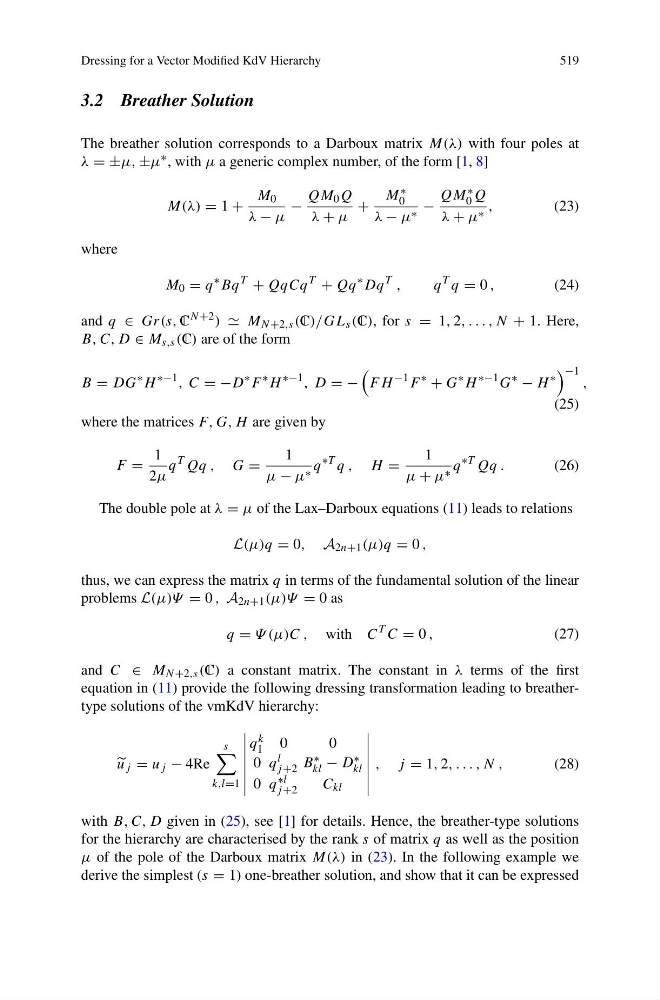
The breather solution corresponds to a Darboux matrix M(λ) with four poles at
λ = ±μ, ±μ ∗ , with μ a generic complex number, of the form [1, 8]
M(λ) = 1 +
M 0
λ − μ
−
QM 0 Q
λ + μ
+
M ∗
0
λ − μ ∗ −
QM ∗
0 Q
λ + μ ∗ ,
(23)
where
M 0 = q
∗ Bq
T
+ QqCq
T
+ Qq
∗ Dq
T ,
q
T q = 0 ,
(24)
and q ∈ Gr(s, C
N +2 ) M N +2,s (C)/GL s (C), for s = 1, 2, . . . , N + 1. Here,
B, C, D ∈ M s,s (C) are of the form
B = DG
∗ H
∗−1 , C = −D
∗ F
∗ H
∗−1 , D = −
F H
−1 F
∗
+ G
∗ H
∗−1 G
∗
− H
∗
−1
,
(25)
where the matrices F, G, H are given by
F =
1
2μ
q
T Qq , G =
1
μ − μ ∗ q
∗T q , H =
1
μ + μ ∗ q
∗T Qq .
(26)
The double pole at λ = μ of the Lax–Darboux equations (11) leads to relations
L(μ)q = 0, A 2n+1 (μ)q = 0 ,
thus, we can express the matrix q in terms of the fundamental solution of the linear
problems L(μ)Ψ = 0 , A 2n+1 (μ)Ψ = 0 as
q = Ψ (μ)C , with C
T C = 0 ,
(27)
and C ∈ M N +2,s (C) a constant matrix. The constant in λ terms of the first
equation in (11) provide the following dressing transformation leading to breathertype solutions of the vmKdV hierarchy:
u j = u j − 4Re
s
k,l=1
q k
1 0
0
0 q l
j +2 B ∗
kl − D ∗
kl
0 q ∗l
j +2
C kl
, j = 1, 2, . . . , N ,
(28)
with B, C, D given in (25), see [1] for details. Hence, the breather-type solutions
for the hierarchy are characterised by the rank s of matrix q as well as the position
μ of the pole of the Darboux matrix M(λ) in (23). In the following example we
derive the simplest (s = 1) one-breather solution, and show that it can be expressed
519
3.2 Breather Solution
The breather solution corresponds to a Darboux matrix M(λ) with four poles at
λ = ±μ, ±μ ∗ , with μ a generic complex number, of the form [1, 8]
M(λ) = 1 +
M 0
λ − μ
−
QM 0 Q
λ + μ
+
M ∗
0
λ − μ ∗ −
QM ∗
0 Q
λ + μ ∗ ,
(23)
where
M 0 = q
∗ Bq
T
+ QqCq
T
∗ Dq
T ,
q
T q = 0 ,
(24)
and q ∈ Gr(s, C
N +2 ) M N +2,s (C)/GL s (C), for s = 1, 2, . . . , N + 1. Here,
B, C, D ∈ M s,s (C) are of the form
B = DG
∗ H
∗−1 , C = −D
∗ F
∗ H
∗−1 , D = −
F H
−1 F
∗
+ G
∗ H
∗−1 G
∗
− H
∗
−1
,
(25)
where the matrices F, G, H are given by
F =
1
2μ
q
T Qq , G =
1
μ − μ ∗ q
∗T q , H =
1
μ + μ ∗ q
∗T Qq .
(26)
The double pole at λ = μ of the Lax–Darboux equations (11) leads to relations
L(μ)q = 0, A 2n+1 (μ)q = 0 ,
thus, we can express the matrix q in terms of the fundamental solution of the linear
problems L(μ)Ψ = 0 , A 2n+1 (μ)Ψ = 0 as
q = Ψ (μ)C , with C
T C = 0 ,
(27)
and C ∈ M N +2,s (C) a constant matrix. The constant in λ terms of the first
equation in (11) provide the following dressing transformation leading to breathertype solutions of the vmKdV hierarchy:
u j = u j − 4Re
s
k,l=1
q k
1 0
0
0 q l
j +2 B ∗
kl − D ∗
kl
0 q ∗l
j +2
C kl
, j = 1, 2, . . . , N ,
(28)
with B, C, D given in (25), see [1] for details. Hence, the breather-type solutions
for the hierarchy are characterised by the rank s of matrix q as well as the position
μ of the pole of the Darboux matrix M(λ) in (23). In the following example we
derive the simplest (s = 1) one-breather solution, and show that it can be expressed