

520
P. Adamopoulou and G. Papamikos
as a ratio of determinants and that it is parameterised by two constant unit vectors
normal to each other.
Example: Rank One One-Breather Solution In the case s = 1, the dressing
transformation (28) takes the form
u j = u j − 4Re
Δ j
Δ
, j = 1, 2, . . . , N ,
(29)
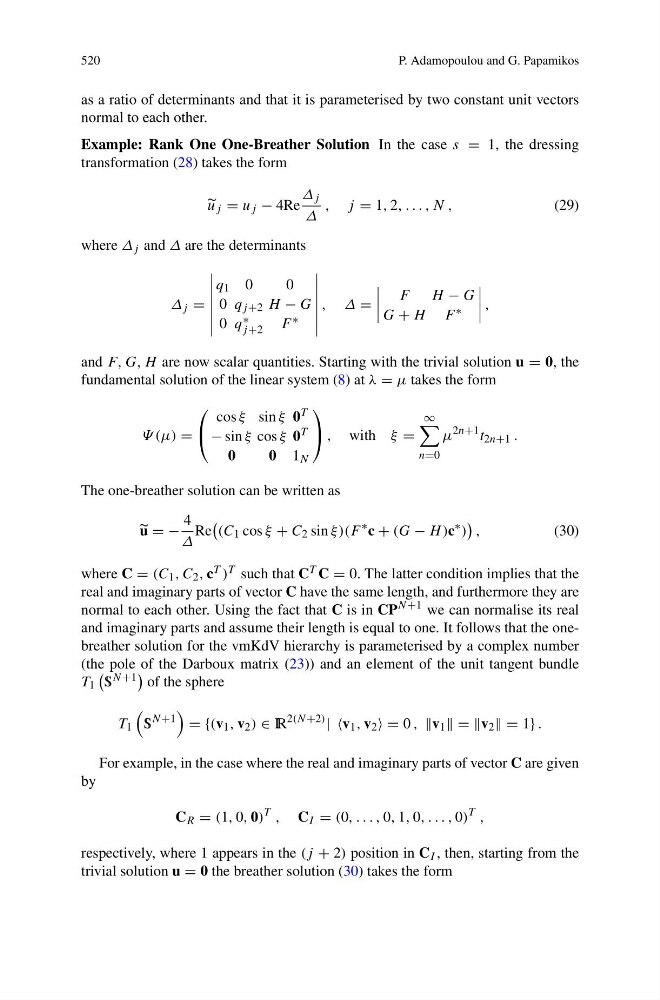
where Δ j and Δ are the determinants
Δ j =
q 1 0
0
0 q j +2 H − G
0 q ∗
j +2
F ∗
, Δ =
F
H − G
G + H F ∗
,
and F, G, H are now scalar quantities. Starting with the trivial solution u = 0, the
fundamental solution of the linear system (8) at λ = μ takes the form
Ψ (μ) =
⎛
⎝
cos ξ sin ξ 0 T
− sin ξ cos ξ 0 T
0
0 1 N
⎞
⎠ , with ξ =
∞
n=0
μ
2n+1 t 2n+1 .
The one-breather solution can be written as
u = −
4
Δ
Re
(C 1 cos ξ + C 2 sin ξ )(F
∗ c + (G − H )c
∗ )
,
(30)
where C = (C 1 , C 2 , c T ) T such that C T C = 0. The latter condition implies that the
real and imaginary parts of vector C have the same length, and furthermore they are
normal to each other. Using the fact that C is in CP
N +1 we can normalise its real
and imaginary parts and assume their length is equal to one. It follows that the onebreather solution for the vmKdV hierarchy is parameterised by a complex number
(the pole of the Darboux matrix (23)) and an element of the unit tangent bundle
T 1
S
N +1
of the sphere
T 1
S
N +1
= {(v 1 , v 2 ) ∈ IR
2(N +2)
| v 1 , v 2 = 0 , 1 = =v 2 = 1} .
For example, in the case where the real and imaginary parts of vector C are given
by
C R = (1, 0, 0)
T , C I = (0, . . . , 0, 1, 0, . . . , 0)
T ,
respectively, where 1 appears in the (j + 2) position in C I , then, starting from the
trivial solution u = 0 the breather solution (30) takes the form
P. Adamopoulou and G. Papamikos
as a ratio of determinants and that it is parameterised by two constant unit vectors
normal to each other.
Example: Rank One One-Breather Solution In the case s = 1, the dressing
transformation (28) takes the form
u j = u j − 4Re
Δ j
Δ
, j = 1, 2, . . . , N ,
(29)
where Δ j and Δ are the determinants
Δ j =
q 1 0
0
0 q j +2 H − G
0 q ∗
j +2
F ∗
, Δ =
F
H − G
G + H F ∗
,
and F, G, H are now scalar quantities. Starting with the trivial solution u = 0, the
fundamental solution of the linear system (8) at λ = μ takes the form
Ψ (μ) =
⎛
⎝
cos ξ sin ξ 0 T
− sin ξ cos ξ 0 T
0
0 1 N
⎞
⎠ , with ξ =
∞
n=0
μ
2n+1 t 2n+1 .
The one-breather solution can be written as
u = −
4
Δ
Re
(C 1 cos ξ + C 2 sin ξ )(F
∗ c + (G − H )c
∗ )
,
(30)
where C = (C 1 , C 2 , c T ) T such that C T C = 0. The latter condition implies that the
real and imaginary parts of vector C have the same length, and furthermore they are
normal to each other. Using the fact that C is in CP
N +1 we can normalise its real
and imaginary parts and assume their length is equal to one. It follows that the onebreather solution for the vmKdV hierarchy is parameterised by a complex number
(the pole of the Darboux matrix (23)) and an element of the unit tangent bundle
T 1
S
N +1
of the sphere
T 1
S
N +1
= {(v 1 , v 2 ) ∈ IR
2(N +2)
| v 1 , v 2 = 0 , 1 = =v 2 = 1} .
For example, in the case where the real and imaginary parts of vector C are given
by
C R = (1, 0, 0)
T , C I = (0, . . . , 0, 1, 0, . . . , 0)
T ,
respectively, where 1 appears in the (j + 2) position in C I , then, starting from the
trivial solution u = 0 the breather solution (30) takes the form