

518
P. Adamopoulou and G. Papamikos
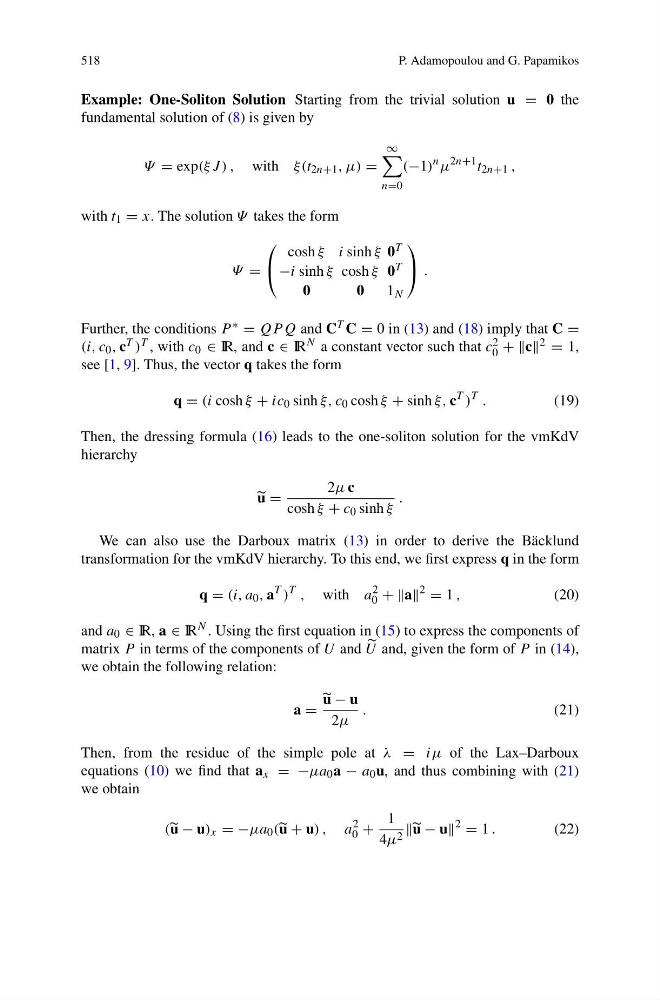
Example: One-Soliton Solution Starting from the trivial solution u = 0 the
fundamental solution of (8) is given by
Ψ = exp(ξJ ) , with ξ(t 2n+1 , μ) =
∞
n=0
(−1)
n μ
2n+1 t 2n+1 ,
with t 1 = x. The solution Ψ takes the form
Ψ =
⎛
⎝
cosh ξ i sinh ξ 0 T
−i sinh ξ cosh ξ 0 T
0
0
1 N
⎞
⎠ .
Further, the conditions P ∗ = QP Q and C T C = 0 in (13) and (18) imply that C =
(i, c 0 , c T ) T , with c 0 ∈ IR, and c ∈ IR
N a constant vector such that c 2
0 + +c 2 = 1,
see [1, 9]. Thus, the vector q takes the form
q = (i cosh ξ + ic 0 sinh ξ, c 0 cosh ξ + sinh ξ, c
T )
T .
(19)
Then, the dressing formula (16) leads to the one-soliton solution for the vmKdV
hierarchy
u =
2μ c
cosh ξ + c 0 sinh ξ
.
We can also use the Darboux matrix (13) in order to derive the Bäcklund
transformation for the vmKdV hierarchy. To this end, we first express q in the form
q = (i, a 0 , a
T )
T , with a
2
0 + +a
2
= 1 ,
(20)
and a 0 ∈ IR, a ∈ IR
N . Using the first equation in (15) to express the components of
matrix P in terms of the components of U and
U and, given the form of P in (14),
we obtain the following relation:
a =
u − u
2μ
.
(21)
Then, from the residue of the simple pole at λ = iμ of the Lax–Darboux
equations (10) we find that a x = −μa 0 a − a 0 u, and thus combining with (21)
we obtain
( u − u) x = −μa 0 ( u + u) , a
2
0 +
1
4μ 2 u − u
2
= 1 .
(22)
P. Adamopoulou and G. Papamikos
Example: One-Soliton Solution Starting from the trivial solution u = 0 the
fundamental solution of (8) is given by
Ψ = exp(ξJ ) , with ξ(t 2n+1 , μ) =
∞
n=0
(−1)
n μ
2n+1 t 2n+1 ,
with t 1 = x. The solution Ψ takes the form
Ψ =
⎛
⎝
cosh ξ i sinh ξ 0 T
−i sinh ξ cosh ξ 0 T
0
0
1 N
⎞
⎠ .
Further, the conditions P ∗ = QP Q and C T C = 0 in (13) and (18) imply that C =
(i, c 0 , c T ) T , with c 0 ∈ IR, and c ∈ IR
N a constant vector such that c 2
0 + +c 2 = 1,
see [1, 9]. Thus, the vector q takes the form
q = (i cosh ξ + ic 0 sinh ξ, c 0 cosh ξ + sinh ξ, c
T )
T .
(19)
Then, the dressing formula (16) leads to the one-soliton solution for the vmKdV
hierarchy
u =
2μ c
cosh ξ + c 0 sinh ξ
.
We can also use the Darboux matrix (13) in order to derive the Bäcklund
transformation for the vmKdV hierarchy. To this end, we first express q in the form
q = (i, a 0 , a
T )
T , with a
2
0 + +a
2
= 1 ,
(20)
and a 0 ∈ IR, a ∈ IR
N . Using the first equation in (15) to express the components of
matrix P in terms of the components of U and
U and, given the form of P in (14),
we obtain the following relation:
a =
u − u
2μ
.
(21)
Then, from the residue of the simple pole at λ = iμ of the Lax–Darboux
equations (10) we find that a x = −μa 0 a − a 0 u, and thus combining with (21)
we obtain
( u − u) x = −μa 0 ( u + u) , a
2
0 +
1
4μ 2 u − u
2
= 1 .
(22)