

Dressing for a Vector Modified KdV Hierarchy
517
3.1 Soliton Solution: Dressing and Bäcklund Transformations
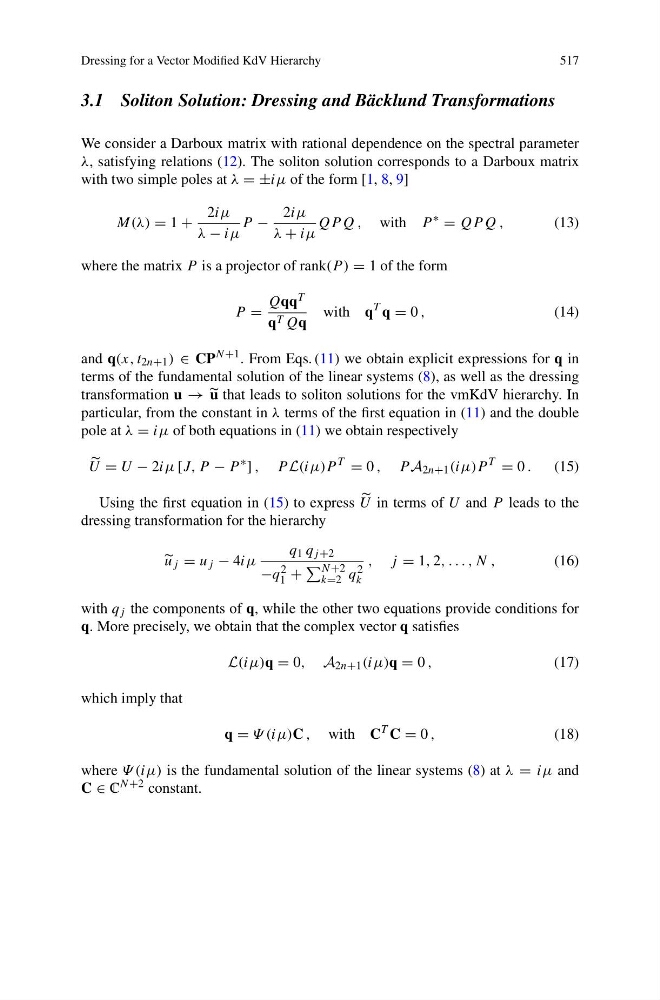
We consider a Darboux matrix with rational dependence on the spectral parameter
λ, satisfying relations (12). The soliton solution corresponds to a Darboux matrix
with two simple poles at λ = ±iμ of the form [1, 8, 9]
M(λ) = 1 +
2iμ
λ − iμ
P −
2iμ
λ + iμ
QP Q , with P
∗
= QP Q ,
(13)
where the matrix P is a projector of rank(P ) = 1 of the form
P =
Qqq T
q T Qq
with q
T q = 0 ,
(14)
and q(x, t 2n+1 ) ∈ CP
N +1 . From Eqs. (11) we obtain explicit expressions for q in
terms of the fundamental solution of the linear systems (8), as well as the dressing
transformation u → u that leads to soliton solutions for the vmKdV hierarchy. In
particular, from the constant in λ terms of the first equation in (11) and the double
pole at λ = iμ of both equations in (11) we obtain respectively
U = U − 2iμ [J, P − P
∗
] , PL(iμ)P
T
= 0 , PA 2n+1 (iμ)P
T
= 0 .
(15)
Using the first equation in (15) to express
U in terms of U and P leads to the
dressing transformation for the hierarchy
u j = u j − 4iμ
q 1 q j +2
−q 2
1 +
N +2
k=2 q 2
k
, j = 1, 2, . . . , N ,
(16)
with q j the components of q, while the other two equations provide conditions for
q. More precisely, we obtain that the complex vector q satisfies
L(iμ)q = 0, A 2n+1 (iμ)q = 0 ,
(17)
which imply that
q = Ψ (iμ)C , with C
T C = 0 ,
(18)
where Ψ (iμ) is the fundamental solution of the linear systems (8) at λ = iμ and
C ∈ C
N +2 constant.
517
3.1 Soliton Solution: Dressing and Bäcklund Transformations
We consider a Darboux matrix with rational dependence on the spectral parameter
λ, satisfying relations (12). The soliton solution corresponds to a Darboux matrix
with two simple poles at λ = ±iμ of the form [1, 8, 9]
M(λ) = 1 +
2iμ
λ − iμ
P −
2iμ
λ + iμ
QP Q , with P
∗
= QP Q ,
(13)
where the matrix P is a projector of rank(P ) = 1 of the form
P =
Qqq T
q T Qq
with q
T q = 0 ,
(14)
and q(x, t 2n+1 ) ∈ CP
N +1 . From Eqs. (11) we obtain explicit expressions for q in
terms of the fundamental solution of the linear systems (8), as well as the dressing
transformation u → u that leads to soliton solutions for the vmKdV hierarchy. In
particular, from the constant in λ terms of the first equation in (11) and the double
pole at λ = iμ of both equations in (11) we obtain respectively
U = U − 2iμ [J, P − P
∗
] , PL(iμ)P
T
= 0 , PA 2n+1 (iμ)P
T
= 0 .
(15)
Using the first equation in (15) to express
U in terms of U and P leads to the
dressing transformation for the hierarchy
u j = u j − 4iμ
q 1 q j +2
−q 2
1 +
N +2
k=2 q 2
k
, j = 1, 2, . . . , N ,
(16)
with q j the components of q, while the other two equations provide conditions for
q. More precisely, we obtain that the complex vector q satisfies
L(iμ)q = 0, A 2n+1 (iμ)q = 0 ,
(17)
which imply that
q = Ψ (iμ)C , with C
T C = 0 ,
(18)
where Ψ (iμ) is the fundamental solution of the linear systems (8) at λ = iμ and
C ∈ C
N +2 constant.