

508
R. Plamondon
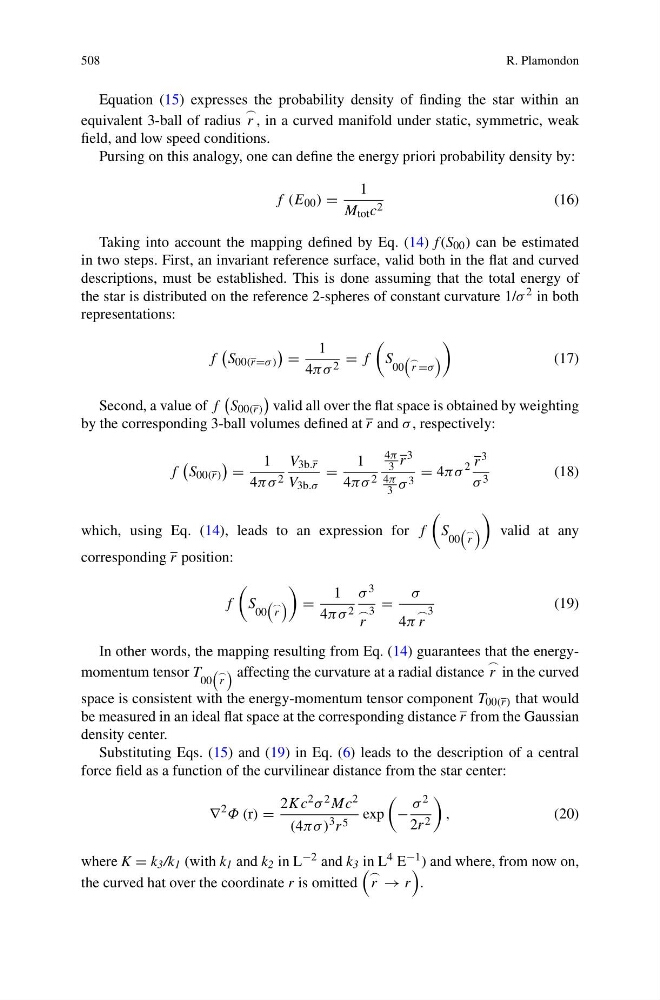
Equation (15) expresses the probability density of finding the star within an
equivalent 3-ball of radius
r , in a curved manifold under static, symmetric, weak
field, and low speed conditions.
Pursing on this analogy, one can define the energy priori probability density by:
f (E 00 ) =
1
M tot c 2
(16)
Taking into account the mapping defined by Eq. (14) f (S 00 ) can be estimated
in two steps. First, an invariant reference surface, valid both in the flat and curved
descriptions, must be established. This is done assuming that the total energy of
the star is distributed on the reference 2-spheres of constant curvature 1/σ 2 in both
representations:
f
S 00(r=σ )
=
1
4πσ 2 = f
S
00
r =σ
(17)
Second, a value of f
S 00(r)
valid all over the flat space is obtained by weighting
by the corresponding 3-ball volumes defined at r and σ , respectively:
f
S 00(r)
=
1
4πσ 2
V 3b.r
V 3b.σ
=
1
4πσ 2
4π
3 r
3
4π
3 σ 3
= 4πσ
2 r
3
σ 3
(18)
which, using Eq. (14), leads to an expression for f
S
00
r
valid at any
corresponding r position:
f
S
00
r
=
1
4πσ 2
σ 3
r
3
=
σ
4π
r
3
(19)
In other words, the mapping resulting from Eq. (14) guarantees that the energymomentum tensor T 00
r
affecting the curvature at a radial distance
r in the curved
space is consistent with the energy-momentum tensor component T 00(r) that would
be measured in an ideal flat space at the corresponding distance r from the Gaussian
density center.
Substituting Eqs. (15) and (19) in Eq. (6) leads to the description of a central
force field as a function of the curvilinear distance from the star center:
∇
2 Φ (r) =
2Kc 2 σ 2 Mc 2
(4πσ )
3 r 5
exp
−
σ 2
2r 2
,
(20)
where K = k 3 /k 1 (with k 1 and k 2 in L −2 and k 3 in L 4 E −1 ) and where, from now on,
the curved hat over the coordinate r is omitted
r → r
.
R. Plamondon
Equation (15) expresses the probability density of finding the star within an
equivalent 3-ball of radius
r , in a curved manifold under static, symmetric, weak
field, and low speed conditions.
Pursing on this analogy, one can define the energy priori probability density by:
f (E 00 ) =
1
M tot c 2
(16)
Taking into account the mapping defined by Eq. (14) f (S 00 ) can be estimated
in two steps. First, an invariant reference surface, valid both in the flat and curved
descriptions, must be established. This is done assuming that the total energy of
the star is distributed on the reference 2-spheres of constant curvature 1/σ 2 in both
representations:
f
S 00(r=σ )
=
1
4πσ 2 = f
S
00
r =σ
(17)
Second, a value of f
S 00(r)
valid all over the flat space is obtained by weighting
by the corresponding 3-ball volumes defined at r and σ , respectively:
f
S 00(r)
=
1
4πσ 2
V 3b.r
V 3b.σ
=
1
4πσ 2
4π
3 r
3
4π
3 σ 3
= 4πσ
2 r
3
σ 3
(18)
which, using Eq. (14), leads to an expression for f
S
00
r
valid at any
corresponding r position:
f
S
00
r
=
1
4πσ 2
σ 3
r
3
=
σ
4π
r
3
(19)
In other words, the mapping resulting from Eq. (14) guarantees that the energymomentum tensor T 00
r
affecting the curvature at a radial distance
r in the curved
space is consistent with the energy-momentum tensor component T 00(r) that would
be measured in an ideal flat space at the corresponding distance r from the Gaussian
density center.
Substituting Eqs. (15) and (19) in Eq. (6) leads to the description of a central
force field as a function of the curvilinear distance from the star center:
∇
2 Φ (r) =
2Kc 2 σ 2 Mc 2
(4πσ )
3 r 5
exp
−
σ 2
2r 2
,
(20)
where K = k 3 /k 1 (with k 1 and k 2 in L −2 and k 3 in L 4 E −1 ) and where, from now on,
the curved hat over the coordinate r is omitted
r → r
.