

What Does the Central Limit Theorem Have to Say About General Relativity?
509
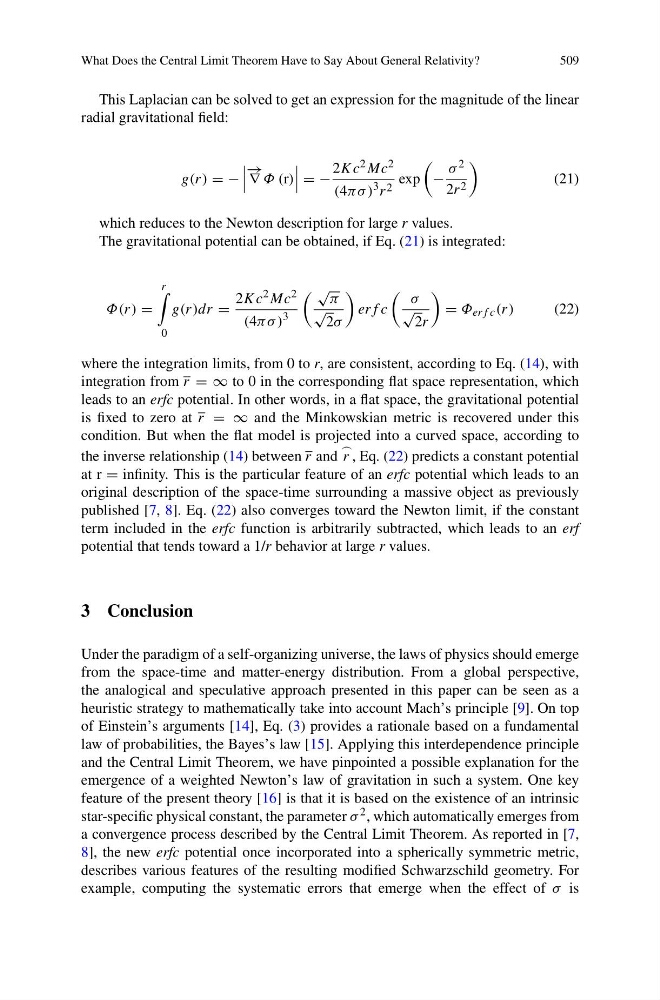
This Laplacian can be solved to get an expression for the magnitude of the linear
radial gravitational field:
g(r) = −
− →
∇ Φ (r)
= −
2Kc 2 Mc 2
(4πσ )
3 r 2
exp
−
σ 2
2r 2
(21)
which reduces to the Newton description for large r values.
The gravitational potential can be obtained, if Eq. (21) is integrated:
Φ(r) =
r
0
g(r)dr =
2Kc 2 Mc 2
(4πσ )
3
√
π
√
2σ
erf c
σ
√
2r
= Φ erf c (r)
(22)
where the integration limits, from 0 to r, are consistent, according to Eq. (14), with
integration from r = ∞ to 0 in the corresponding flat space representation, which
leads to an erfc potential. In other words, in a flat space, the gravitational potential
is fixed to zero at r = ∞ and the Minkowskian metric is recovered under this
condition. But when the flat model is projected into a curved space, according to
the inverse relationship (14) between r and
r , Eq. (22) predicts a constant potential
at r = infinity. This is the particular feature of an erfc potential which leads to an
original description of the space-time surrounding a massive object as previously
published [7, 8]. Eq. (22) also converges toward the Newton limit, if the constant
term included in the erfc function is arbitrarily subtracted, which leads to an erf
potential that tends toward a 1/r behavior at large r values.
3 Conclusion
Under the paradigm of a self-organizing universe, the laws of physics should emerge
from the space-time and matter-energy distribution. From a global perspective,
the analogical and speculative approach presented in this paper can be seen as a
heuristic strategy to mathematically take into account Mach’s principle [9]. On top
of Einstein’s arguments [14], Eq. (3) provides a rationale based on a fundamental
law of probabilities, the Bayes’s law [15]. Applying this interdependence principle
and the Central Limit Theorem, we have pinpointed a possible explanation for the
emergence of a weighted Newton’s law of gravitation in such a system. One key
feature of the present theory [16] is that it is based on the existence of an intrinsic
star-specific physical constant, the parameter σ 2 , which automatically emerges from
a convergence process described by the Central Limit Theorem. As reported in [7,
8], the new erfc potential once incorporated into a spherically symmetric metric,
describes various features of the resulting modified Schwarzschild geometry. For
example, computing the systematic errors that emerge when the effect of σ is
509
This Laplacian can be solved to get an expression for the magnitude of the linear
radial gravitational field:
g(r) = −
− →
∇ Φ (r)
= −
2Kc 2 Mc 2
(4πσ )
3 r 2
exp
−
σ 2
2r 2
(21)
which reduces to the Newton description for large r values.
The gravitational potential can be obtained, if Eq. (21) is integrated:
Φ(r) =
r
0
g(r)dr =
2Kc 2 Mc 2
(4πσ )
3
√
π
√
2σ
erf c
σ
√
2r
= Φ erf c (r)
(22)
where the integration limits, from 0 to r, are consistent, according to Eq. (14), with
integration from r = ∞ to 0 in the corresponding flat space representation, which
leads to an erfc potential. In other words, in a flat space, the gravitational potential
is fixed to zero at r = ∞ and the Minkowskian metric is recovered under this
condition. But when the flat model is projected into a curved space, according to
the inverse relationship (14) between r and
r , Eq. (22) predicts a constant potential
at r = infinity. This is the particular feature of an erfc potential which leads to an
original description of the space-time surrounding a massive object as previously
published [7, 8]. Eq. (22) also converges toward the Newton limit, if the constant
term included in the erfc function is arbitrarily subtracted, which leads to an erf
potential that tends toward a 1/r behavior at large r values.
3 Conclusion
Under the paradigm of a self-organizing universe, the laws of physics should emerge
from the space-time and matter-energy distribution. From a global perspective,
the analogical and speculative approach presented in this paper can be seen as a
heuristic strategy to mathematically take into account Mach’s principle [9]. On top
of Einstein’s arguments [14], Eq. (3) provides a rationale based on a fundamental
law of probabilities, the Bayes’s law [15]. Applying this interdependence principle
and the Central Limit Theorem, we have pinpointed a possible explanation for the
emergence of a weighted Newton’s law of gravitation in such a system. One key
feature of the present theory [16] is that it is based on the existence of an intrinsic
star-specific physical constant, the parameter σ 2 , which automatically emerges from
a convergence process described by the Central Limit Theorem. As reported in [7,
8], the new erfc potential once incorporated into a spherically symmetric metric,
describes various features of the resulting modified Schwarzschild geometry. For
example, computing the systematic errors that emerge when the effect of σ is