

What Does the Central Limit Theorem Have to Say About General Relativity?
507
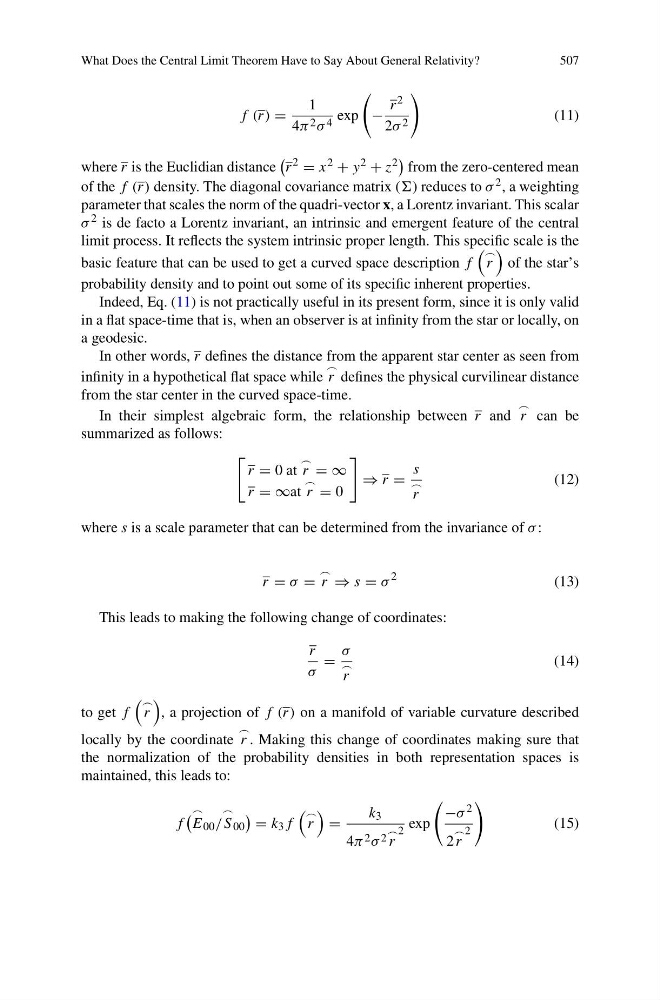
f (r) =
1
4π 2 σ 4 exp
−
r
2
2σ 2
(11)
where r is the Euclidian distance
r
2
= x 2 + y 2 + z 2
from the zero-centered mean
of the f (r) density. The diagonal covariance matrix () reduces to σ 2 , a weighting
parameter that scales the norm of the quadri-vector x, a Lorentz invariant. This scalar
σ 2 is de facto a Lorentz invariant, an intrinsic and emergent feature of the central
limit process. It reflects the system intrinsic proper length. This specific scale is the
basic feature that can be used to get a curved space description f
r
of the star’s
probability density and to point out some of its specific inherent properties.
Indeed, Eq. (11) is not practically useful in its present form, since it is only valid
in a flat space-time that is, when an observer is at infinity from the star or locally, on
a geodesic.
In other words, r defines the distance from the apparent star center as seen from
infinity in a hypothetical flat space while
r defines the physical curvilinear distance
from the star center in the curved space-time.
In their simplest algebraic form, the relationship between r and
r can be
summarized as follows:
r = 0 at
r = ∞
r = ∞at
r = 0
⇒ r =
s
r
(12)
where s is a scale parameter that can be determined from the invariance of σ :
r = σ =
r ⇒ s = σ
2
(13)
This leads to making the following change of coordinates:
r
σ
=
σ
r
(14)
to get f
r
, a projection of f (r) on a manifold of variable curvature described
locally by the coordinate
r . Making this change of coordinates making sure that
the normalization of the probability densities in both representation spaces is
maintained, this leads to:
f
E 00 /
S 00
= k 3 f
r
=
k 3
4π 2 σ 2
r
2
exp
−σ 2
2
r
2
(15)
507
f (r) =
1
4π 2 σ 4 exp
−
r
2
2σ 2
(11)
where r is the Euclidian distance
r
2
= x 2 + y 2 + z 2
from the zero-centered mean
of the f (r) density. The diagonal covariance matrix () reduces to σ 2 , a weighting
parameter that scales the norm of the quadri-vector x, a Lorentz invariant. This scalar
σ 2 is de facto a Lorentz invariant, an intrinsic and emergent feature of the central
limit process. It reflects the system intrinsic proper length. This specific scale is the
basic feature that can be used to get a curved space description f
r
of the star’s
probability density and to point out some of its specific inherent properties.
Indeed, Eq. (11) is not practically useful in its present form, since it is only valid
in a flat space-time that is, when an observer is at infinity from the star or locally, on
a geodesic.
In other words, r defines the distance from the apparent star center as seen from
infinity in a hypothetical flat space while
r defines the physical curvilinear distance
from the star center in the curved space-time.
In their simplest algebraic form, the relationship between r and
r can be
summarized as follows:
r = 0 at
r = ∞
r = ∞at
r = 0
⇒ r =
s
r
(12)
where s is a scale parameter that can be determined from the invariance of σ :
r = σ =
r ⇒ s = σ
2
(13)
This leads to making the following change of coordinates:
r
σ
=
σ
r
(14)
to get f
r
, a projection of f (r) on a manifold of variable curvature described
locally by the coordinate
r . Making this change of coordinates making sure that
the normalization of the probability densities in both representation spaces is
maintained, this leads to:
f
E 00 /
S 00
= k 3 f
r
=
k 3
4π 2 σ 2
r
2
exp
−σ 2
2
r
2
(15)