

506
R. Plamondon
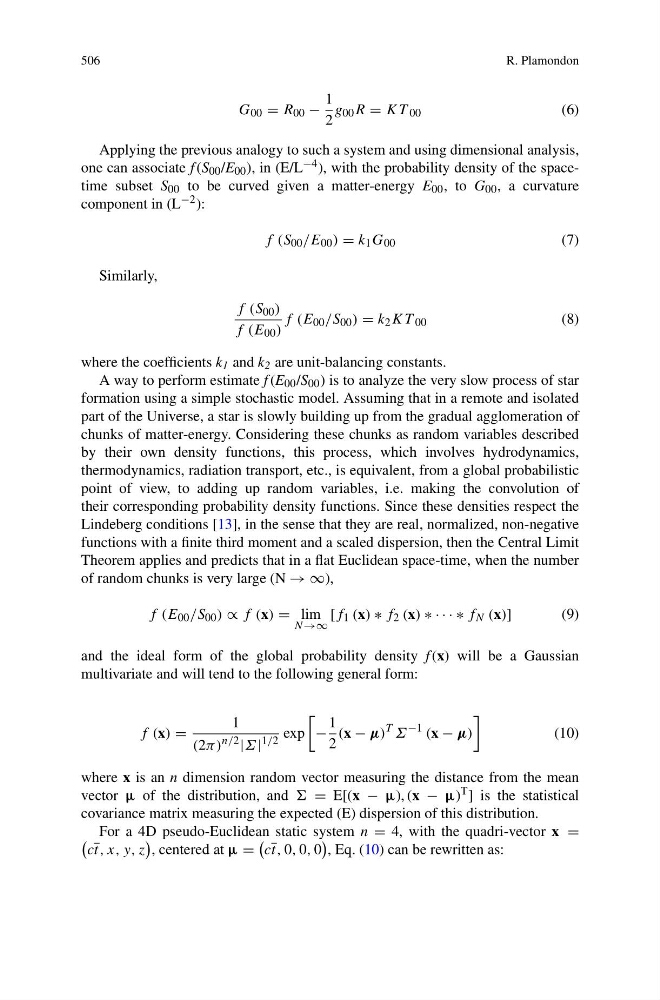
G 00 = R 00 −
1
2
g 00 R = KT 00
(6)
Applying the previous analogy to such a system and using dimensional analysis,
one can associate f (S 00 /E 00 ), in (E/L −4 ), with the probability density of the spacetime subset S 00 to be curved given a matter-energy E 00 , to G 00 , a curvature
component in (L −2 ):
f (S 00 /E 00 ) = k 1 G 00
(7)
Similarly,
f (S 00 )
f (E 00 )
f (E 00 /S 00 ) = k 2 KT 00
(8)
where the coefficients k 1 and k 2 are unit-balancing constants.
A way to perform estimate f (E 00 /S 00 ) is to analyze the very slow process of star
formation using a simple stochastic model. Assuming that in a remote and isolated
part of the Universe, a star is slowly building up from the gradual agglomeration of
chunks of matter-energy. Considering these chunks as random variables described
by their own density functions, this process, which involves hydrodynamics,
thermodynamics, radiation transport, etc., is equivalent, from a global probabilistic
point of view, to adding up random variables, i.e. making the convolution of
their corresponding probability density functions. Since these densities respect the
Lindeberg conditions [13], in the sense that they are real, normalized, non-negative
functions with a finite third moment and a scaled dispersion, then the Central Limit
Theorem applies and predicts that in a flat Euclidean space-time, when the number
of random chunks is very large (N → ∞),
f (E 00 /S 00 ) ∝ f (x) = lim
N →∞
[f 1 (x) ∗ f 2 (x) ∗ · · · ∗ f N (x)]
(9)
and the ideal form of the global probability density f (x) will be a Gaussian
multivariate and will tend to the following general form:
f (x) =
1
(2π )
n/2 |Σ| 1/2 exp
−
1
2
(x − μ)
T Σ
−1 (x − μ)
(10)
where x is an n dimension random vector measuring the distance from the mean
vector μ of the distribution, and = E[(x − μ), (x − μ) T ] is the statistical
covariance matrix measuring the expected (E) dispersion of this distribution.
For a 4D pseudo-Euclidean static system n = 4, with the quadri-vector x =
ct, x, y, z
, centered at μ =
ct, 0, 0, 0
, Eq. (10) can be rewritten as:
R. Plamondon
G 00 = R 00 −
1
2
g 00 R = KT 00
(6)
Applying the previous analogy to such a system and using dimensional analysis,
one can associate f (S 00 /E 00 ), in (E/L −4 ), with the probability density of the spacetime subset S 00 to be curved given a matter-energy E 00 , to G 00 , a curvature
component in (L −2 ):
f (S 00 /E 00 ) = k 1 G 00
(7)
Similarly,
f (S 00 )
f (E 00 )
f (E 00 /S 00 ) = k 2 KT 00
(8)
where the coefficients k 1 and k 2 are unit-balancing constants.
A way to perform estimate f (E 00 /S 00 ) is to analyze the very slow process of star
formation using a simple stochastic model. Assuming that in a remote and isolated
part of the Universe, a star is slowly building up from the gradual agglomeration of
chunks of matter-energy. Considering these chunks as random variables described
by their own density functions, this process, which involves hydrodynamics,
thermodynamics, radiation transport, etc., is equivalent, from a global probabilistic
point of view, to adding up random variables, i.e. making the convolution of
their corresponding probability density functions. Since these densities respect the
Lindeberg conditions [13], in the sense that they are real, normalized, non-negative
functions with a finite third moment and a scaled dispersion, then the Central Limit
Theorem applies and predicts that in a flat Euclidean space-time, when the number
of random chunks is very large (N → ∞),
f (E 00 /S 00 ) ∝ f (x) = lim
N →∞
[f 1 (x) ∗ f 2 (x) ∗ · · · ∗ f N (x)]
(9)
and the ideal form of the global probability density f (x) will be a Gaussian
multivariate and will tend to the following general form:
f (x) =
1
(2π )
n/2 |Σ| 1/2 exp
−
1
2
(x − μ)
T Σ
−1 (x − μ)
(10)
where x is an n dimension random vector measuring the distance from the mean
vector μ of the distribution, and = E[(x − μ), (x − μ) T ] is the statistical
covariance matrix measuring the expected (E) dispersion of this distribution.
For a 4D pseudo-Euclidean static system n = 4, with the quadri-vector x =
ct, x, y, z
, centered at μ =
ct, 0, 0, 0
, Eq. (10) can be rewritten as: