

What Does the Central Limit Theorem Have to Say About General Relativity?
505
“Space-time curvature (S) and energy-momentum (E) are two inextricable
descriptive approaches to define the physically observable probabilistic universe
(U); they must be mutually exploited to describe any subset U i of this universe. The
probability of observing and describing a given subset of the universe P(U i ), i.e.
the joint probability P(S i ,E i ), can be studied from two equivalent methods: either
by analyzing the curvature of space-time S i after hypothesizing a given energymomentum E i or by analyzing the energy-momentum E i under the hypothesis of
a given space-time curvature S i . In terms of conditional probabilities, this leads to
two equivalent descriptions:
P (U i ) = P (S i , E i ) = P (S i /E i ) P (E i ) = P (E i /S i ) P (S i )
(2)
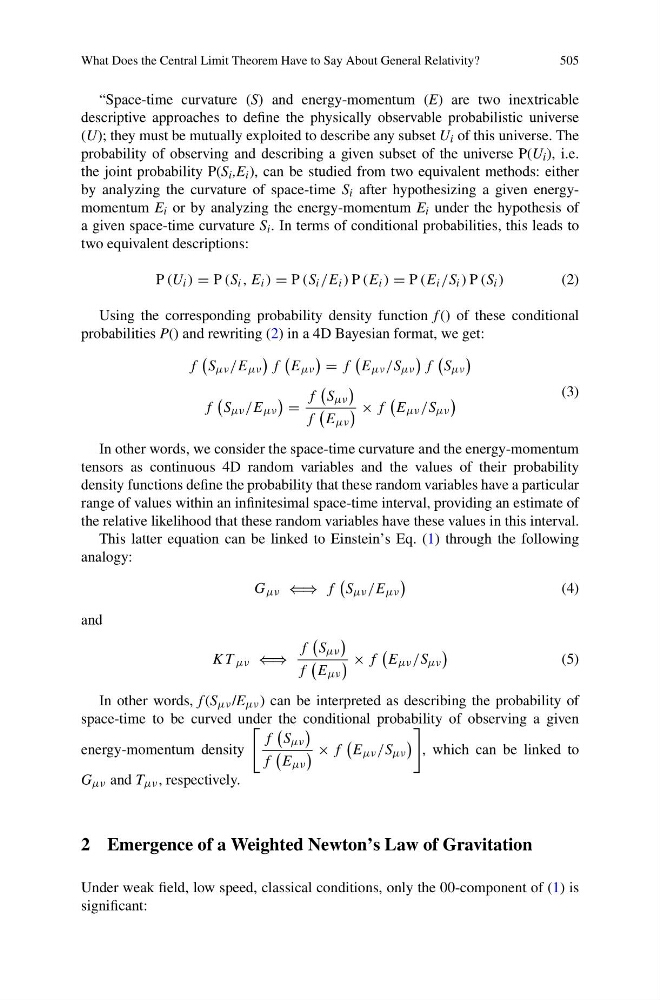
Using the corresponding probability density function f () of these conditional
probabilities P() and rewriting (2) in a 4D Bayesian format, we get:
f
S μν /E μν
f
E μν
= f
E μν /S μν
f
S μν
f
S μν /E μν
=
f
S μν
f
E μν
× f
E μν /S μν
(3)
In other words, we consider the space-time curvature and the energy-momentum
tensors as continuous 4D random variables and the values of their probability
density functions define the probability that these random variables have a particular
range of values within an infinitesimal space-time interval, providing an estimate of
the relative likelihood that these random variables have these values in this interval.
This latter equation can be linked to Einstein’s Eq. (1) through the following
analogy:
G μν ⇐⇒ f
S μν /E μν
(4)
and
KT μν ⇐⇒
f
S μν
f
E μν
× f
E μν /S μν
(5)
In other words, f (S μν /E μν ) can be interpreted as describing the probability of
space-time to be curved under the conditional probability of observing a given
energy-momentum density
f
S μν
f
E μν
× f
E μν /S μν
, which can be linked to
G μν and T μν , respectively.
2 Emergence of a Weighted Newton’s Law of Gravitation
Under weak field, low speed, classical conditions, only the 00-component of (1) is
significant:
505
“Space-time curvature (S) and energy-momentum (E) are two inextricable
descriptive approaches to define the physically observable probabilistic universe
(U); they must be mutually exploited to describe any subset U i of this universe. The
probability of observing and describing a given subset of the universe P(U i ), i.e.
the joint probability P(S i ,E i ), can be studied from two equivalent methods: either
by analyzing the curvature of space-time S i after hypothesizing a given energymomentum E i or by analyzing the energy-momentum E i under the hypothesis of
a given space-time curvature S i . In terms of conditional probabilities, this leads to
two equivalent descriptions:
P (U i ) = P (S i , E i ) = P (S i /E i ) P (E i ) = P (E i /S i ) P (S i )
(2)
Using the corresponding probability density function f () of these conditional
probabilities P() and rewriting (2) in a 4D Bayesian format, we get:
f
S μν /E μν
f
E μν
= f
E μν /S μν
f
S μν
f
S μν /E μν
=
f
S μν
f
E μν
× f
E μν /S μν
(3)
In other words, we consider the space-time curvature and the energy-momentum
tensors as continuous 4D random variables and the values of their probability
density functions define the probability that these random variables have a particular
range of values within an infinitesimal space-time interval, providing an estimate of
the relative likelihood that these random variables have these values in this interval.
This latter equation can be linked to Einstein’s Eq. (1) through the following
analogy:
G μν ⇐⇒ f
S μν /E μν
(4)
and
KT μν ⇐⇒
f
S μν
f
E μν
× f
E μν /S μν
(5)
In other words, f (S μν /E μν ) can be interpreted as describing the probability of
space-time to be curved under the conditional probability of observing a given
energy-momentum density
f
S μν
f
E μν
× f
E μν /S μν
, which can be linked to
G μν and T μν , respectively.
2 Emergence of a Weighted Newton’s Law of Gravitation
Under weak field, low speed, classical conditions, only the 00-component of (1) is
significant: