

484
R. MacKenzie et al.
can equivalently be seen to arise as a two-loop correction to the self-energy of the
fermion [26]. Using f this one can compute the exchange energy E xc , as
E xc =
±s
±s
d 3 p
(2π) 3
d 3 p
(2π) 3 f (ps, p
s
)n(p, s)n(p
, s
)
(2)
and the effective quasi-particle energy is the kinetic energy of the quasi-particles
with renormalised mass parameter E kin plus the spin-dependent exchange energy in
a spin-polarised background. For this purpose it is necessary to calculate the selfenergy with a Feynman propagator in the presence of non-zero number density, and
spin imbalance [27].
To set up a spin-asymmetric state, we introduce a parameter ζ such that the net
density n splits up into densities of spin up and down fermions as
n ↑ = n(1 + ζ ) and n ↓ = n(1 − ζ )
(3)
Correspondingly, we have Fermi momenta p F ↑ = p F (1+ζ ) 1/3 and p F ↓ = p F (1−
ζ ) 1/3 , with p 3
F = 3π 2 n. The exchange energy was calculated in [27] and the final
expression is too long to be quoted in this presentation. However the leading order
expansions in β = p F /m for the fully polarised case ζ = 1 is [11]
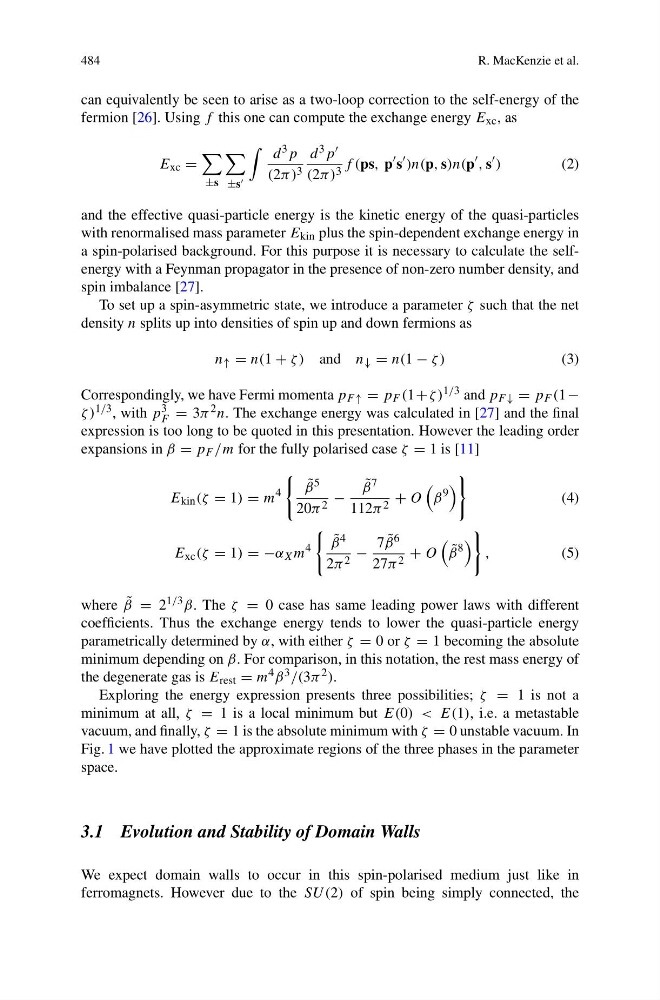
E kin (ζ = 1) = m
4
˜
β 5
20π 2 −
˜
β 7
112π 2 + O
β
9
(4)
E xc (ζ = 1) = −α X m
4
˜
β 4
2π 2 −
7 ˜
β 6
27π 2 + O
˜
β
8
,
(5)
where ˜
β = 2 1/3 β. The ζ = 0 case has same leading power laws with different
coefficients. Thus the exchange energy tends to lower the quasi-particle energy
parametrically determined by α, with either ζ = 0 or ζ = 1 becoming the absolute
minimum depending on β. For comparison, in this notation, the rest mass energy of
the degenerate gas is E rest = m 4 β 3 /(3π 2 ).
Exploring the energy expression presents three possibilities; ζ = 1 is not a
minimum at all, ζ = 1 is a local minimum but E(0) < E(1), i.e. a metastable
vacuum, and finally, ζ = 1 is the absolute minimum with ζ = 0 unstable vacuum. In
Fig. 1 we have plotted the approximate regions of the three phases in the parameter
space.
3.1 Evolution and Stability of Domain Walls
We expect domain walls to occur in this spin-polarised medium just like in
ferromagnets. However due to the SU (2) of spin being simply connected, the
R. MacKenzie et al.
can equivalently be seen to arise as a two-loop correction to the self-energy of the
fermion [26]. Using f this one can compute the exchange energy E xc , as
E xc =
±s
±s
d 3 p
(2π) 3
d 3 p
(2π) 3 f (ps, p
s
)n(p, s)n(p
, s
)
(2)
and the effective quasi-particle energy is the kinetic energy of the quasi-particles
with renormalised mass parameter E kin plus the spin-dependent exchange energy in
a spin-polarised background. For this purpose it is necessary to calculate the selfenergy with a Feynman propagator in the presence of non-zero number density, and
spin imbalance [27].
To set up a spin-asymmetric state, we introduce a parameter ζ such that the net
density n splits up into densities of spin up and down fermions as
n ↑ = n(1 + ζ ) and n ↓ = n(1 − ζ )
(3)
Correspondingly, we have Fermi momenta p F ↑ = p F (1+ζ ) 1/3 and p F ↓ = p F (1−
ζ ) 1/3 , with p 3
F = 3π 2 n. The exchange energy was calculated in [27] and the final
expression is too long to be quoted in this presentation. However the leading order
expansions in β = p F /m for the fully polarised case ζ = 1 is [11]
E kin (ζ = 1) = m
4
˜
β 5
20π 2 −
˜
β 7
112π 2 + O
β
9
(4)
E xc (ζ = 1) = −α X m
4
˜
β 4
2π 2 −
7 ˜
β 6
27π 2 + O
˜
β
8
,
(5)
where ˜
β = 2 1/3 β. The ζ = 0 case has same leading power laws with different
coefficients. Thus the exchange energy tends to lower the quasi-particle energy
parametrically determined by α, with either ζ = 0 or ζ = 1 becoming the absolute
minimum depending on β. For comparison, in this notation, the rest mass energy of
the degenerate gas is E rest = m 4 β 3 /(3π 2 ).
Exploring the energy expression presents three possibilities; ζ = 1 is not a
minimum at all, ζ = 1 is a local minimum but E(0) < E(1), i.e. a metastable
vacuum, and finally, ζ = 1 is the absolute minimum with ζ = 0 unstable vacuum. In
Fig. 1 we have plotted the approximate regions of the three phases in the parameter
space.
3.1 Evolution and Stability of Domain Walls
We expect domain walls to occur in this spin-polarised medium just like in
ferromagnets. However due to the SU (2) of spin being simply connected, the