

Ferromagnetic Instability in PAAI in the Sky
485
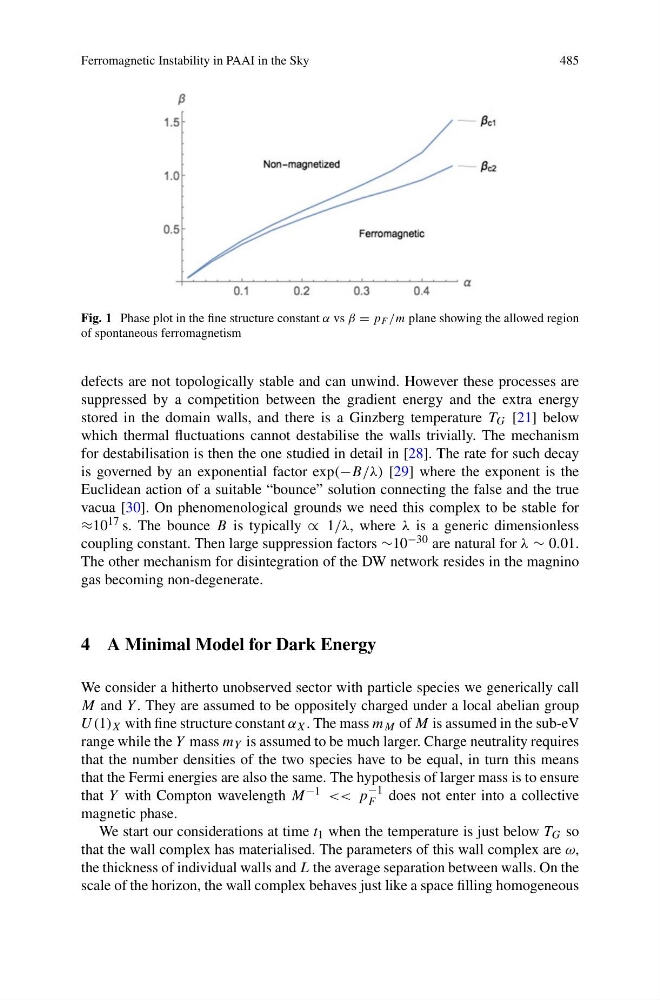
Fig. 1 Phase plot in the fine structure constant α vs β = p F /m plane showing the allowed region
of spontaneous ferromagnetism
defects are not topologically stable and can unwind. However these processes are
suppressed by a competition between the gradient energy and the extra energy
stored in the domain walls, and there is a Ginzberg temperature T G [21] below
which thermal fluctuations cannot destabilise the walls trivially. The mechanism
for destabilisation is then the one studied in detail in [28]. The rate for such decay
is governed by an exponential factor exp(−B/λ) [29] where the exponent is the
Euclidean action of a suitable “bounce” solution connecting the false and the true
vacua [30]. On phenomenological grounds we need this complex to be stable for
≈10 17 s. The bounce B is typically ∝ 1/λ, where λ is a generic dimensionless
coupling constant. Then large suppression factors ∼10 −30 are natural for λ ∼ 0.01.
The other mechanism for disintegration of the DW network resides in the magnino
gas becoming non-degenerate.
4 A Minimal Model for Dark Energy
We consider a hitherto unobserved sector with particle species we generically call
M and Y . They are assumed to be oppositely charged under a local abelian group
U(1) X with fine structure constant α X . The mass m M of M is assumed in the sub-eV
range while the Y mass m Y is assumed to be much larger. Charge neutrality requires
that the number densities of the two species have to be equal, in turn this means
that the Fermi energies are also the same. The hypothesis of larger mass is to ensure
that Y with Compton wavelength M −1 << p
−1
F does not enter into a collective
magnetic phase.
We start our considerations at time t 1 when the temperature is just below T G so
that the wall complex has materialised. The parameters of this wall complex are ω,
the thickness of individual walls and L the average separation between walls. On the
scale of the horizon, the wall complex behaves just like a space filling homogeneous
485
Fig. 1 Phase plot in the fine structure constant α vs β = p F /m plane showing the allowed region
of spontaneous ferromagnetism
defects are not topologically stable and can unwind. However these processes are
suppressed by a competition between the gradient energy and the extra energy
stored in the domain walls, and there is a Ginzberg temperature T G [21] below
which thermal fluctuations cannot destabilise the walls trivially. The mechanism
for destabilisation is then the one studied in detail in [28]. The rate for such decay
is governed by an exponential factor exp(−B/λ) [29] where the exponent is the
Euclidean action of a suitable “bounce” solution connecting the false and the true
vacua [30]. On phenomenological grounds we need this complex to be stable for
≈10 17 s. The bounce B is typically ∝ 1/λ, where λ is a generic dimensionless
coupling constant. Then large suppression factors ∼10 −30 are natural for λ ∼ 0.01.
The other mechanism for disintegration of the DW network resides in the magnino
gas becoming non-degenerate.
4 A Minimal Model for Dark Energy
We consider a hitherto unobserved sector with particle species we generically call
M and Y . They are assumed to be oppositely charged under a local abelian group
U(1) X with fine structure constant α X . The mass m M of M is assumed in the sub-eV
range while the Y mass m Y is assumed to be much larger. Charge neutrality requires
that the number densities of the two species have to be equal, in turn this means
that the Fermi energies are also the same. The hypothesis of larger mass is to ensure
that Y with Compton wavelength M −1 << p
−1
F does not enter into a collective
magnetic phase.
We start our considerations at time t 1 when the temperature is just below T G so
that the wall complex has materialised. The parameters of this wall complex are ω,
the thickness of individual walls and L the average separation between walls. On the
scale of the horizon, the wall complex behaves just like a space filling homogeneous