

Ferromagnetic Instability in PAAI in the Sky
483
the DM discussion we refer the reader to our longer paper [11]. In Sect. 5 we obtain
a restriction on the length scale of the domains for successful explanation of origin
of cosmic magnetic fields from mixing with standard electromagnetism. After the
conclusion in Sect. 6 we also include a few salient questions from the audience and
their answers in Sect. 7.
2 Cosmic Relics and the Origin of Negative Pressure
A homogeneous, isotropic universe is described by the Friedmann equation for the
scale factor a(t) supplemented by an equation of state relation p = wρ. Extended
relativistic objects in gauge theories in the cosmological setting [21] are known to
lead to negative values for w [22, 23]. A heuristic argument runs as follows. In
the case of a frozen-out vortex line network, the average separation between string
segments scales as 1/a 3 but there is also an increment in the energy proportional to
a due to an average length of vortex network proportional to a entering the physical
volume. As such, the energy density of the network has to be taken to scale as 1/a 2 ,
and we get the effective value w = −1/3. Likewise, for a domain wall complex, the
effective energy density scales as 1/a and w = −2/3. By extension, for a relativistic
substance filling up space homogeneously, the energy density is independent of
the scale factor, and has w = −1. In quantum theory this arises naturally as the
vacuum expectation value of a relativistic scalar field. In the following, we consider
a scenario that gives rise to a complex of domain walls whose separation scale is
extremely small compared to the causal horizon and which remains fixed during
expansion, and hence simulates an equation of state p = −ρ.
3 Ferromagnetic Instability of PAAI
A system of fermions can be treated as a gas of weakly interacting quasi-particles
in the presence of oppositely charged much heavier ions or protons which are
mostly spectators and serve to keep the medium neutral. The total energy of such
a system can be treated as a functional of electron number density, according to
the Hohenberg–Kohn theorem. In a relativistic setting, it becomes a functional of
the covariant 4-current, and hence also of the electron spin density [24]. In the
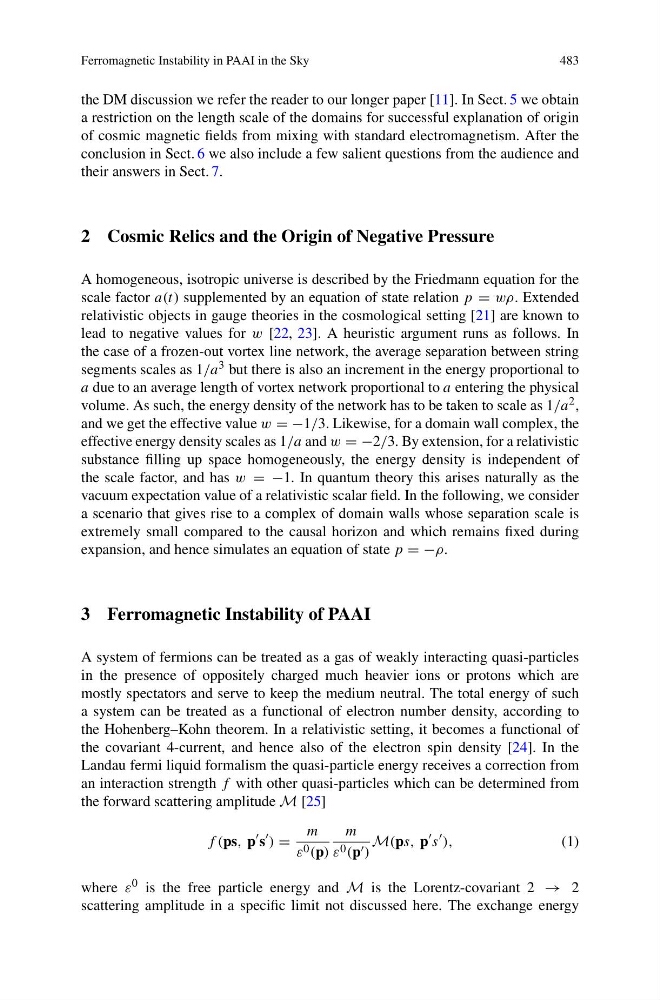
Landau fermi liquid formalism the quasi-particle energy receives a correction from
an interaction strength f with other quasi-particles which can be determined from
the forward scattering amplitude M [25]
f (ps, p
s
) =
m
ε 0 (p)
m
ε 0 (p )
M(ps, p
s
),
(1)
where ε 0 is the free particle energy and M is the Lorentz-covariant 2 → 2
scattering amplitude in a specific limit not discussed here. The exchange energy
483
the DM discussion we refer the reader to our longer paper [11]. In Sect. 5 we obtain
a restriction on the length scale of the domains for successful explanation of origin
of cosmic magnetic fields from mixing with standard electromagnetism. After the
conclusion in Sect. 6 we also include a few salient questions from the audience and
their answers in Sect. 7.
2 Cosmic Relics and the Origin of Negative Pressure
A homogeneous, isotropic universe is described by the Friedmann equation for the
scale factor a(t) supplemented by an equation of state relation p = wρ. Extended
relativistic objects in gauge theories in the cosmological setting [21] are known to
lead to negative values for w [22, 23]. A heuristic argument runs as follows. In
the case of a frozen-out vortex line network, the average separation between string
segments scales as 1/a 3 but there is also an increment in the energy proportional to
a due to an average length of vortex network proportional to a entering the physical
volume. As such, the energy density of the network has to be taken to scale as 1/a 2 ,
and we get the effective value w = −1/3. Likewise, for a domain wall complex, the
effective energy density scales as 1/a and w = −2/3. By extension, for a relativistic
substance filling up space homogeneously, the energy density is independent of
the scale factor, and has w = −1. In quantum theory this arises naturally as the
vacuum expectation value of a relativistic scalar field. In the following, we consider
a scenario that gives rise to a complex of domain walls whose separation scale is
extremely small compared to the causal horizon and which remains fixed during
expansion, and hence simulates an equation of state p = −ρ.
3 Ferromagnetic Instability of PAAI
A system of fermions can be treated as a gas of weakly interacting quasi-particles
in the presence of oppositely charged much heavier ions or protons which are
mostly spectators and serve to keep the medium neutral. The total energy of such
a system can be treated as a functional of electron number density, according to
the Hohenberg–Kohn theorem. In a relativistic setting, it becomes a functional of
the covariant 4-current, and hence also of the electron spin density [24]. In the
Landau fermi liquid formalism the quasi-particle energy receives a correction from
an interaction strength f with other quasi-particles which can be determined from
the forward scattering amplitude M [25]
f (ps, p
s
) =
m
ε 0 (p)
m
ε 0 (p )
M(ps, p
s
),
(1)
where ε 0 is the free particle energy and M is the Lorentz-covariant 2 → 2
scattering amplitude in a specific limit not discussed here. The exchange energy