

Unified Superfluid Dark Sector
443
0
2
4
6
8
10
12
14
0.0
0.2
0.4
0.6
0.8
1.0
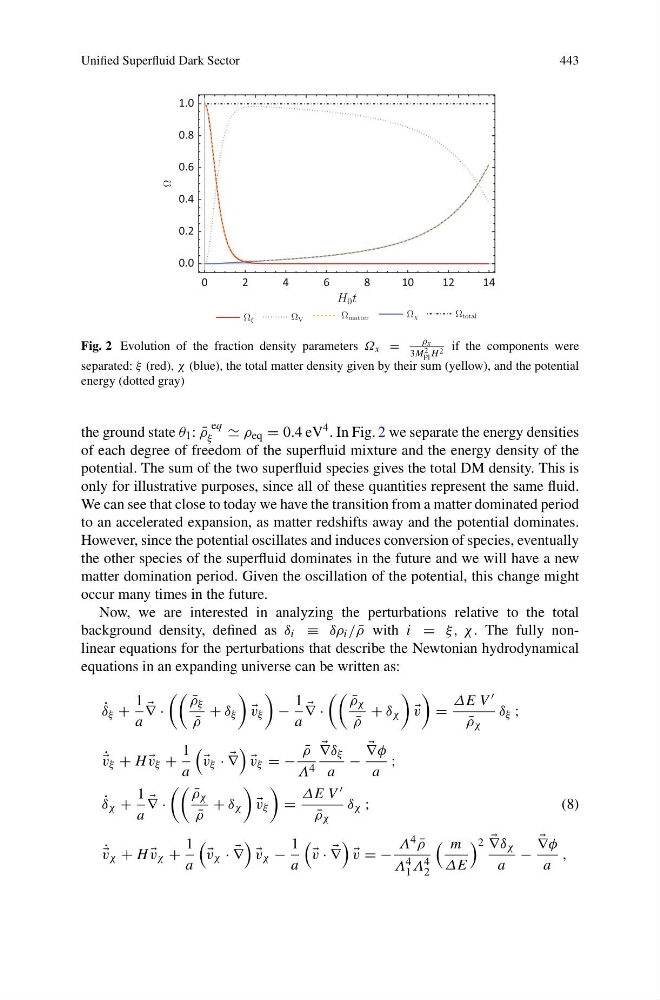
Fig. 2 Evolution of the fraction density parameters Ω x =
ρx
3M 2
Pl H 2 if the components were
separated: ξ (red), χ (blue), the total matter density given by their sum (yellow), and the potential
energy (dotted gray)
the ground state θ 1 : ¯
ρ
eq
ξ ρ eq = 0.4 eV
4 . In Fig. 2 we separate the energy densities
of each degree of freedom of the superfluid mixture and the energy density of the
potential. The sum of the two superfluid species gives the total DM density. This is
only for illustrative purposes, since all of these quantities represent the same fluid.
We can see that close to today we have the transition from a matter dominated period
to an accelerated expansion, as matter redshifts away and the potential dominates.
However, since the potential oscillates and induces conversion of species, eventually
the other species of the superfluid dominates in the future and we will have a new
matter domination period. Given the oscillation of the potential, this change might
occur many times in the future.
Now, we are interested in analyzing the perturbations relative to the total
background density, defined as δ i ≡ δρ i / ¯
ρ with i = ξ, χ. The fully nonlinear equations for the perturbations that describe the Newtonian hydrodynamical
equations in an expanding universe can be written as:
˙
δ ξ +
1
a
∇ ·
¯
ρ ξ
¯
ρ
+ δ ξ
v ξ
−
1
a
∇ ·
¯
ρ χ
¯
ρ
+ δ χ
v
=
ΔE V
¯
ρ χ
δ ξ ;
˙
v ξ + H
v ξ +
1
a
v ξ ·
∇
v ξ = −
¯
ρ
Λ 4
∇δ ξ
a
−
∇φ
a
;
˙
δ χ +
1
a
∇ ·
¯
ρ χ
¯
ρ
+ δ χ
v ξ
=
ΔE V
¯
ρ χ
δ χ ;
(8)
˙
v χ + H
v χ +
1
a
v χ ·
∇
v χ −
1
a
v ·
∇
v = −
Λ 4 ¯
ρ
Λ 4
1 Λ 4
2
m
ΔE
2
∇δ χ
a
−
∇φ
a
,
443
0
2
4
6
8
10
12
14
0.0
0.2
0.4
0.6
0.8
1.0
Fig. 2 Evolution of the fraction density parameters Ω x =
ρx
3M 2
Pl H 2 if the components were
separated: ξ (red), χ (blue), the total matter density given by their sum (yellow), and the potential
energy (dotted gray)
the ground state θ 1 : ¯
ρ
eq
ξ ρ eq = 0.4 eV
4 . In Fig. 2 we separate the energy densities
of each degree of freedom of the superfluid mixture and the energy density of the
potential. The sum of the two superfluid species gives the total DM density. This is
only for illustrative purposes, since all of these quantities represent the same fluid.
We can see that close to today we have the transition from a matter dominated period
to an accelerated expansion, as matter redshifts away and the potential dominates.
However, since the potential oscillates and induces conversion of species, eventually
the other species of the superfluid dominates in the future and we will have a new
matter domination period. Given the oscillation of the potential, this change might
occur many times in the future.
Now, we are interested in analyzing the perturbations relative to the total
background density, defined as δ i ≡ δρ i / ¯
ρ with i = ξ, χ. The fully nonlinear equations for the perturbations that describe the Newtonian hydrodynamical
equations in an expanding universe can be written as:
˙
δ ξ +
1
a
∇ ·
¯
ρ ξ
¯
ρ
+ δ ξ
v ξ
−
1
a
∇ ·
¯
ρ χ
¯
ρ
+ δ χ
v
=
ΔE V
¯
ρ χ
δ ξ ;
˙
v ξ + H
v ξ +
1
a
v ξ ·
∇
v ξ = −
¯
ρ
Λ 4
∇δ ξ
a
−
∇φ
a
;
˙
δ χ +
1
a
∇ ·
¯
ρ χ
¯
ρ
+ δ χ
v ξ
=
ΔE V
¯
ρ χ
δ χ ;
(8)
˙
v χ + H
v χ +
1
a
v χ ·
∇
v χ −
1
a
v ·
∇
v = −
Λ 4 ¯
ρ
Λ 4
1 Λ 4
2
m
ΔE
2
∇δ χ
a
−
∇φ
a
,