

444
E. G. M. Ferreira
where the velocities are given by
v i (
l/a(t), t) = =
u i − H
l, with u ξ = −
∇ξ/Λ 2 and
v χ = −(Λ 2 /Λ 2
1 Λ 2
2 )(m/ΔE)
∇χ , plus Poisson’s equation,
∇ 2 Φ =
a 2
2M 2
Pl
¯
ρ δ.
We can simplify these equations by taking the linear regime, where δ i and v i
are small. We can also ignore the spatial gradients, since both c s,i λ1. We can then
combine the above equations into the equation for the density perturbations:
¨
δ +
2H −
ΔE V
¯
ρ
˙
δ =
1
2M 2
Pl
¯
ρ δ +
ΔE V
¯
ρ
5H +
ΔE V
¯
ρ
δ,
(9)
The total velocity evolves as ˙
v + H
v 0, which redshifts as 1/a.
5 Observational Signatures
Although our model has an evolution that is very close way to ΛCDM, it predicts
distinct observational implications. We cite some of those in this section.
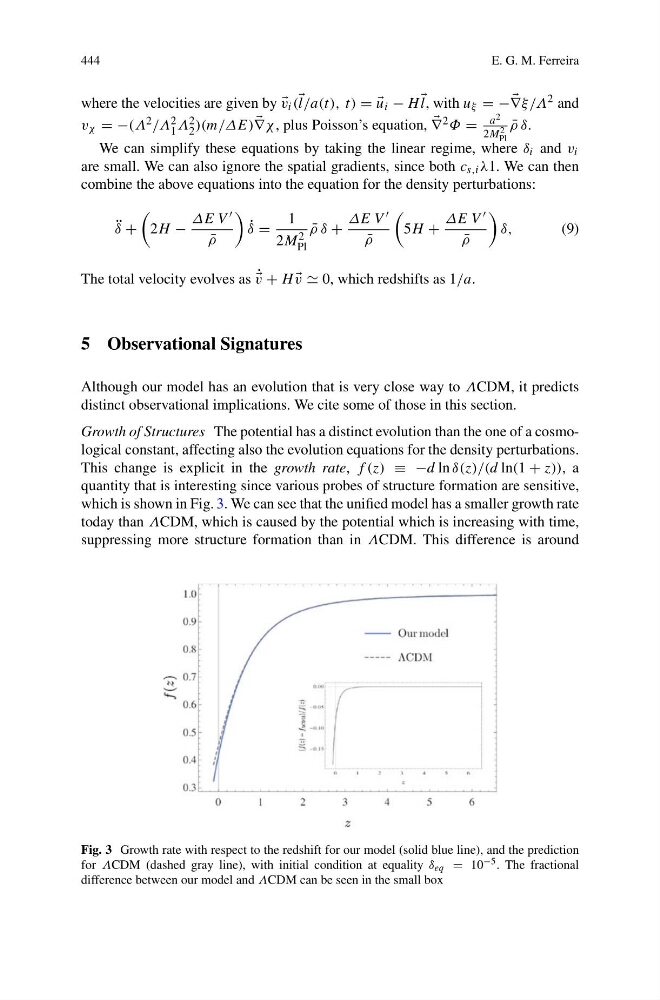
Growth of Structures The potential has a distinct evolution than the one of a cosmological constant, affecting also the evolution equations for the density perturbations.
This change is explicit in the growth rate, f (z) ≡ −d ln δ(z)/(d ln(1 + z)), a
quantity that is interesting since various probes of structure formation are sensitive,
which is shown in Fig. 3. We can see that the unified model has a smaller growth rate
today than ΛCDM, which is caused by the potential which is increasing with time,
suppressing more structure formation than in ΛCDM. This difference is around
Fig. 3 Growth rate with respect to the redshift for our model (solid blue line), and the prediction
for ΛCDM (dashed gray line), with initial condition at equality δ eq = 10 −5 . The fractional
difference between our model and ΛCDM can be seen in the small box
E. G. M. Ferreira
where the velocities are given by
v i (
l/a(t), t) = =
u i − H
l, with u ξ = −
∇ξ/Λ 2 and
v χ = −(Λ 2 /Λ 2
1 Λ 2
2 )(m/ΔE)
∇χ , plus Poisson’s equation,
∇ 2 Φ =
a 2
2M 2
Pl
¯
ρ δ.
We can simplify these equations by taking the linear regime, where δ i and v i
are small. We can also ignore the spatial gradients, since both c s,i λ1. We can then
combine the above equations into the equation for the density perturbations:
¨
δ +
2H −
ΔE V
¯
ρ
˙
δ =
1
2M 2
Pl
¯
ρ δ +
ΔE V
¯
ρ
5H +
ΔE V
¯
ρ
δ,
(9)
The total velocity evolves as ˙
v + H
v 0, which redshifts as 1/a.
5 Observational Signatures
Although our model has an evolution that is very close way to ΛCDM, it predicts
distinct observational implications. We cite some of those in this section.
Growth of Structures The potential has a distinct evolution than the one of a cosmological constant, affecting also the evolution equations for the density perturbations.
This change is explicit in the growth rate, f (z) ≡ −d ln δ(z)/(d ln(1 + z)), a
quantity that is interesting since various probes of structure formation are sensitive,
which is shown in Fig. 3. We can see that the unified model has a smaller growth rate
today than ΛCDM, which is caused by the potential which is increasing with time,
suppressing more structure formation than in ΛCDM. This difference is around
Fig. 3 Growth rate with respect to the redshift for our model (solid blue line), and the prediction
for ΛCDM (dashed gray line), with initial condition at equality δ eq = 10 −5 . The fractional
difference between our model and ΛCDM can be seen in the small box