

442
E. G. M. Ferreira
0.01
0.10
1
10
0.5
1
5
10
50
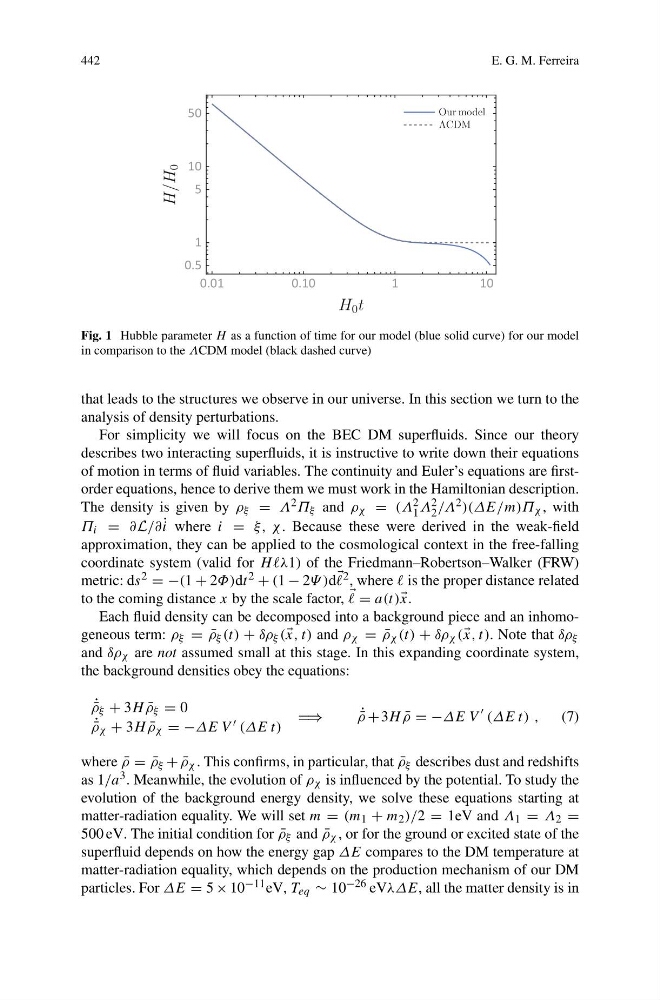
Fig. 1 Hubble parameter H as a function of time for our model (blue solid curve) for our model
in comparison to the ΛCDM model (black dashed curve)
that leads to the structures we observe in our universe. In this section we turn to the
analysis of density perturbations.
For simplicity we will focus on the BEC DM superfluids. Since our theory
describes two interacting superfluids, it is instructive to write down their equations
of motion in terms of fluid variables. The continuity and Euler’s equations are firstorder equations, hence to derive them we must work in the Hamiltonian description.
The density is given by ρ ξ = Λ 2 Π ξ and ρ χ = (Λ 2
1 Λ 2
2 /Λ 2 )(ΔE/m)Π χ , with
Π i = ∂L/∂ ˙
i where i = ξ, χ. Because these were derived in the weak-field
approximation, they can be applied to the cosmological context in the free-falling
coordinate system (valid for H Hλ1) of the Friedmann–Robertson–Walker (FRW)
metric: ds 2 = −(1 + 2Φ)dt 2 + (1 − 2Ψ )d
2 , where is the proper distance related
to the coming distance x by the scale factor,
= a(t) x.
Each fluid density can be decomposed into a background piece and an inhomogeneous term: ρ ξ = ¯
ρ ξ (t) + δρ ξ ( x, t) and ρ χ = ¯
ρ χ (t) + δρ χ ( x, t). Note that δρ ξ
and δρ χ are not assumed small at this stage. In this expanding coordinate system,
the background densities obey the equations:
˙ ¯
ρ ξ + 3H ¯
ρ ξ = 0
˙ ¯
ρ χ + 3H ¯
ρ χ = −ΔE V (ΔE t)
˙ ¯
ρ + 3H ¯
ρ = −ΔE V
(ΔE t) ,
(7)
where ¯
ρ = ¯
ρ ξ + ¯
ρ χ . This confirms, in particular, that ¯
ρ ξ describes dust and redshifts
as 1/a 3 . Meanwhile, the evolution of ρ χ is influenced by the potential. To study the
evolution of the background energy density, we solve these equations starting at
matter-radiation equality. We will set m = (m 1 + m 2 )/2 = 1eV and Λ 1 = Λ 2 =
500 eV. The initial condition for ¯
ρ ξ and ¯
ρ χ , or for the ground or excited state of the
superfluid depends on how the energy gap ΔE compares to the DM temperature at
matter-radiation equality, which depends on the production mechanism of our DM
particles. For ΔE = 5 × 10 −11 eV, T eq ∼ 10 −26 eVλΔE, all the matter density is in
E. G. M. Ferreira
0.01
0.10
1
10
0.5
1
5
10
50
Fig. 1 Hubble parameter H as a function of time for our model (blue solid curve) for our model
in comparison to the ΛCDM model (black dashed curve)
that leads to the structures we observe in our universe. In this section we turn to the
analysis of density perturbations.
For simplicity we will focus on the BEC DM superfluids. Since our theory
describes two interacting superfluids, it is instructive to write down their equations
of motion in terms of fluid variables. The continuity and Euler’s equations are firstorder equations, hence to derive them we must work in the Hamiltonian description.
The density is given by ρ ξ = Λ 2 Π ξ and ρ χ = (Λ 2
1 Λ 2
2 /Λ 2 )(ΔE/m)Π χ , with
Π i = ∂L/∂ ˙
i where i = ξ, χ. Because these were derived in the weak-field
approximation, they can be applied to the cosmological context in the free-falling
coordinate system (valid for H Hλ1) of the Friedmann–Robertson–Walker (FRW)
metric: ds 2 = −(1 + 2Φ)dt 2 + (1 − 2Ψ )d
2 , where is the proper distance related
to the coming distance x by the scale factor,
= a(t) x.
Each fluid density can be decomposed into a background piece and an inhomogeneous term: ρ ξ = ¯
ρ ξ (t) + δρ ξ ( x, t) and ρ χ = ¯
ρ χ (t) + δρ χ ( x, t). Note that δρ ξ
and δρ χ are not assumed small at this stage. In this expanding coordinate system,
the background densities obey the equations:
˙ ¯
ρ ξ + 3H ¯
ρ ξ = 0
˙ ¯
ρ χ + 3H ¯
ρ χ = −ΔE V (ΔE t)
˙ ¯
ρ + 3H ¯
ρ = −ΔE V
(ΔE t) ,
(7)
where ¯
ρ = ¯
ρ ξ + ¯
ρ χ . This confirms, in particular, that ¯
ρ ξ describes dust and redshifts
as 1/a 3 . Meanwhile, the evolution of ρ χ is influenced by the potential. To study the
evolution of the background energy density, we solve these equations starting at
matter-radiation equality. We will set m = (m 1 + m 2 )/2 = 1eV and Λ 1 = Λ 2 =
500 eV. The initial condition for ¯
ρ ξ and ¯
ρ χ , or for the ground or excited state of the
superfluid depends on how the energy gap ΔE compares to the DM temperature at
matter-radiation equality, which depends on the production mechanism of our DM
particles. For ΔE = 5 × 10 −11 eV, T eq ∼ 10 −26 eVλΔE, all the matter density is in