

The Moduli Portal to Dark Matter Particles
431
which is the famous Boltzmann suppression. We can recognize the presence of the
poles of both components of the modulus, when the temperature of the thermal bath
equals their masses. We can also notice the weaker temperature dependence of the
production rate of a fermionic FIMP, due to the chirality flip. For completeness, I
point out in Fig. 2 the analytic approximations of the production rates in the limiting
cases where the mediators are much lighter, of the same order and much heavier
than the temperature of the SM thermal bath.
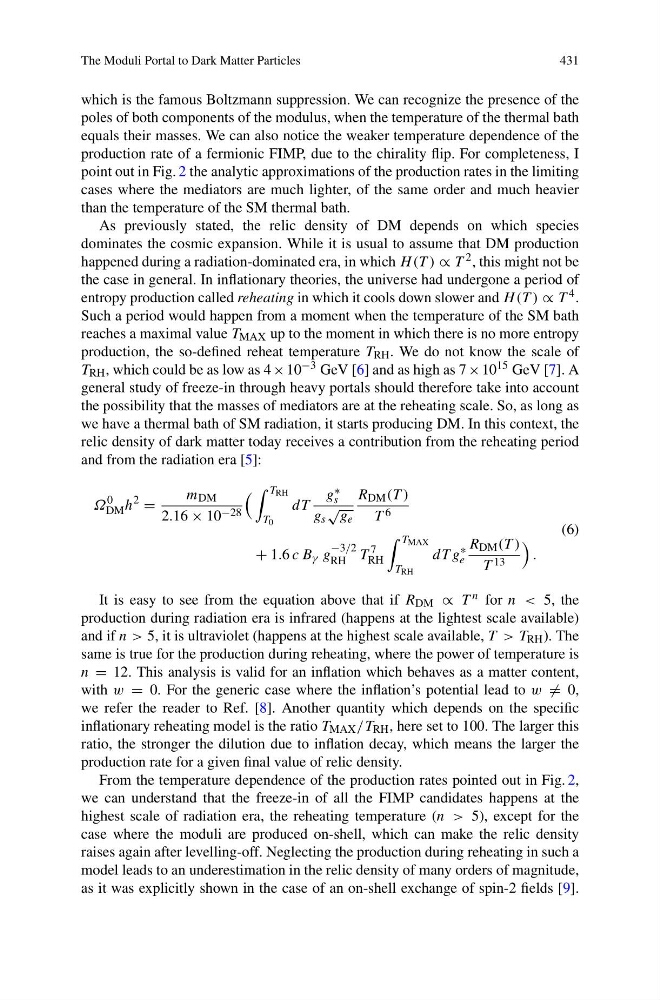
As previously stated, the relic density of DM depends on which species
dominates the cosmic expansion. While it is usual to assume that DM production
happened during a radiation-dominated era, in which H (T ) ∝ T 2 , this might not be
the case in general. In inflationary theories, the universe had undergone a period of
entropy production called reheating in which it cools down slower and H (T ) ∝ T 4 .
Such a period would happen from a moment when the temperature of the SM bath
reaches a maximal value T MAX up to the moment in which there is no more entropy
production, the so-defined reheat temperature T RH . We do not know the scale of
T RH , which could be as low as 4 × 10 −3 GeV [6] and as high as 7 × 10 15 GeV [7]. A
general study of freeze-in through heavy portals should therefore take into account
the possibility that the masses of mediators are at the reheating scale. So, as long as
we have a thermal bath of SM radiation, it starts producing DM. In this context, the
relic density of dark matter today receives a contribution from the reheating period
and from the radiation era [5]:
Ω
0
DM h
2
=
m DM
2.16 × 10 −28
T RH
T 0
dT
g ∗
s
g s
√ g e
R DM (T )
T 6
+ 1.6 c B γ g
−3/2
RH T
7
RH
T MAX
T RH
dT g
∗
e
R DM (T )
T 13
.
(6)
It is easy to see from the equation above that if R DM ∝ T n for n < 5, the
production during radiation era is infrared (happens at the lightest scale available)
and if n > 5, it is ultraviolet (happens at the highest scale available, T > T RH ). The
same is true for the production during reheating, where the power of temperature is
n = 12. This analysis is valid for an inflation which behaves as a matter content,
with w = 0. For the generic case where the inflation’s potential lead to w = 0,
we refer the reader to Ref. [8]. Another quantity which depends on the specific
inflationary reheating model is the ratio T MAX /T RH , here set to 100. The larger this
ratio, the stronger the dilution due to inflation decay, which means the larger the
production rate for a given final value of relic density.
From the temperature dependence of the production rates pointed out in Fig. 2,
we can understand that the freeze-in of all the FIMP candidates happens at the
highest scale of radiation era, the reheating temperature (n > 5), except for the
case where the moduli are produced on-shell, which can make the relic density
raises again after levelling-off. Neglecting the production during reheating in such a
model leads to an underestimation in the relic density of many orders of magnitude,
as it was explicitly shown in the case of an on-shell exchange of spin-2 fields [9].
431
which is the famous Boltzmann suppression. We can recognize the presence of the
poles of both components of the modulus, when the temperature of the thermal bath
equals their masses. We can also notice the weaker temperature dependence of the
production rate of a fermionic FIMP, due to the chirality flip. For completeness, I
point out in Fig. 2 the analytic approximations of the production rates in the limiting
cases where the mediators are much lighter, of the same order and much heavier
than the temperature of the SM thermal bath.
As previously stated, the relic density of DM depends on which species
dominates the cosmic expansion. While it is usual to assume that DM production
happened during a radiation-dominated era, in which H (T ) ∝ T 2 , this might not be
the case in general. In inflationary theories, the universe had undergone a period of
entropy production called reheating in which it cools down slower and H (T ) ∝ T 4 .
Such a period would happen from a moment when the temperature of the SM bath
reaches a maximal value T MAX up to the moment in which there is no more entropy
production, the so-defined reheat temperature T RH . We do not know the scale of
T RH , which could be as low as 4 × 10 −3 GeV [6] and as high as 7 × 10 15 GeV [7]. A
general study of freeze-in through heavy portals should therefore take into account
the possibility that the masses of mediators are at the reheating scale. So, as long as
we have a thermal bath of SM radiation, it starts producing DM. In this context, the
relic density of dark matter today receives a contribution from the reheating period
and from the radiation era [5]:
Ω
0
DM h
2
=
m DM
2.16 × 10 −28
T RH
T 0
dT
g ∗
s
g s
√ g e
R DM (T )
T 6
+ 1.6 c B γ g
−3/2
RH T
7
RH
T MAX
T RH
dT g
∗
e
R DM (T )
T 13
.
(6)
It is easy to see from the equation above that if R DM ∝ T n for n < 5, the
production during radiation era is infrared (happens at the lightest scale available)
and if n > 5, it is ultraviolet (happens at the highest scale available, T > T RH ). The
same is true for the production during reheating, where the power of temperature is
n = 12. This analysis is valid for an inflation which behaves as a matter content,
with w = 0. For the generic case where the inflation’s potential lead to w = 0,
we refer the reader to Ref. [8]. Another quantity which depends on the specific
inflationary reheating model is the ratio T MAX /T RH , here set to 100. The larger this
ratio, the stronger the dilution due to inflation decay, which means the larger the
production rate for a given final value of relic density.
From the temperature dependence of the production rates pointed out in Fig. 2,
we can understand that the freeze-in of all the FIMP candidates happens at the
highest scale of radiation era, the reheating temperature (n > 5), except for the
case where the moduli are produced on-shell, which can make the relic density
raises again after levelling-off. Neglecting the production during reheating in such a
model leads to an underestimation in the relic density of many orders of magnitude,
as it was explicitly shown in the case of an on-shell exchange of spin-2 fields [9].