

430
M. Dutra
The rate at which the number of DM particles change in a comoving volume
a 3 , with a the scale factor, is given by the Boltzmann fluid equation ˙
N DM =
R DM (t)a 3 , with N DM = n DM a 3 the total number of DM particles and R DM (t)
the time/temperature-dependent interaction rate density, which in the case of the
freeze-in only account for production and not for loss of FIMPs. On the other hand,
the Hubble rate H (t) determines how the scale factor varies with time, H (t) = ˙
a/a,
and since this quantity is proportional to the total energy density of the universe,
different species dominating the expansion lead to different final total number of
DM particles, as well as different time-temperature relations.
For a 12 → 34 process, the production rate density of species 3, in the limiting
case where species 1 and 2 have Maxwell–Boltzmann distributions, is given by
Dutra [5]
R
12→34
3
≡ n
eq
1 n
eq
2 σ v =
S 12 S 34
32(2π) 6
ds
λ(s, m 2
3 , m 2
4 )
s
dΩ 13 |M|
2
×
2T
√
s
λ(s, m 2
1 , m 2
2 )K 1
√
s
T
,
(5)
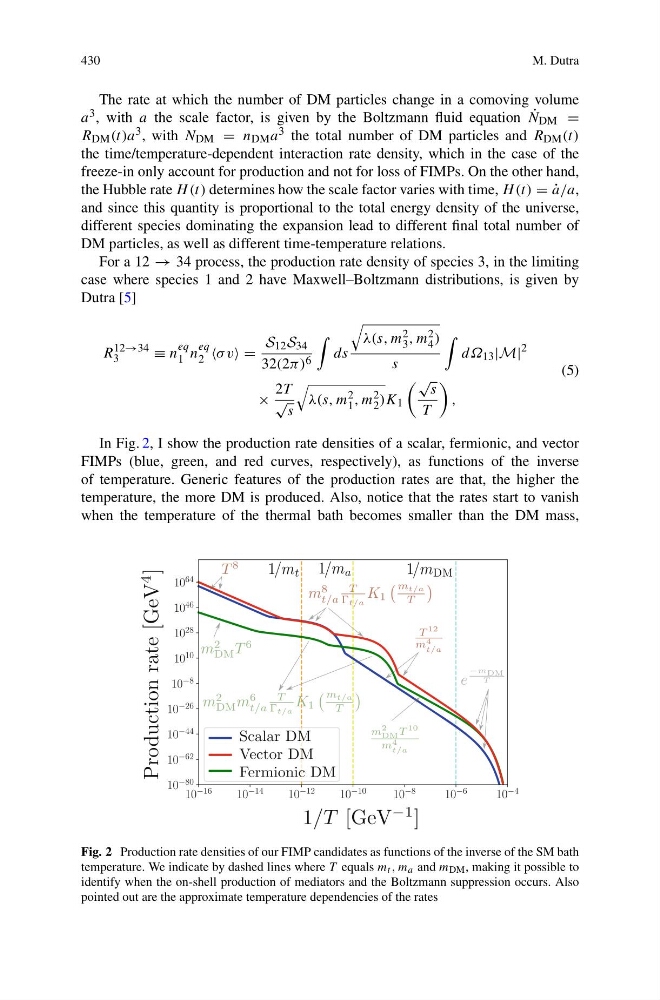
In Fig. 2, I show the production rate densities of a scalar, fermionic, and vector
FIMPs (blue, green, and red curves, respectively), as functions of the inverse
of temperature. Generic features of the production rates are that, the higher the
temperature, the more DM is produced. Also, notice that the rates start to vanish
when the temperature of the thermal bath becomes smaller than the DM mass,
Fig. 2 Production rate densities of our FIMP candidates as functions of the inverse of the SM bath
temperature. We indicate by dashed lines where T equals m t , m a and m DM , making it possible to
identify when the on-shell production of mediators and the Boltzmann suppression occurs. Also
pointed out are the approximate temperature dependencies of the rates
M. Dutra
The rate at which the number of DM particles change in a comoving volume
a 3 , with a the scale factor, is given by the Boltzmann fluid equation ˙
N DM =
R DM (t)a 3 , with N DM = n DM a 3 the total number of DM particles and R DM (t)
the time/temperature-dependent interaction rate density, which in the case of the
freeze-in only account for production and not for loss of FIMPs. On the other hand,
the Hubble rate H (t) determines how the scale factor varies with time, H (t) = ˙
a/a,
and since this quantity is proportional to the total energy density of the universe,
different species dominating the expansion lead to different final total number of
DM particles, as well as different time-temperature relations.
For a 12 → 34 process, the production rate density of species 3, in the limiting
case where species 1 and 2 have Maxwell–Boltzmann distributions, is given by
Dutra [5]
R
12→34
3
≡ n
eq
1 n
eq
2 σ v =
S 12 S 34
32(2π) 6
ds
λ(s, m 2
3 , m 2
4 )
s
dΩ 13 |M|
2
×
2T
√
s
λ(s, m 2
1 , m 2
2 )K 1
√
s
T
,
(5)
In Fig. 2, I show the production rate densities of a scalar, fermionic, and vector
FIMPs (blue, green, and red curves, respectively), as functions of the inverse
of temperature. Generic features of the production rates are that, the higher the
temperature, the more DM is produced. Also, notice that the rates start to vanish
when the temperature of the thermal bath becomes smaller than the DM mass,
Fig. 2 Production rate densities of our FIMP candidates as functions of the inverse of the SM bath
temperature. We indicate by dashed lines where T equals m t , m a and m DM , making it possible to
identify when the on-shell production of mediators and the Boltzmann suppression occurs. Also
pointed out are the approximate temperature dependencies of the rates