

The Moduli Portal to Dark Matter Particles
429
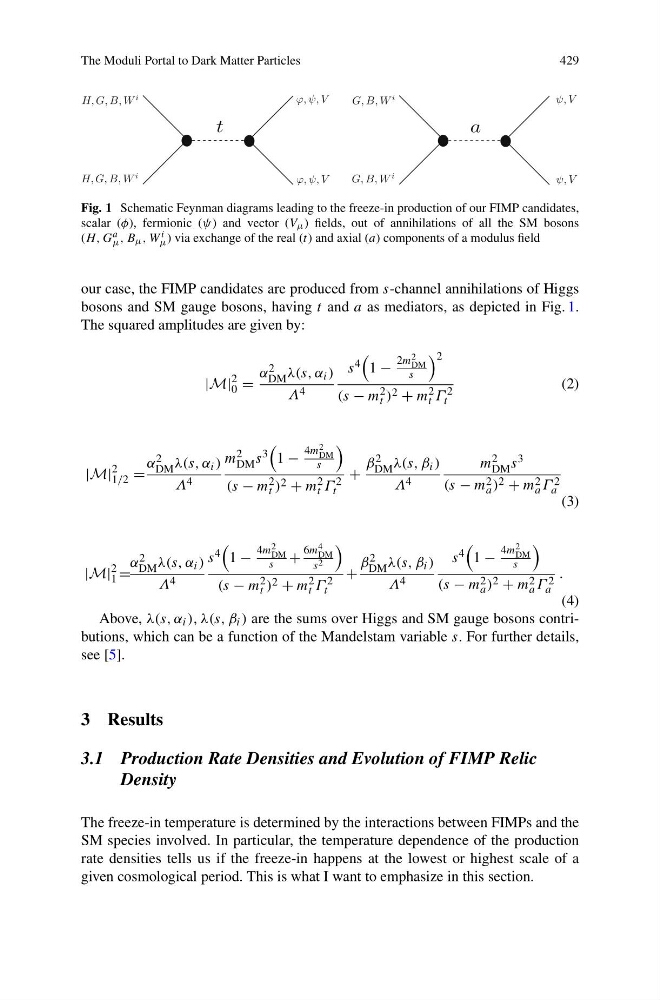
Fig. 1 Schematic Feynman diagrams leading to the freeze-in production of our FIMP candidates,
scalar (φ), fermionic (ψ) and vector (V μ ) fields, out of annihilations of all the SM bosons
(H, G a
μ , B μ , W i
μ ) via exchange of the real (t) and axial (a) components of a modulus field
our case, the FIMP candidates are produced from s-channel annihilations of Higgs
bosons and SM gauge bosons, having t and a as mediators, as depicted in Fig. 1.
The squared amplitudes are given by:
|M|
2
0 =
α 2
DM λ(s, α i )
Λ 4
s 4
1 −
2m 2
DM
s
2
(s − m 2
t ) 2 + m 2
t Γ 2
t
(2)
|M|
2
1/2 =
α 2
DM λ(s, α i )
Λ 4
m 2
DM s 3
1 −
4m 2
DM
s
(s − m 2
t ) 2 + m 2
t Γ 2
t
+
β 2
DM λ(s, β i )
Λ 4
m 2
DM s 3
(s − m 2
a ) 2 + m 2
a Γ 2
a
(3)
|M|
2
1 =
α 2
DM λ(s, α i )
Λ 4
s 4
1 −
4m 2
DM
s +
6m 4
DM
s 2
(s − m 2
t ) 2 + m 2
t Γ 2
t
+
β 2
DM λ(s, β i )
Λ 4
s 4
1 −
4m 2
DM
s
(s − m 2
a ) 2 + m 2
a Γ 2
a
.
(4)
Above, λ(s, α i ), λ(s, β i ) are the sums over Higgs and SM gauge bosons contributions, which can be a function of the Mandelstam variable s. For further details,
see [5].
3 Results
3.1 Production Rate Densities and Evolution of FIMP Relic
Density
The freeze-in temperature is determined by the interactions between FIMPs and the
SM species involved. In particular, the temperature dependence of the production
rate densities tells us if the freeze-in happens at the lowest or highest scale of a
given cosmological period. This is what I want to emphasize in this section.
429
Fig. 1 Schematic Feynman diagrams leading to the freeze-in production of our FIMP candidates,
scalar (φ), fermionic (ψ) and vector (V μ ) fields, out of annihilations of all the SM bosons
(H, G a
μ , B μ , W i
μ ) via exchange of the real (t) and axial (a) components of a modulus field
our case, the FIMP candidates are produced from s-channel annihilations of Higgs
bosons and SM gauge bosons, having t and a as mediators, as depicted in Fig. 1.
The squared amplitudes are given by:
|M|
2
0 =
α 2
DM λ(s, α i )
Λ 4
s 4
1 −
2m 2
DM
s
2
(s − m 2
t ) 2 + m 2
t Γ 2
t
(2)
|M|
2
1/2 =
α 2
DM λ(s, α i )
Λ 4
m 2
DM s 3
1 −
4m 2
DM
s
(s − m 2
t ) 2 + m 2
t Γ 2
t
+
β 2
DM λ(s, β i )
Λ 4
m 2
DM s 3
(s − m 2
a ) 2 + m 2
a Γ 2
a
(3)
|M|
2
1 =
α 2
DM λ(s, α i )
Λ 4
s 4
1 −
4m 2
DM
s +
6m 4
DM
s 2
(s − m 2
t ) 2 + m 2
t Γ 2
t
+
β 2
DM λ(s, β i )
Λ 4
s 4
1 −
4m 2
DM
s
(s − m 2
a ) 2 + m 2
a Γ 2
a
.
(4)
Above, λ(s, α i ), λ(s, β i ) are the sums over Higgs and SM gauge bosons contributions, which can be a function of the Mandelstam variable s. For further details,
see [5].
3 Results
3.1 Production Rate Densities and Evolution of FIMP Relic
Density
The freeze-in temperature is determined by the interactions between FIMPs and the
SM species involved. In particular, the temperature dependence of the production
rate densities tells us if the freeze-in happens at the lowest or highest scale of a
given cosmological period. This is what I want to emphasize in this section.