

428
M. Dutra
as mediators. If the masses of these heavy mediators are close to the scale of the
post-inflationary reheating, it is important to take into account the freeze-in during
a reheating period in which entropy is being injected into the thermal bath. Here
we shed light on this matter, presenting handy formulae that can be useful for any
scenario.
Moduli fields are scalars which would be present in the effective limit of many
string theory frameworks. Since they would need to be very feebly coupled to SM
fields, it is interesting to investigate whether their feeble interactions with dark
and visible matter would be enough to produce dark matter via freeze-in. In this
conference, I have presented a recent study on the moduli portal to dark matter [4].
2 The Model
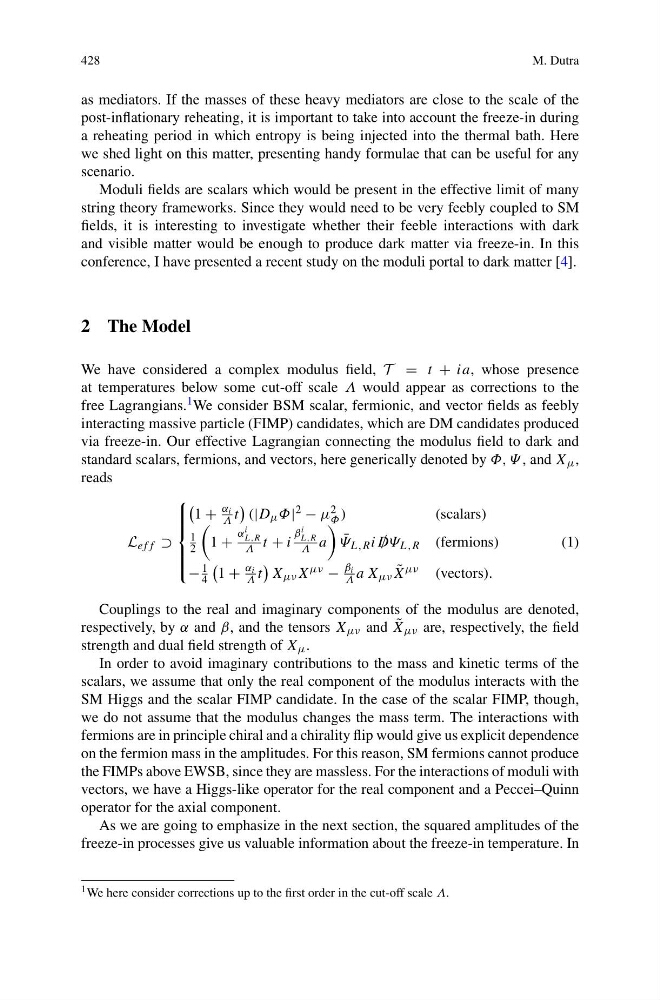
We have considered a complex modulus field, T = t + ia, whose presence
at temperatures below some cut-off scale Λ would appear as corrections to the
free Lagrangians. 1 We consider BSM scalar, fermionic, and vector fields as feebly
interacting massive particle (FIMP) candidates, which are DM candidates produced
via freeze-in. Our effective Lagrangian connecting the modulus field to dark and
standard scalars, fermions, and vectors, here generically denoted by Φ, Ψ , and X μ ,
reads
L eff ⊃
⎧
⎪ ⎪ ⎪ ⎨
⎪ ⎪ ⎪ ⎩
1 +
α i
Λ t
(|D μ Φ| 2 − μ 2
Φ )
(scalars)
1
2
1 +
α i
L,R
Λ t + i
β i
L,R
Λ a
¯
Ψ L,R i /
DΨ L,R (fermions)
−
1
4
1 +
α i
Λ t
X μν X μν −
β i
Λ a X μν ˜
X μν (vectors).
(1)
Couplings to the real and imaginary components of the modulus are denoted,
respectively, by α and β, and the tensors X μν and ˜
X μν are, respectively, the field
strength and dual field strength of X μ .
In order to avoid imaginary contributions to the mass and kinetic terms of the
scalars, we assume that only the real component of the modulus interacts with the
SM Higgs and the scalar FIMP candidate. In the case of the scalar FIMP, though,
we do not assume that the modulus changes the mass term. The interactions with
fermions are in principle chiral and a chirality flip would give us explicit dependence
on the fermion mass in the amplitudes. For this reason, SM fermions cannot produce
the FIMPs above EWSB, since they are massless. For the interactions of moduli with
vectors, we have a Higgs-like operator for the real component and a Peccei–Quinn
operator for the axial component.
As we are going to emphasize in the next section, the squared amplitudes of the
freeze-in processes give us valuable information about the freeze-in temperature. In
1 We here consider corrections up to the first order in the cut-off scale Λ.
M. Dutra
as mediators. If the masses of these heavy mediators are close to the scale of the
post-inflationary reheating, it is important to take into account the freeze-in during
a reheating period in which entropy is being injected into the thermal bath. Here
we shed light on this matter, presenting handy formulae that can be useful for any
scenario.
Moduli fields are scalars which would be present in the effective limit of many
string theory frameworks. Since they would need to be very feebly coupled to SM
fields, it is interesting to investigate whether their feeble interactions with dark
and visible matter would be enough to produce dark matter via freeze-in. In this
conference, I have presented a recent study on the moduli portal to dark matter [4].
2 The Model
We have considered a complex modulus field, T = t + ia, whose presence
at temperatures below some cut-off scale Λ would appear as corrections to the
free Lagrangians. 1 We consider BSM scalar, fermionic, and vector fields as feebly
interacting massive particle (FIMP) candidates, which are DM candidates produced
via freeze-in. Our effective Lagrangian connecting the modulus field to dark and
standard scalars, fermions, and vectors, here generically denoted by Φ, Ψ , and X μ ,
reads
L eff ⊃
⎧
⎪ ⎪ ⎪ ⎨
⎪ ⎪ ⎪ ⎩
1 +
α i
Λ t
(|D μ Φ| 2 − μ 2
Φ )
(scalars)
1
2
1 +
α i
L,R
Λ t + i
β i
L,R
Λ a
¯
Ψ L,R i /
DΨ L,R (fermions)
−
1
4
1 +
α i
Λ t
X μν X μν −
β i
Λ a X μν ˜
X μν (vectors).
(1)
Couplings to the real and imaginary components of the modulus are denoted,
respectively, by α and β, and the tensors X μν and ˜
X μν are, respectively, the field
strength and dual field strength of X μ .
In order to avoid imaginary contributions to the mass and kinetic terms of the
scalars, we assume that only the real component of the modulus interacts with the
SM Higgs and the scalar FIMP candidate. In the case of the scalar FIMP, though,
we do not assume that the modulus changes the mass term. The interactions with
fermions are in principle chiral and a chirality flip would give us explicit dependence
on the fermion mass in the amplitudes. For this reason, SM fermions cannot produce
the FIMPs above EWSB, since they are massless. For the interactions of moduli with
vectors, we have a Higgs-like operator for the real component and a Peccei–Quinn
operator for the axial component.
As we are going to emphasize in the next section, the squared amplitudes of the
freeze-in processes give us valuable information about the freeze-in temperature. In
1 We here consider corrections up to the first order in the cut-off scale Λ.