

432
M. Dutra
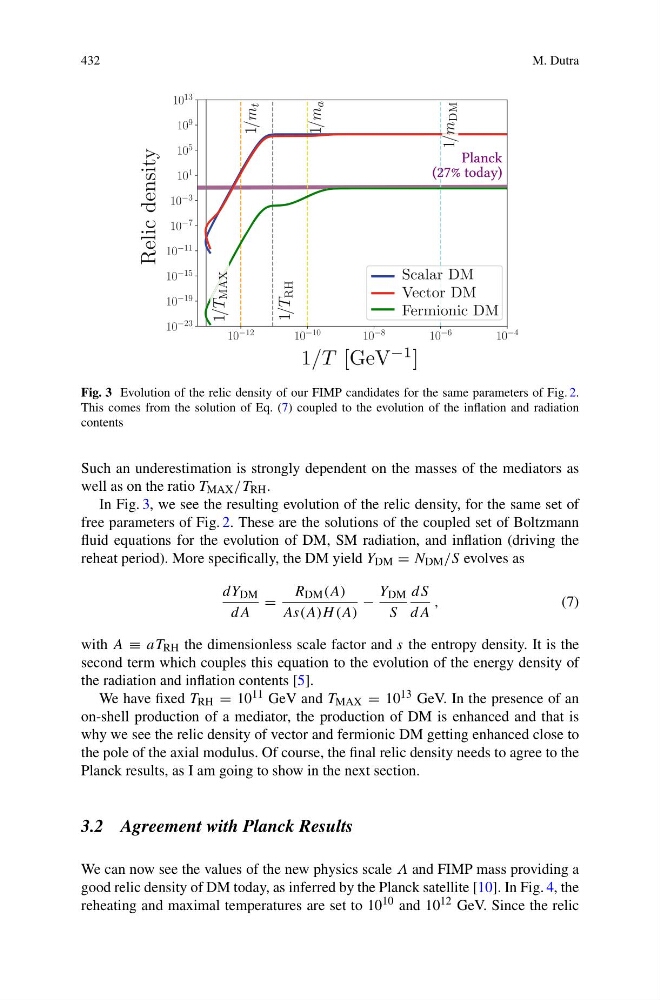
Fig. 3 Evolution of the relic density of our FIMP candidates for the same parameters of Fig. 2.
This comes from the solution of Eq. (7) coupled to the evolution of the inflation and radiation
contents
Such an underestimation is strongly dependent on the masses of the mediators as
well as on the ratio T MAX /T RH .
In Fig. 3, we see the resulting evolution of the relic density, for the same set of
free parameters of Fig. 2. These are the solutions of the coupled set of Boltzmann
fluid equations for the evolution of DM, SM radiation, and inflation (driving the
reheat period). More specifically, the DM yield Y DM = N DM /S evolves as
dY DM
dA
=
R DM (A)
As(A)H (A)
−
Y DM
S
dS
dA
,
(7)
with A ≡ aT RH the dimensionless scale factor and s the entropy density. It is the
second term which couples this equation to the evolution of the energy density of
the radiation and inflation contents [5].
We have fixed T RH = 10 11 GeV and T MAX = 10 13 GeV. In the presence of an
on-shell production of a mediator, the production of DM is enhanced and that is
why we see the relic density of vector and fermionic DM getting enhanced close to
the pole of the axial modulus. Of course, the final relic density needs to agree to the
Planck results, as I am going to show in the next section.
3.2 Agreement with Planck Results
We can now see the values of the new physics scale Λ and FIMP mass providing a
good relic density of DM today, as inferred by the Planck satellite [10]. In Fig. 4, the
reheating and maximal temperatures are set to 10 10 and 10 12 GeV. Since the relic
M. Dutra
Fig. 3 Evolution of the relic density of our FIMP candidates for the same parameters of Fig. 2.
This comes from the solution of Eq. (7) coupled to the evolution of the inflation and radiation
contents
Such an underestimation is strongly dependent on the masses of the mediators as
well as on the ratio T MAX /T RH .
In Fig. 3, we see the resulting evolution of the relic density, for the same set of
free parameters of Fig. 2. These are the solutions of the coupled set of Boltzmann
fluid equations for the evolution of DM, SM radiation, and inflation (driving the
reheat period). More specifically, the DM yield Y DM = N DM /S evolves as
dY DM
dA
=
R DM (A)
As(A)H (A)
−
Y DM
S
dS
dA
,
(7)
with A ≡ aT RH the dimensionless scale factor and s the entropy density. It is the
second term which couples this equation to the evolution of the energy density of
the radiation and inflation contents [5].
We have fixed T RH = 10 11 GeV and T MAX = 10 13 GeV. In the presence of an
on-shell production of a mediator, the production of DM is enhanced and that is
why we see the relic density of vector and fermionic DM getting enhanced close to
the pole of the axial modulus. Of course, the final relic density needs to agree to the
Planck results, as I am going to show in the next section.
3.2 Agreement with Planck Results
We can now see the values of the new physics scale Λ and FIMP mass providing a
good relic density of DM today, as inferred by the Planck satellite [10]. In Fig. 4, the
reheating and maximal temperatures are set to 10 10 and 10 12 GeV. Since the relic