

380
G. Barnich and M. Bonte
F
C (β) =
2A
β
d 2 k
(2π) 2
∞
n=0
ln
1 − e
−¯ hβ
√
k a k a +(
nπ
d ) 2
(46)
−d
+∞
−∞
dk z
2π
ln
1 − e
−¯ hβ
√
k a k a +k 2
z
,
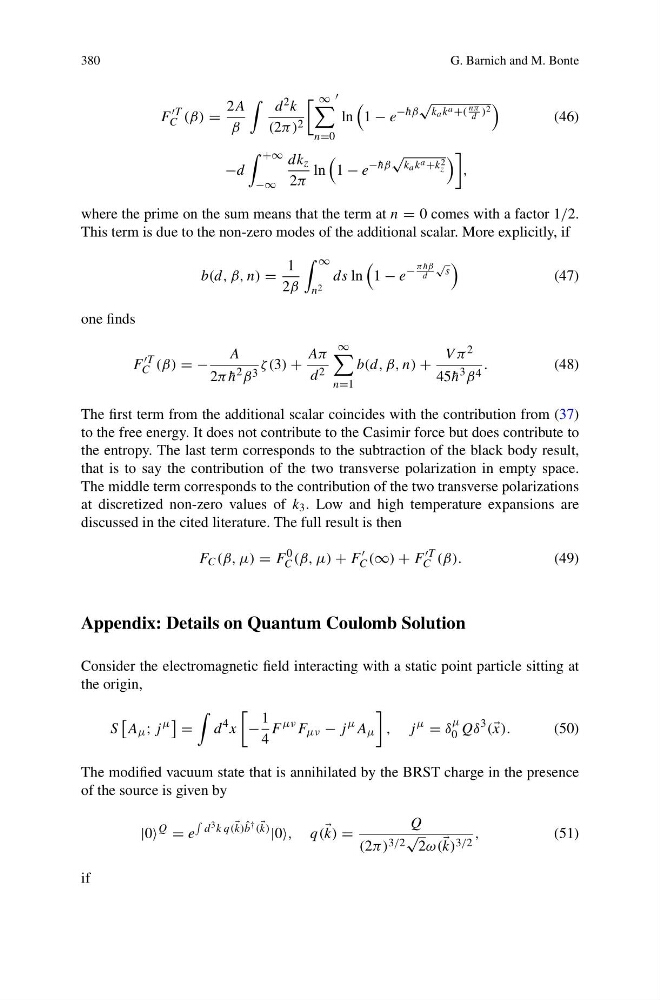
where the prime on the sum means that the term at n = 0 comes with a factor 1/2.
This term is due to the non-zero modes of the additional scalar. More explicitly, if
b(d, β, n) =
1
2β
∞
n 2
ds ln
1 − e
−
π ¯
hβ
d
√
s
(47)
one finds
F
C (β) = −
A
2π ¯
h 2 β 3
ζ(3) +
Aπ
d 2
∞
n=1
b(d, β, n) +
V π 2
45 ¯
h 3 β 4
.
(48)
The first term from the additional scalar coincides with the contribution from (37)
to the free energy. It does not contribute to the Casimir force but does contribute to
the entropy. The last term corresponds to the subtraction of the black body result,
that is to say the contribution of the two transverse polarization in empty space.
The middle term corresponds to the contribution of the two transverse polarizations
at discretized non-zero values of k 3 . Low and high temperature expansions are
discussed in the cited literature. The full result is then
F C (β, μ) = F
0
C (β, μ) + F
C (∞) + F
C (β).
(49)
Appendix: Details on Quantum Coulomb Solution
Consider the electromagnetic field interacting with a static point particle sitting at
the origin,
S
A μ ; j
μ
=
d
4 x
−
1
4
F
μν F μν − j
μ A μ
, j
μ
= δ
μ
0 Qδ
3 ( x).
(50)
The modified vacuum state that is annihilated by the BRST charge in the presence
of the source is given by
|0
Q
= e
d 3 k q(
k) ˆ
b † (
k)
|0, q(
k) =
Q
(2π) 3/2
√
2ω(
k) 3/2
,
(51)
if
G. Barnich and M. Bonte
F
C (β) =
2A
β
d 2 k
(2π) 2
∞
n=0
ln
1 − e
−¯ hβ
√
k a k a +(
nπ
d ) 2
(46)
−d
+∞
−∞
dk z
2π
ln
1 − e
−¯ hβ
√
k a k a +k 2
z
,
where the prime on the sum means that the term at n = 0 comes with a factor 1/2.
This term is due to the non-zero modes of the additional scalar. More explicitly, if
b(d, β, n) =
1
2β
∞
n 2
ds ln
1 − e
−
π ¯
hβ
d
√
s
(47)
one finds
F
C (β) = −
A
2π ¯
h 2 β 3
ζ(3) +
Aπ
d 2
∞
n=1
b(d, β, n) +
V π 2
45 ¯
h 3 β 4
.
(48)
The first term from the additional scalar coincides with the contribution from (37)
to the free energy. It does not contribute to the Casimir force but does contribute to
the entropy. The last term corresponds to the subtraction of the black body result,
that is to say the contribution of the two transverse polarization in empty space.
The middle term corresponds to the contribution of the two transverse polarizations
at discretized non-zero values of k 3 . Low and high temperature expansions are
discussed in the cited literature. The full result is then
F C (β, μ) = F
0
C (β, μ) + F
C (∞) + F
C (β).
(49)
Appendix: Details on Quantum Coulomb Solution
Consider the electromagnetic field interacting with a static point particle sitting at
the origin,
S
A μ ; j
μ
=
d
4 x
−
1
4
F
μν F μν − j
μ A μ
, j
μ
= δ
μ
0 Qδ
3 ( x).
(50)
The modified vacuum state that is annihilated by the BRST charge in the presence
of the source is given by
|0
Q
= e
d 3 k q(
k) ˆ
b † (
k)
|0, q(
k) =
Q
(2π) 3/2
√
2ω(
k) 3/2
,
(51)
if